


|
|
|
| |
||
|
||
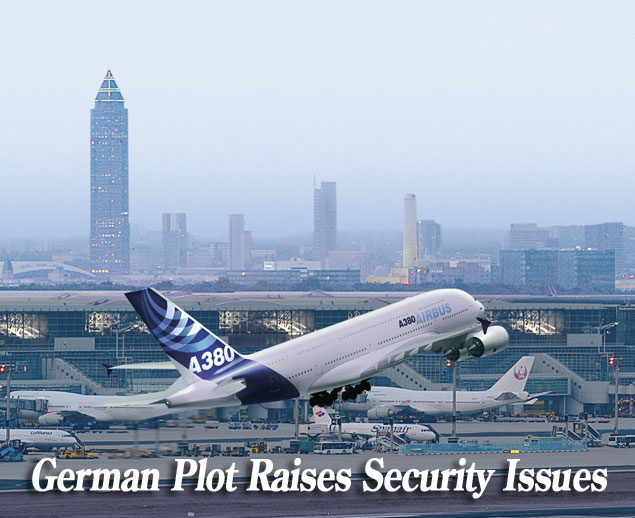
Frankfurt International Airport is Europe's third-busiest
airport and top air cargo hub. |
Gregg Pasco, the president of Quality Packaging,
a specialized coffee packaging machinery and engineering company near
Philadelphia is somewhat dumbfounded by the whole U.S. security arrangement:
“How is it that when I import a machine
from Europe, destined for California, that the container is offloaded
from a ship in New York, travels by rail across the entire country, and
then finally clears customs in Los Angeles? That’s crazy to me!”
Pasco said in disbelief.
He also notes he’s basing his conclusions
on what his forwarders tell him.
Pasco said to ensure better safety, he thinks
cargo should certainly clear customs at point of entry and not after his
container, like millions of others, traverses the entire continent.
He imports up to a dozen large pieces of
machinery a year—both by air and sea—that can wind up with
customers anywhere in North America.
 Juergen
Kempf, a spokesman for the Transported Asset Protection Association in
Munich says in a way, the recent German arrests put a spotlight on the
security issues and have turned up the heat on European lawmakers in Brussels
to continue focusing on cargo security.
Juergen
Kempf, a spokesman for the Transported Asset Protection Association in
Munich says in a way, the recent German arrests put a spotlight on the
security issues and have turned up the heat on European lawmakers in Brussels
to continue focusing on cargo security.
TAPA establishes freight security minimum
standard requirements, and tries to persuade airlines, airports and logistics
companies to apply the standards and methods.
The association has 210 member companies
and a newly formed lobbying presence in Brussels as well, that should
foster more security in future.
He says he thinks a big emphasis should
be on the cargo handling side, because since the 9/11 attacks, airports
and airlines have already done a lot to step up security at their bases.
“In a way, airlines are taking a risk
with their own property and investment, so I think they’ve started
considering security a lot more since September 11.”
Kempf said he thought Air France’s
cargo hub in Paris especially, had made significant improvements and that
Lufthansa’s cargo hub at Frankfurt was also solid from a security
standpoint. While Heathrow, which had gained the distinguished reputation
as “Thiefrow” in the past, and Schiphol had theft issues,
the problems were being worked on and corrected.
That however still illustrates that there
are some gaps in the system.
Kempf said the E.U. has recently released
statistics indicating €8.2 billion in freight is stolen yearly in
Europe, but that the majority of it is from road transit.
TAPA’s members include many high-value
products companies like electronics and computer firms Apple, Cisco and
Sony and carriers, freight and air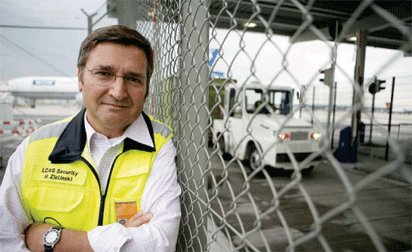 port
companies like DHL, Lufthansa Cargo, Air France Cargo, Emirates Airlines
and Fraport.
port
companies like DHL, Lufthansa Cargo, Air France Cargo, Emirates Airlines
and Fraport.
Next week (September 19) in Frankfurt, Lufthansa
Cargo and its energetic head of cargo security Harald Zielinski are holding
a by invitation only, one day air cargo seminar and presentation at a
local hotel here.
Mr. Zielinski who at one time was a foot
cop in Frankfurt has been a vocal critic of many of the security procedures
currently in place and also of TSA mandates that do not take into consideration
reality of the varied drivers in the global air cargo business.
But more security is top of Mr. Zielinski’s
list of “must to do” and he is not shy while talking about
it.
“The secret to great cargo security
is whatever you do, keep it simple. Trust, but verify.
“I wish somebody would invent a giant
sniffer for all air cargo,” Harald told FlyingTypers recently.
George/Geoffrey