|
  Warsaw
Dateline Exclusive—Yesterday at the IATA Cargo Emerging
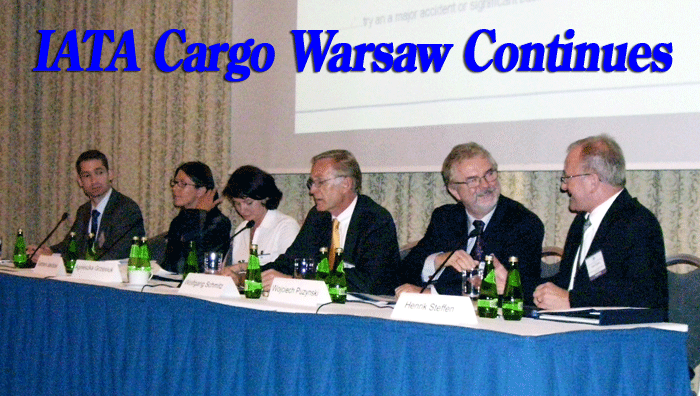
Markets two-day conference being held in Warsaw Poland, Wolfgang Schmitz
(right) Lufthansa Cargo Head of Corporate and Business Development, set
the tone for a busy day affording attendees a brief word picture of how
to do business in Poland. Warsaw
Dateline Exclusive—Yesterday at the IATA Cargo Emerging
Markets two-day conference being held in Warsaw Poland, Wolfgang Schmitz
(right) Lufthansa Cargo Head of Corporate and Business Development, set
the tone for a busy day affording attendees a brief word picture of how
to do business in Poland.
“Business in Poland must be studied
before actually executed,” Schmitz said.
“That’s what this gathering
is all about,” he added.
“Air cargo opportunities in Poland
are driven by strong growth last year of12.6%.
“But doing business here is rated
in terms of difficulty at 75th by the World Bank Group IATA’s Serge
Pauporte said.
“The challenges are daunting, but
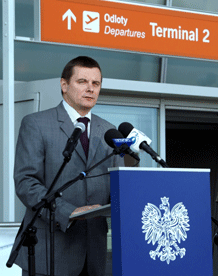
the payoffs are huge,” Jerzego Polaczka Poland’s Minister
of Transport, (left) told FlyingTypers.
As sessions continued EU commitments for
air cargo and overall view for the future of cargo in the EU: regulations,
forthcoming emissions taxes and possible impact of the external EU air
transport policy were discussed.
An interesting session maybe worth the trip
all by itself was a first rate presentation covering various wrinkles
in making smart decisions about air cargo investment opportunities in
Eastern Europe.
Another session took perhaps the most discussed
aspect of the airline and air cargo business center stage in Warsaw.
 John
Edwards, Head of Cargo Security, IATA delivered a brief, underscoring
importance of compliance to security and safety standards. John
Edwards, Head of Cargo Security, IATA delivered a brief, underscoring
importance of compliance to security and safety standards.
Mr. Edwards discussed certain negative impact
toward business expansion across the region, that not paying attention
to security can generate.
 Also worth considering while conferees sat
in Warsaw, was an exceptionally strong afternoon presentation titled:
Also worth considering while conferees sat
in Warsaw, was an exceptionally strong afternoon presentation titled:
“The Baltic States As Europe’s
New Global Hubs?
The presentation was handled in two parts.
Daiva Palm, Sales Manager for the Baltic,
Russia & CIS, for SAS Cargo noted that SAS was the first foreign carrier
in the Baltic’s while outlining how the market was developed and
how SAS became the market leader by adapting strategy.
As Day One sessions drew to a close The
Baltic States were again in focus as Lithuania, Latvia and Estonia were
compared in terms of future potential by Toms Andersons, Head of Cargo
at airBaltic.
The fast growing Latvian airline is adding
two new destinations in its winter timetable October 28 and increased
flight frequencies on nine routes with 37 flights out of Riga, 18 flights
out of Vilnius, and 3 out of Liepja.
The two new routes are Riga-Tashkent and
Oulu, Finland from the airBaltic base in Riga.
Today as the conference concluded a full
schedule was on the boards.
Highlight of Cargo Emerging Markets Day
Two included“Six IATA Solutions” with presentations and “how
to” sessions on IATA Cargo Accounts Settlement System (CASS); IATA
Cargo Training; IATA e-freight; Cargo 2000 and Security and Safety.
Another session titled “The Lufthansa
Go East Strategy,” detailed first hand that DLH hub in Astana, Kazakhstan.
Expect the myths and realities of doing
business in Russia and elsewhere in the former Soviet Union to get a good
once over here.
Geoffrey
Markets East Grow Domodedovo
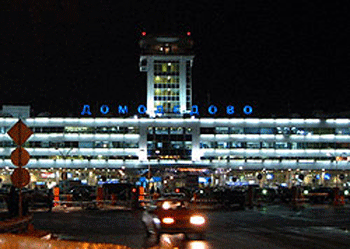
Domodedovo Airport, the largest
in Russia, says its cargo center is one of the most technologically sophisticated
in the country, moving around 126,000 tons of cargo in 2006, growing,
and with current capacity for around 170,000 tons annually.
Domodedovo’s also busy with passengers,
and saw strong traffic growth during the first half of 2007. In that period,
the airport handled more than 10 million passengers, an increase of 20%
over the previous year. International passenger traffic levels grew over
25%, while domestic traffic rose by about 10%.
The airport forecasts about 19 million passengers
for the full year.
According to the airport, in terms of freight,
the gateway aims to provide “high quality and world standard services”
to airlines and shippers, and to work closely with customers to tailor-fit
their needs.
The airport’s newly improved cargo facility,
which with the airport is owned by the East Line Group – started
operations in 1994, when East Line started a broad investment campaign.
The main air cargo facilities were put into operation between 1995 and
1997.
“Within a short space of time Domodedovo
Cargo Terminal became a technologically sophisticated facility with state-of-the-art
capability and showed a willingness to compete with international air
cargo terminals,” the group said.
The airport says the cargo terminal operates 24-hours
a day and offers air cargo services including quick customs clearance,
and all ground handling and warehousing. It also offers sales and booking
of air transportation from Domodedovo, including charter. Terminal facilities
also allow handling refrigerated, valuable, animal, and dangerous cargos,
while cargo packaging and road service can be arranged as well.
The facility says the cargo area could undergo
more expansion, and that in future, cargo customers will be able to do
more business via the Internet, like tracking services, the calculation
of charges, and document registration.
Major cargo carriers at the airport include Air
Bridge Cargo, Airstars, and Alrosa.
In July 2007, Lufthansa announced that it would
move its Moscow cargo and passenger operations from Moscow Sheremetyevo
to Domodedovo beginning March 31, 2008.
The move will put Lufthansa closer to its Star
Alliance partners operating in Moscow, all of which are already at Domodedovo.
“By shifting our operations to Domodedovo,
we will once again be able to work with our partners under one roof and
offer our passengers a standardized service. Lufthansa passengers will
find a modern, service-oriented environment at Domodedovo,” said
Lufthansa CEO Wolfgang Mayrhuber.
“Furthermore, the planned extension of Domodedovo
will open up new, exciting perspectives in one of the fastest-growing
markets worldwide.”
Earlier this month, JAL also announced it would
move its Moscow operations to Domodedovo, beginning December 14, 2007.
George Frey
|