Lufthansa Cargo Examines Security
Dateline Frankfurt—Lufthansa Wednesday
(Sept. 19), hosted its first Cargo Security Conference 2007 in Frankfurt,
drawing about 200 industry and government security experts to discuss
the state of the air cargo industry’s security, threats at hand,
and the steps that must be undertaken to ensure safe passenger travel
and cargo transit in future.
The conference was also a platform to continue dialogue between
European, and U.S. government air cargo security administrations and
the industry, as officials on both continents are working to implement
more comprehensive cargo security measures.
In light of the recent events in Germany, terrorism was a main highlight
of the conference. At the beginning of September, German authorities
arrested three men that were allegedly planning major bomb attacks on
Frankfurt Airport and nearby Ramstein Airbase, the U.S. Air Forces European
Headquarters. Police have said they are still searching for many other
suspects.
Along with the U.S., U.K. and Israel,
“Germany is and remains under threat of a terrorist attack,”
said Klaus Hahn, a Politically Motivated Criminal expert from the German
Federal Office of Criminal Investigation.
He said Islamic terrorist structures’ desire to wreak revenge
on the west has gained popularity while every form of attack has become
conceivable – including through cargo. Because of the diversity
of possible attacks, the predictability and preventability are lessened,
Hahn said. He said six concrete attack plans had been found “in
the last several years” in Germany, but didn’t provide any
examples or predictions of the current threats. “I can’t
make a prognosis,” he said. “We work to structure the threat,
we have to research and optimize our investigating.”
Nonetheless, whether cargo or passenger, “airplanes
provide a great status target for terrorists because they take on the
nationality of the “flag-carrying aircraft,” guarantee media
coverage, carry a great deal of insecurity potential among the population
and almost guarantee a huge potential of victims,” Mr. Hahn said.
Mr. Hahn, as other speakers, acknowledged that there are gaps in
the cargo system that need to be addressed. “Some freight remains
uncontrolled from ‘accredited senders,’ and the question
for us remains how security in the routing of this freight is maintained.”
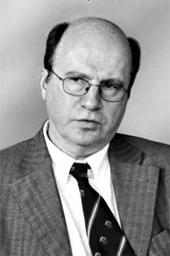 Eckard
Seebohm, (left) the director of air safety at the European Union said
the E.U. and the U.S. Transportation Security Administration have made
recent progress in the harmonization of more air cargo security measures,
and that future “mutual recognition of trans-Atlantic air cargo
measures would avoid costly duplications.”
Eckard
Seebohm, (left) the director of air safety at the European Union said
the E.U. and the U.S. Transportation Security Administration have made
recent progress in the harmonization of more air cargo security measures,
and that future “mutual recognition of trans-Atlantic air cargo
measures would avoid costly duplications.”
But U.S. officials have said European cargo safety measures have
not come up to all of its standards so far, and more work needs to be
done.
Mr. Seebohm said the E.U. would keep a close eye on how the U.S.’
9.11 bill’s requirement to screen 100% of cargo on passenger flights
within three years would pan out for Europe. He said the European Commission
and its member states were working to further strengthen the supply
chain’s security by considering measures including the introduction
of the independent validation of known shippers – something the
U.S. supports - and devices to keep better track of cargo business participants,
like mandatory shipper databases.
Mr. Seebohm said improvements to the supply chain must be made in
a balanced way to ensure a high standard of security without having
an adverse effect on the flow of trade.
Attendee David Lara, a senior London-based director with Eagle Global
Logistics, a transportation and supply chain management company, said
he thought the speaker forums were great, and addressed the timely issue
well.
“Everybody in the room will sit here and say more needs to
be done, but the proof in the pudding will be what exactly changes and
how,” Mr. Lara said. What monetary price those changes would eventually
come at were also an interesting issue, he said, predicting, “they’ll
come at a massive cost.”
“It’s created a dialogue about how to move things forward.
There are gaps in what’s important between the U.S.A. and Europe.
It’s absolutely great that Lufthansa has taken the initiative
to organize this. It’s commendable. There are good speakers and
the dialogue is positive,” Mr. Lara said.
George Frey