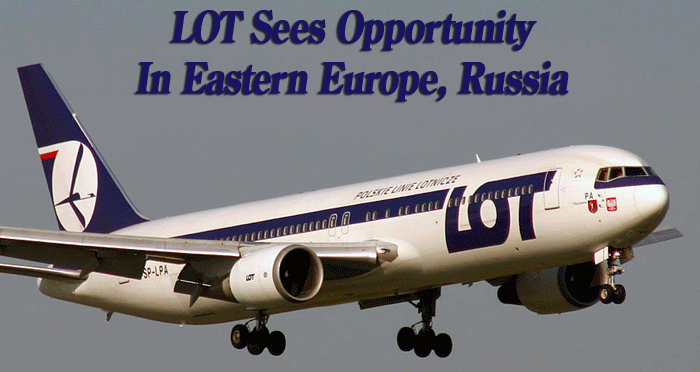
Polish carrier LOT said it
sees a great deal of opportunity in Eastern Europe and Russia, as growing
economies are leading to more capital investment that should contribute
to more air cargo traffic, Jakub Mielniczuk, of LOT in Warsaw told Air
Cargo News/FlyingTypers.
“The future of Eastern European cargo
is deeply connected to the growth of the economy of particular countries,”
Mr. Mielniczuk said, adding that in his view, Russia and the Ukraine showed
significant air cargo growth potential as well.
“New (European Union) states could
offer lower labor costs of operations, and very fast growing markets,”
Mr. Mielniczuk said. “No customs controls within the European Union
should result in boosting new member trade including airfreight growth.”
That growth of economies bit should be no
worry, as Poland’s has indeed shown strong progress of late, as
have neighbors like the Czech Republic. Poland’s main trading partners’
economies in Western Europe and the rest of the E.U. have also improved
in recent years.
According to Polish Airports, the state
company that runs Warsaw Airport, IATA forecasts Poland to be the fastest
growing aviation market worldwide between 2005 and 2009.
Meanwhile, Poland’s and neighboring
country’s inclusions into the E.U. have added to the airline’s
opportunities, namely with more passenger traffic. But its also forced
airlines like LOT to face steep competition from bigger and more established
airlines from Western Europe. The LOT Group carried about 5 million passengers
in 2006, around a 14% increase over the previous year.
On the other hand, Mr. Mielniczuk said limitations
caused by the legal regulations of the non-E.U. states, mainly in the
former Soviet Union have their drawbacks to the air cargo market in the
region.
Despite any challenges, Mr. Mielniczuk said
LOT Cargo still holds the strongest position in the Polish cargo market.
According to the company’s annual
report, LOT did about $40 million worth of cargo business in 2006, but
didn’t provide comparative figures. LOT is part of the Star Alliance,
so it can also rely on its partner airlines for any intercontinental cargo
needs customers may have.
90% of LOT’s freight goes through
Warsaw, and the company also offers road feeder service and charter flights
on request.
Mr. Mielniczuk said Warsaw’s 7,500
square meter cargo terminal was constructed in 1992 and still has room
to do more volume. Furthermore a lot of trucking companies and forwarders
have set up shop around the airport, making it an efficient place to do
business, he said.
George Frey
|