 Scott
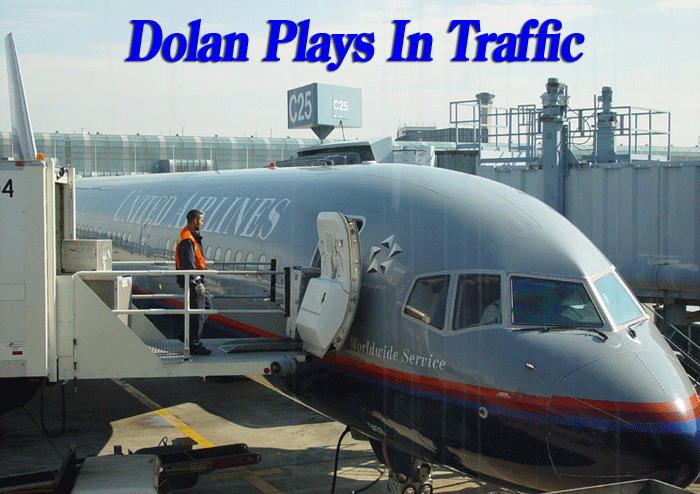
Dolan addressed The Traffic Club of Chicago (Thursday September 20). Scott
Dolan addressed The Traffic Club of Chicago (Thursday September 20).
The United Airlines Worldwide Cargo
top executive helped mark the 100th anniversary of the pioneering transportation
organization with a brief yet concise look into America’s second
largest airline’s air cargo activities, offering a glimpse at what
lies ahead.
“We must create value for our
companies and our customers—using the specific example of air cargo's
key role in today's global market.
The industry has experienced tremendous
change over the last few years and continues to be reshaped by a number
of dynamic and fluid factors.
Fuel is probably the first thing most
people think of when considering change and pressures in the air transport
industry.
The rising cost of fuel continues
to place real constraints on how air carriers have to operate.
It makes the pursuit of continual
cost reduction and efficiency a stream of constant work at United and
across the industry.
Of course the changing picture of
competition continues to pose challenges as well.
With the growth of low-fare carriers
on the domestic side and continuing serious players on the international
side, capacity is outstripping demand more each day.
This makes consolidation increasingly
necessary—and creating value in new ways for one's company and its
customers at every opportunity increasingly important.
Some forms of consolidation are already
happening on the cargo side of things, and affecting everyone involved—particularly
combination carriers, such as United, who handle both passengers and cargo.
The idea of forming alliances to build
capacity, attract customers, enhance service and drive growth and profitability
is resulting in more mergers and acquisitions.
Some freight forwarders are getting
larger and larger, and their control over total spend is increasing with
their size. On the other hand, some local forwarders are willing to pay
more per kilo to get their cargo on a specific flight.
Additionally, trucking networks are
becoming more critical components in the overall cargo picture.
In addition to forcing additional
cost reduction in other areas, the high price of fuel also is affecting
the flow of air cargo traffic.
With a current level 12 fuel surcharge
of 60 cents a kilo, a great deal of former air cargo is now shifting to
the ocean. Shipping cargo via ocean is no longer what it used to be.
Ships are much faster and ports have
improved their efficiency—making the quality of cargo service provided
by air carriers even more critical to sustaining and growing that business.
Finally, in the last few years, we
have all had to adjust to a world where security is now a primary concern.
New requirements and processes have
changed the way we do business on a daily basis, and add additional cost
and time.
In addition, it requires a great deal
of manpower at all levels of the organization to help shape and then comply
with the requirements.
As a belly carrier in this complex
picture of air transport, United occupies a unique position when it comes
to a business model.
The relationship between the cargo
and passenger sides of the business is complex.
United's focus on international expansion—and
strengthening our international passenger service—has direct implications
for cargo.
Widebody flights cannot be truly profitable
without solid cargo traffic. And with our high aircraft utilization, coordinating
cargo to maximize revenue on every flight has become even more critical.
While the air cargo business is growing
in certain parts of the world, we continue to face a number of threats
that make sustaining a solid business in the market a challenge.
From increasing competition from different
modes of transportation to increased security requirements that add cost
and transit times for shipments, air carriers have to find new ways to
create value for customers.
All of these factors are forcing each
of us to rethink how we do business, and how we can continue to create
value for ourselves and our customers.
United Airlines is not alone in that
fact and has focused specifically on tightening and restructuring the
cargo business over the last three years as one way to be more competitive
in the changing marketplace.”
Geoffrey
|