




Outlook 2008 What Lies Ahead


Editor’s Note: The following roundup story is comprised of some highlights that made headlines in Air Cargo News/FlyingTypers during 2007, and some idea of what lies ahead for air cargo in 2008.
We also asked for feedback from sources looking forward and back and wrote a few stories on the responses from individual companies and organizations.
The way we figure it, some industry issues are indivisible meaning that although situations and individuals are unique, the quest for knowledge begins with knowing as much as possible about what is going on around us.
We are writers and reporters with shorter emphasis on sales and marketing ourselves, than reporting the news.
Usually when the email arrives or the phone call is blinking from Air Cargo News/FlyingTypers it is a news hound making contact.
So answer your phones and emails from us especially if your story needs to be told.
The year is brand new and the story is just unfolding.
Best of luck in 2008 and thanks for helping us share these words.
Geoffrey

Security To Higher Profile In 2008
John Edwards, IATA’s cargo security chief sees security programs remaining in the spotlight for 2008.
He spoke to Air Cargo News/FlyingTypers on trends of the past year and others set to continue.
ACN/FT: What were IATA’s cargo security highlights in 2007?
John Edwards: During early March, IATA held its first World Cargo Symposium in Mexico City. The theme was Focus on Simplicity. The event included a two-day Cargo Terminal & Security Track. The agreed take-away actions for cargo security were developing an IATA quality security audit and forming an industry action group to be jointly led by FIATA and IATA.
ACN/FT: What were your other security projects during the year?
John Edwards The industry action group, now named ACSIF (Air Cargo Security Industry Forum) became well established with 25 industry association members, a key intent being alignment on one message for air cargo security. The inaugural News Brief was published in April, the first meeting held in June and three conference calls took place in July, September and November. The first Annual General Meeting is scheduled for March 3 during the second World Cargo Symposium in Rome (March 3-6).
ACN/FT: Why the quality security audit; what do you hope it will achieve?
John Edwards Development of the quality security audit is a priority project currently in the feasibility stage. For of all types of air cargo supply chain operators, we aim to create a voluntary security validation conducted against internationally recognized standards and leading to certification. Where applied it will enhance supply chain security and strengthen its justification. The feasibility study go/no-go decision will likely be made during February.
ACN/FT: What else is on the agenda, and of importance to IATA’s air cargo security initiatives?
John Edwards Last August Implementing the 9/11 Commission Recommendations Act of 2007 was signed into U.S. (public) law. Development of its provisions by the TSA (Transportation Security Administration) is underway. For cargo security it requires a level of security commensurate with that of passenger checked baggage. The definition of screening includes reference to a program for certifying the security methods used by shippers.
Our (other) priority plans for 2008 include further development of ACSIF - as its purpose and goals mature and we gain experience of how best to work for the collective good of members. We will likely develop the quality security audit into a program and plan to conduct pilots in early 2009. The theme of the World Cargo Symposium is "Focus on the Customer: Dialogue to deliver Simplicity" building on "Simplicity" (in 2007). The Cargo Security Track will feature high profile customers and regulators and towards the end of the day establish three new take-away actions, which track participants will be invited to formulate. Overall 2008 looks to be another exciting and productive year during which we will face new challenges and make tough choices—all intended to deliver more secure freight.


Cargo Sting Will Continue In 2008


=

     
Last year may be remembered as the time when some in air cargo took a collective perp-walk .
     Sadly, global air cargo price fixing investigations and regulatory scandal in China for one of the world’s largest logistics providers made some of the biggest headlines for cargo in 2007.
     Who talks to who and what that means to an industry is in the spotlight as more and more air cargo companies get snared in the regulatory nets and pay fines and are disgraced.
     But consider what is happening in world banking right now.
     Have you noticed that top executives at Citibank and elsewhere are dropping like flies as Abu Dhabi interests now own part of Citibank and Singapore interests now own some of JP Morgan/Chase and the list goes on as the mortgage crises deepens in USA?
     Can anybody doubt that all these bankers were in some measure conducting the same practices, whether with a wink and a nod or some other manner that somehow went wrong and has led to the sub-prime mortgage loan meltdown mess in USA that threatens the world economy?
     So why do the bankers who followed a trend and were collectively dead wrong get off with losing their jobs via a golden parachute while people in air cargo in a similar fix are put under international scrutiny?
     So maybe air cargo has operated in some kind of grey area or regulatory twilight zone.
     But let’s get off all this sensationalism and midnight raids and at times politically-motivated news stories.
     Business is business and air cargo is a great business that deserves more respect.
     How about enlightened re-regulation and less tabloid fodder headlines in 2008?
     But back to cases.
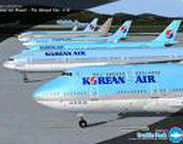
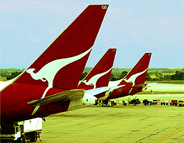
     Early on, Lufthansa and Virgin volunteered information in international price fixing probes in late 2006 that last year landed fines for British Airways, Korean Airlines, and most recently Qantas from the U.S. Department of Justice in what the Australian press called “the world’s largest and most far reaching anti-cartel investigation.”
     Many global forwarders were also implicated, and investigations around the world are ongoing. The fallout is most likely to continue and spread as investigators probably have more cards they haven’t shown yet.
     As we write this, class action suits around the world totaling hundreds of millions of dollars continue to be filed on behalf of plaintiffs that claim they were duped into paying secretly set bogus surcharges and inflated rates.
     One of the world’s largest logistics providers Schenker, a division of German rail giant Deutsche Bahn, was also charged by Chinese authorities in late summer for operating with false licenses in China and was ordered to cease operations temporarily.
     The company said it was back to operating normally shortly thereafter and chalked up the entire episode as an oversight on the part of Chinese regulators.


Airbus /Boeing & China Going It Alone
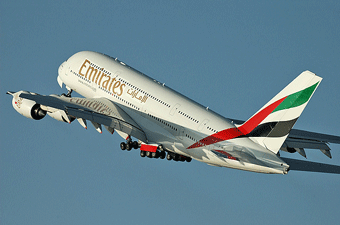
     Airbus’ Leviathan A380, after costly and lengthy delays, finally made its debut, though we haven’t seen the delivery of a freighter yet.
     Boeing B787 that has sold more aircraft than any other big commercial plane ever before launch joined Airbus A380 delay parade against a backdrop of charges by some leading ex-Boeing engineers that the all composite aircraft is being rushed to market and for safety sake should be slowed down while more testing can be conducted.
     Boeing and Airbus’ race for market share in especially the last two years has been like a late set volley at Wimbledon as each company seems to continue to announce orders eclipsing the prior’s.
     As the year begins, the two seem neck and neck as ever. Meantime China plans to challenge both Boeing and Airbus
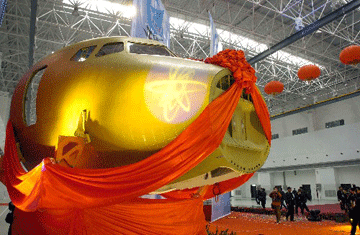
     Air Cargo News/FlyingTypers learned at year’s end that Beijing plans to merge its two major national aircraft producers AVIC I and AVIC II to become one entity based in Shanghai.
     According to our local sources, government officials will announce the details of the project next March.
     The joining forces of the two state owned AVIC production sites is in high accordance with China’s mid-term ambitions to become a major aircraft manufacturer within the next ten to twelve years.
     Main target is the development and assembly of a 150-seater passenger jet that shall take off for its maiden flight by 2020.
Bigger aircraft are to follow after the kick off and successful introduction of this initial project.
     By becoming a producer of aircraft with over 100 seats China wants to gain more independence from both Airbus and Boeing, who presently dominate the global producer market due to their duopoly. Beijing sees reasonable chances to market the future passenger jet successfully because of lower production costs compared to the U.S. and European competitors.
     Third factor is the booming passenger traffic in domestic China with more flights, frequencies and a rapidly growing network within the country that leaped by 15 percent in 2007.
     AVIC I just presented its newest product, the ARJ-21 that–according to demand–can accommodate 70 to 100 passengers.
It rivals similar products offered by Canadian manufacturer Bombardier and Brazil’s Embraer. AVIC II is the sole Chinese producer of commercial and military helicopters.
     In a joint venture with Embraer, AVIC II in addition assembles the ERJ-145 regional jet.
     Both AVIC enterprises traditionally supply components for Airbus and Boeing.

What Was And Will Be
     Russia put the squeeze on Lufthansa Cargo to move its Astana, Kazakhstan hub to Krasnoyarsk, Siberia by refusing the company overflight rights late in the year, but gave the airline an easement until the beginning of 2008, in what essentially sounds like a chance for the airline to come up with a plan to make the move to Russian soil.
     The airline said it wouldn’t do so unless major improvements were made to the Russian airport.
     Expect more politically charged negotiations early in this New Year.


Is It Easy Being Green?
     The environment took a mainstream center stage for all industries the first time in 2007, with airlines, and indeed all transportation squarely in the spotlight.
     In Europe, trade groups and the European Union, started to take solid steps in the direction of emissions reductions.
     Frankfurt and Munich Airports for example, in an initiative called “Air Traffic for Germany,” said they will start a test program beginning in 2008 that would charge €3 per kilogram of nitrogen oxide emissions from aircraft in an effort to get manufacturers to build and carriers to run cleaner machines.
     The proceeds wouldn’t go into the airports’ coffers, however, but will instead be used to offset the costs of takeoff weight charges.
     The German Ministry of Transport, and the likes of Lufthansa endorsed the program.
     Air Charter Service, a passenger and cargo charter company in the U.K., for example, also announced in November the company would offset carbon emissions from its own internal business by investing in a methane gas capture project.
     The trend of transportation companies making any possible environmental benefiting improvements in their businesses, or offsetting them by swaps elsewhere, will certainly be a continuing and necessary theme.
     Green gets steamed in Zurich February 20-21 at The Green Transportation & Logistics World Summit.
     The gathering is set up to discuss the business case for greening supply chains through transportation and logistics initiatives.
     Green offers a withering number of speakers for those who either want to stick their toes in the water or wish to be totally baptized into the culture.
     “How Green Is My Company,” experts will be center stage from Nike, Hewlett-Packard, Schneider Electric, IBM, GE Energy, Lexmark, Cisco, Motorola, Intel, Fujitsu, Sharp Electronics, Deutsche Post World Net, Kuehne & Nagel, Wincanton, Christian Salvesen, Agility Logistics, Swiss Federal Ministry of Transport, UK Freight Transport Association, the European Environmental Agency.
     More: www.greenlogisticsforum.com


Cargo Venturesome

     Despite booming economies like China and India contributing to surges in cargo growth and competition in their respective markets, a glut in air cargo capacity remains, which will probably not abate anytime soon.
     Nonetheless, a slew of companies were planning to launch cargo services and even start new ventures to do so.
     DHL and Lufthansa for example announced they’d start a new joint cargo airline to primarily serve the Chinese market, still named NewCo at press time (that changes January 28 at a big press pow-wow (oh wow) in FRA). Both airlines also pulled out of Cologne-Bonn airport in 2007 to put down stakes for a new cargo hub at Leipzig.
     Lufthansa’s other freight joint venture project, China-based Jade Cargo, says it’s still experiencing a shortage of pilots and isn’t flying all of the frequencies it originally promised. Jade nonetheless, said it’s looking forward to correcting that and taking its sixth aircraft into service in 2008.
     The company said it also hoped to start flying to the U.S. next year.
     Other companies like India’s Jet Airways also have ambitious plans on tap for that booming economy’s market. Naresh Goyal, the company’s CEO recently told ACN/FT, the company hoped to see cargo contribute 15% to Jet’s bottom line in future, as it was working on plans to further service to North America via its Brussels hub, and to other destinations around the world.

Harminder Rana Is Brilliant
     Meantime the longtime India airline to the world, Air India having added Indian Airlines at home and a bevy of latest technology long-range aircraft also made strides in building its air cargo program in 2007.

     We spoke to Mrs. Harminder Rana, Regional Director-Europe for Air India.
     Air India is developing new routes while deepening some old ones including services to west coast USA and new services being forged into China and elsewhere.
     “When you think of it,” Mrs. Rana explains “India has practiced ‘Open Skies’ with just about everybody for the past seventy years.
     “For all these decades ahead of any other major world address, anybody has been able to fly almost everywhere across India.
     “So now with airline globalization and the fervent attention being paid to a Subcontinent that by almost everyone’s reckoning will be among the top three economies of the world by 2050, it just makes sense that AI would ramp up an effort to compete and win the future.”
     Mrs. Rana said that she believes the addition of those all-cargo A310 freighters once proven, will form the catalyst of even more all-cargo services in the months and years ahead.
     “There is some concern that rates could be a bit stronger but we are seeing solid bookings as launch of Paris and Frankfurt services to Mumbai draws near.”
     In fact Air India is converting as many as six A310s in Dresden at EADS Elbe Flugewerk in a move that is repositioning the airline in the main deck freighter business although in fact AI has maintained some combi lift in certain markets all along.
     “Big challenge is the well reported cargo infrastructure shortfall at home, but my view is that since so much of the world’s IT is being created across India the move to apply various information technologies and systems to the need will come rather quickly now.
     “Creating a network of state of the art cargo facilities is another matter.
     “But with demand and room to grow in abundance, building the means to make room for the boom and service India’s business unlocks even a broader menu of possibilities and opportunities to all comers.”


Where Cargo Booms
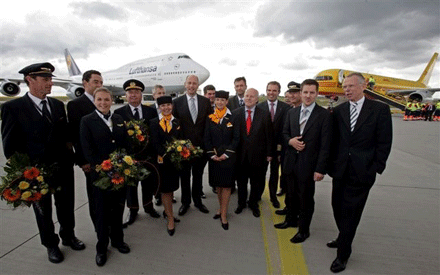
     Meanwhile Cologne-Bonn, Germany’s second busiest freight airport in tonnage after Frankfurt, was offering more capacity to cargo airlines and marked the departure of Lufthansa-DHL with a commitment from FedEx to up its presence and frequencies there, making it FedEx’s second largest hub after Paris Charles de Gaulle. Cologne-Bonn is UPS’ main European hub.
     “We’re focused on acquiring more general cargo business, space is at a premium at Frankfurt and that airport is facing a night flight ban; this will force one or the other cargo carrier to shift to a new location,” said Michael Garvens, (left) the chief executive of Cologne-Bonn, in an interview this past summer.
     “We would like to obtain a considerable stake of this market,” Mr. Garvens said. “During the daytime especially, we basically have unlimited space available for more cargo flights. During the day, we have huge cargo aprons that are basically unused at the moment.”
     Munich christened a new 15,000 square meter freight forwarding facility December 7, fully rented before the doors even opened.
     The airport’s cargo volumes have more than quadrupled in the last 15 years, and the airport said it was already considering inquiries prompting it to start building the second phase of the project.
     “The expansion of the freight facilities is a key milestone in the development of Munich Airport (right) into a leading logistics center,” said Walter Vill, Munich Airport’s deputy CEO in his speech during the opening ceremony.
     “It will benefit not only the freight forwarders using the new building and their customers, but also the entire economy in southern Germany,” (and the rest of the airport’s catchement area), Mr. Vill sai


Business Flies Onward
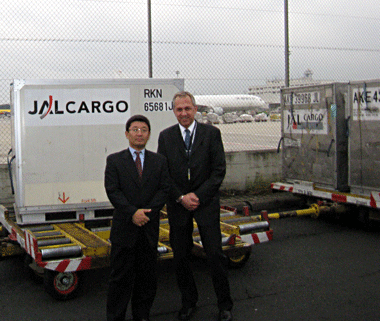
     Japan Airlines’ Shinji Akamatsu, the European regional manager for JAL Cargo in Frankfurt, for example said its German- apan traffic was growing year to year.

     “Our main business in Germany is focused on Japan traffic, the demand is mainly out of Japan to Germany, but every year the demand is getting bigger and bigger.
     Both inbound and outbound,” Mr. Akamatsu said in an interview in the fall of 2007.
     Mr. Akamatsu said comparing the fiscal year 2006 with 2002, (April-March), JAL has seen a 19% increase in export tonnage in Frankfurt, to 19,000 tons, compared with 16,000 tons in 2002.
     In terms of import tonnage, JAL saw a 35% increase to 23,000 tons in 2006 from 17,000 tons in 2002.
     Other European airlines business must be seeing similar demand and gains. SAS, for example, said recently it was adding capacity to its winter timetable from Scandinavia to Bangkok and Dubai.

     “The extra capacity is important for us,” said Nils Pries-Knudsen, the SAS vice president of global sales in a statement on the announcement of the new routes. “Bangkok is an important hub for us and it will improve our products to the Southeast Asian region.”
     “With six weekly frequencies on both passenger and all-cargo aircraft, it is possible for SAS Cargo to offer quite a unique transport solution between Scandinavia and Dubai.
     This will especially benefit customers with a demand for express products and special products,” Mr. Pries-Knudsen said.


Open Skies
     The agreement between the U.S. and Europe to Open Skies looked to be the new growth – and possibly consolidation driver for the whole of the industry in the coming year.
     The agreement, that should go into effect at the end of March 2008, will allow for every U.S. and E.U. airline to fly between every city in the E.U. and the U.S.; operate without restriction on the number of flights, aircraft and routes; set fares according to market demand; and enter into cooperative arrangements, including codesharing, franchising and leasing, according to the U.S. State Department, the U.S. entity responsible for the agreement.
     Other benefits of the plan, according to the State Department, include that it would foster a pro-growth, pro-competitive framework that eliminates outmoded arrangements affecting Heathrow, where U.S.-British service is now limited to only four airlines. (British Airways, American, United and Virgin).
     The agreement would also allow for more investment in airlines between continents and the transport of cargo between the U.S. and all third (including non-E.U.) countries.
     Lufthansa, in a recent politics, media and economics newsletter called the Open Skies agreement “an important step to a mutual trans-Atlantic air traffic market, from which a strong growth is expected.
     Lufthansa also noted a recently released European Commission study predicted that eventually, combined airline costs could fall by €12 billion because of the agreement; that Open Skies could encourage more than 20 million more passengers to travel—presumably because of falling costs and added convenience; and that 80,000 jobs on both sides of the Atlantic could be generated because of the pact.
     Air France-KLM, said Open Skies was a great opportunity for the Franco-Dutch company, and its Sky Team partners around the world:
     “Of course it means more opportunities: an opening of routes, new entrants into the market and lower fares for consumers,” said Bart Koster, a KLM spokesman in Amsterdam during a recent interview.
     As far as what KLM will do with all the new possibilities: “Everything is being considered,” Mr. Koster said. For instance, Northwest Airlines, a SkyTeam partner, will be able to access London through the agreement. Northwest was planning more services to Europe including a route from Hartford, Connecticut to Amsterdam, and future service from Detroit to Brussels and Detroit to Düsseldorf.
     “North-Atlantic Open Skies would be a good framework to copy and paste to the rest of the world. A global Open Skies agreement would be the ideal picture from a KLM perspective,” Mr. Koster said.


What’s Up At UPS
     Eric Kirchner, the recently named president of UPS freight forwarding said the U.S. based global logistics giant was seeing more customers’ working on gaining flexibility and containing costs with active management of multi-modal strategies among the prevalent trends the company expects to continue in the coming year.

     Mr. Kirchner told Air Cargo News/FlyingTypers in a statement the management of multi-modal strategies on the part of UPS’ customers is taking into account especially product value, life cycle and handling characteristics. That enables more efficient demand planning, pre-allocation for destinations along with visibility in transit and better management if there are production delays, he said.
     Mr. Kirchner said through customers’ search for greater efficiency, UPS was seeing an increase in the use of its UPS Trade Direct Air and Trade Direct Ocean products that “enhance efficient origin assembly and labeling tied to better supplier information management.” Those products also contribute to “consolidation and transportation planning for smaller supplier companies and receiving retailers to gain speed and reduce days-on-hand inventory,” for example.
     UPS said export logistics compliance in 2008 will also drive “more licensing and documentation, with a particular emphasis on dual-use items and diversion concerns and denied party lists. More global customs organizations are deploying technology systems and requiring improved document management for departure origins as well as to speed inbound clearances,” Mr. Kirchner said.
     UPS said data management will be an important theme in 2008 as companies look for more low-cost country options for sourcing. Information management is, and will be more important to coordinate and verify production scheduling. Consolidation of components or inventory from multiple suppliers, transportation documentation for customs clearance, for example, will also be more a focus in future, the company said.
     In addition to continuing growth of production and supplier expansion, China’s profile will be heightened in 2008, with the Beijing Olympic Games, for which UPS is coordinating onsite logistics, Mr. Kirchner continued.
     The greening of the supply chain will drive continuing attention to fuel, packaging, waste minimization and flexible mode shifts that balance speed to market of air transit with lower carbon options from ocean and ground. Companies will seek paperless options for customs documentation and visibility tools to enhance planning, network optimization including routing, scheduling and dispatching.
     UPS did not provide a financial outlook for 2008, but said it expects only modest increases in fourth quarter retail sales in the softening U.S. economy, but believes solid results will be driven by UPS export growth of approximately 10%, and further gains for UPS in the company’s supply chain and freight segments.


Get It On American
     We caught up with David Kerr, the managing director of sales for American Airlines Cargo in Europe, the Middle East and Africa to get his take on the closing year and the airline’s goals for 2008.
     As one of the four airlines serving London Heathrow’s trans-Atlantic market at the moment, Mr. Kerr said AA was looking forward to more competition through the market expansion Open Skies will provide.
     “Opens Skies in London will occupy our thoughts in early 2008 starting with realigning of our Raleigh-Durham and one of our Dallas Fort Worth services to Heathrow from Gatwick—we anticipate strong competition with Opens Skies and we will compete strongly,” he said.
     As for the industry’s climate, Mr. Kerr’s complaint was not foreign to that of others in his and similar positions:
     “2007 was undoubtedly a story of economic headwinds and rising costs,” Mr. Kerr said. “But the loyalty of customers and the hard work of the AA Cargo team from the warehouse to the back office shone through.”
     “In 2008 new services to New York from London Stansted, Milan and Barcelona will strengthen our competitive edge in schedule to JFK,” he said, adding: “Our new venture in the Russian market with the first non-stop service to Chicago from Moscow looks like an exciting proposition.”
Geoffrey/George Frey


Architecture In The Emirates

     It’s January and one thing should be clear about the New Year already.
     You are not going to change much in January.
     So maybe an extension of some reading habits picked up (or missed) during the holidays might be in order.
     But not stuff that is too heavy.
     January should be about expanding ones mind and seeking some enlightened enjoyment during a time that can still be somewhat stressful despite the end of the holidays.
     How about a book all about what is going on outside your window in Dubai and Doha and Abu Dhabi to and from the airport?
     In case you missed it or truthfully have only seen a blur about what you have heard is going on there, construction projects in Abu Dhabi, Ajman, Dubai, Fujairah, Ras al-Khaimah, Sharjah, and Umm al-Quwain and elsewhere in the UAE and nearby Gulf region are building new cities in the desert at an astonishing rate.
     So it's no surprise that the Gulf region has attracted many of the world's most prominent architects, including AEDAS, Tadao Ando, Asymptote, Atkins, Behnisch Architects, Frank O. Gehry, Gensler, Zaha Hadid, HOK Sport, Kazuhiro Kojima+Kazuko Akamatsu/C+A, KPF, Greg Lynn Form, Jean Nouvel, OMA/Rem Kohlhaas, ONL, Carlos Ott, I.M. Pei, RNL, Hadi Simaan, Skidmore Owings & Merrill, Studio Pei Zhu.
     It should also be no surprise that someone has done a book about it.
     “Architecture in the Emirates,” By Philip Jodidio is a hardcover, 9.1 x 11.4 in., 192 page beauty that is both words and big pictures that are destined to land on the coffee table, but also as a mind bender serve as more than a giant coaster at cocktail time.
     Here is an exciting look at what is new and next in city building for sure.
     At $29.99 a throw Architecture In The Emirates (ISBN 978-3-8228-1396-6) is at once uplifting and exciting just like the places it describes.
More: www.taschen.com.