



|
|
|
| |
||
|
||
|
||
|
Vol. 7 No. 34 WE COVER THE WORLD Wednesday April 2, 2008  |
March 31 was be Ulrik Marschall's
last day with SAS Cargo. The spokesman of the Scandinavian air freight carrier
abandons his chair in Copenhagen's
SAS headquarters to switch over to the SAS passenger
airline. When FlyingTypers asked his office who would replace him, we were told,
"up to now we do not know who will follow Ulrik as head of media at SAS
Cargo." Ulrik is not the only one to wave goodbye to the Nordic cargo airline.
Another staff member is SAS Cargo's Stuttgart sales manager,
Peter Sommer who recently retired. However, instead
of hiring a successor SAS will leave his position vacant. "The Frankfurt
and Munich stations will be in charge of the market in Southwest Germany,"
said SAS. Same thing might happen in Hamburg where Northern Germany regional
representative Jens Imbeck, a local SAS institution will step down soon, after
having served the Scandinavian Airline for ages. Whether he will be replaced
is an open issue.
Fact is, instead of following a global growth
strategy, SAS Cargo is concentrating their efforts increasingly on the Scandinavian
home market.
There, some very big boys and worldwide renowned
players like Volvo, Ikea, Hennes & Mauritz, Scania, Alfa Laval, and Bang
& Olufsen are based.
Therefore, more and more players are entering
the markets in Copenhagen, Gothenburg and Stockholm to compete for the business.
"Our home market is extremely competitive
and does not generate enough volume for feeding the mouths of those many carriers,"
a high ranking cargo official puts it.
Consequently the pressure on the Nordic freight
carrier mounts.
The airline, making the 2007 yearly results public,
titled their press release "SAS Cargo's result hit by hard competition.”
A turnover of €363 million Euros which lead
to a meager profit of €2.4 million Euros were the disappointing figures
presented by the management.
To improve the finances the SAS board has decided
to sell Spirit Air Cargo Handling, the handling subsidiary of SAS Cargo.
A more ambitious plan by the SAS grandees however,
had to be put back into the drawer for the time being: the entire selling off
of SAS Cargo.
The unions had fiercely protested and vetoed that
plan.
Heiner Siegmund
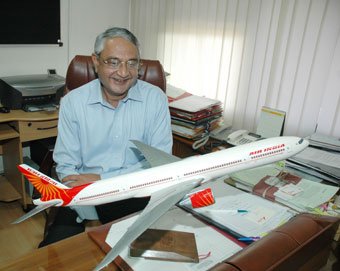 No,
this is not dear Ram, who stays put at Emirates.
No,
this is not dear Ram, who stays put at Emirates.
 But
get ready for two top airline executives making world headlines and both are
named Menen or Menon depending on which one you are reading about.
But
get ready for two top airline executives making world headlines and both are
named Menen or Menon depending on which one you are reading about.
At Air India, Vasudevan Thulasidas has hung
up his wings.
Although not a flier, VT nevertheless piloted
Air India and later the National Aviation Company of India Limited (NACIL)
in its most troubled period.
A civil servant well known in government parlance
as an Indian Administrative Service (IAS) officer (people who are trained
to administer the country) Thulasidas retired on March 31, 2008.
Which brings us to Raghu Menon, also an IAS
officer.
Menon has been Special Secretary and Financial
Adviser in the Civil
Aviation Ministry.
As Chairman and Managing Director of NACIL,
Menon was chosen out of 51-odd aspirants for the post.
The process to find a successor took around
three months prompting many in the corridors of power to comment that Thulasidas'
tenure had been extended.
However, Minister Praful Patel had his say and
decided on Menon.
The new man faces a number of hurdles: how to
stem the losses of both Air India and Indian.
Incidentally, in the financial year 2006-07,
Air India had a loss of Rs 447.93 crore while Indian showed a loss of Rs 240.29
crore.
The losses for both in 2007-2008, the financial
year that ended on March 31 this year, amounted to more than Rs 800 crore.
The other big challenge that the new man at
the top will face is ensuring a successful merger of the two carriers.
Tirthankar Ghosh
Celebrating A New Beginning
|
| They brought in a Catholic Priest from Holy
Rosary Church, Staten Island, New York USA, a Hindu Priest from Queens,
New York and Buddhist Clergy from a Princeton, NJ Temple and an Islamic
Mullah from an undisclosed location as Sri Lankan Travel Inc. - GSA for
SriLankan Airlines celebrated the return of full management rights and operations
of Sri Lankan Airlines back to the Sri Lanka Government after 10 years,
effective April 1, 2008. Traditional Sri Lankan food including Kiribath, Lunumiris and a variety of sweets were served. Dillan Ariyawansa, Head GSA for SriLankan Airlines in North America said: “We are fully confident that SriLankan Airlines will fly into even greater heights and "we will continue to do our part towards achieving that goal. “After all, we are all SriLankan." Meantime SriLankan’s partner for the past decade and while holding 43% of the airline into the foreseeable future, Emirates Group was carrying on its own business as usual, even as its management contract was twisting in the wind amidst the hoopla. Fair to say that SriLankan Airlines was crafted into a money-making machine, capturing a lion’s share of the India market and healthy respect, even admiration during the Emirates management era, as former CEO Peter Hill raised an exuberant team at the island carrier into their current “Hub of the Ocean,” mode. Maybe the clerics were the right touch as a new and fairly uncertain era dawns and as stiff competition and soaring fuel costs will certainly test the mettle of every airline. Geoffrey |

In China, AVIC1 Commercial Aircraft Company
signed a memorandum of understanding (MOU) with GE Commercial Aviation
Services (GECAS) to place firm orders for five ARJ21 regional jets. |


“This place is going to the dogs,”
or “See what the bears in the back room will have.” |
Iraqi Airways purchases 40 Boeing aircraft with an option, which includes
15 Boeing 737’s, and 787 Dreamliners
Baghdad also announced a 400 million dollar contract with Bombardier to purchase
10 planes.
Deliveries in the multi-billion dollar deal begin this year.
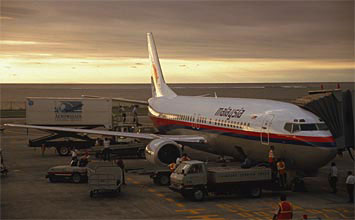 Malaysia
Airlines is ordering up to 55 B737-800 aircraft. Malaysia
Airlines is ordering up to 55 B737-800 aircraft. The national carrier will also take delivery of 6 A380-800 in 2011. Managing Director/ Chief Executive Officer, Dato’ Sri Idris Jala said: “We have placed a firm order for 35 B737-800 with an option for another 20 aircraft to replace our existing B737-400 fleet and to allow us to expand to points which were not previously economically viable. “Malaysia Airlines also has the option to swap the B737-800 to the larger B737-900.” Jala also said that Malaysia Airlines will take delivery of all 6 A380-800 in 2011, with the first aircraft to be delivered in January and the sixth in August. |
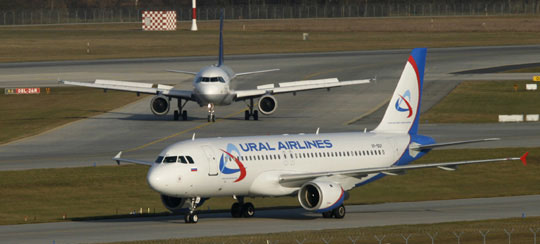 Sick
of coach or business or even first class? Sick
of coach or business or even first class?How about Love Class? In Russia, Ural Airlines offers just the ticket for married people. Ural says Love-Class flights can be bought only if the couple holds a certificate of marriage registration. The Love-Class area aboard the plane is separated from the business and economy classes with a cover and is equipped with special seats that have a bigger inclination angle than the standard passenger seats in case the marrieds are inclined to recline. Couples also get a personal steward who apparently leaps under the covers at the signal of the call-button. Ural says Love-Class flights allow marrieds to carry 30% more liquids aboard in hand luggage. What the liquid may be we wonder about, but choose not to go there. What’s the catch? For one thing, Love-Class tickets are non refundable unless the couple provide proof of divorce. So maybe Love Class joins death and taxes as another aspect of no way out? Your move. |
Publisher-Geoffrey Arend o Managing Editor-Flossie
Arend o Advertising Sales-Judy Miller
Send comments and news to geoffrey@aircargonews.com
FlyingTypers reserves the right to edit all submissions for length and content.
Copyright ©2008 Air Cargo News. All Rights Reserved. More@
www.aircargonews.com









 The
International Air Transport Association (IATA) downgraded its industry
profit expectations for 2008 to US$4.5 billion based on global economic
growth slowing to 2.6% and an average oil price of US$86 per barrel
(Brent Crude).
The
International Air Transport Association (IATA) downgraded its industry
profit expectations for 2008 to US$4.5 billion based on global economic
growth slowing to 2.6% and an average oil price of US$86 per barrel
(Brent Crude). 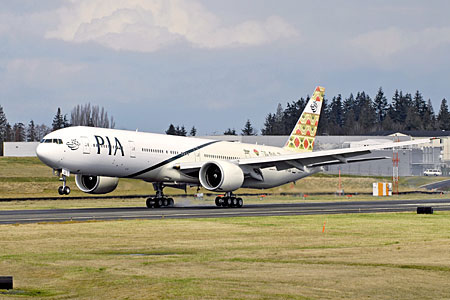
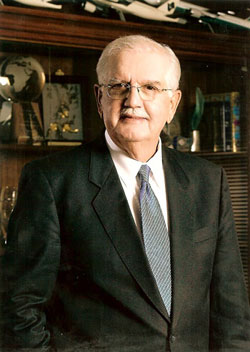 Now
with new elections finally completed and a new government in power, hopes
are rising for the return of Pakistan International Airways (PIA), a carrier
that somehow gets up off the mat and comes back despite turmoil all around.
Now
with new elections finally completed and a new government in power, hopes
are rising for the return of Pakistan International Airways (PIA), a carrier
that somehow gets up off the mat and comes back despite turmoil all around.

 A
recent Asia Pacific Aviation (AAPA) Security Forum in Kuala Lumpur jointly
organized by AAPA and the USA TSA managed to achieve a historic first
as high-level security chiefs gathered.
A
recent Asia Pacific Aviation (AAPA) Security Forum in Kuala Lumpur jointly
organized by AAPA and the USA TSA managed to achieve a historic first
as high-level security chiefs gathered. AAPA
Director General, Mr. Andrew Herdman, added:
AAPA
Director General, Mr. Andrew Herdman, added: 