Contact Security Focus In New York

 Harald
Zielinski, Lufthansa Cargo Chief of Security & Risk Management Prevention
lays it on the line: Harald
Zielinski, Lufthansa Cargo Chief of Security & Risk Management Prevention
lays it on the line:
“There simply cannot be a separate but unequal
approach to air cargo security,” he says.
“The industry needs to act together with
governments and shippers and other interested parties to create a security
system benchmarked in workable procedures.
“But as the security threat increases, we
must be prepared to admit as an industry that nothing is impossible.
“We need to harmonize our efforts to get
security right while advancing technologies that offer both added value
to the process and safeguards for everyone who flies.”
Lufthansa Cargo is about ramping up security at
an unprecedented level in advance and in accordance with various governmental
mandated edicts while driving the debate toward better understanding all
around.
On September 30, 2008 in New York, independent
of any organization either industry driven or governmental, and at company
expense, Lufthansa Cargo showing some tangible leadership gathers the
largest group of the best and brightest experts that have met to discuss
air cargo security in a substantive deep-dish fashion so far this year
in North America.
At Lufthansa Cargo’s second public security
conference, and the first to be held in New York discussion moves from
current trends and perspectives in airfreight security to what is needed
to make air cargo work as new rules come into reality in the months and
years ahead.
In addition to analyzing the international security
situation, conferees discuss various regulatory provisions as well as
outline technological, process and personal challenges.
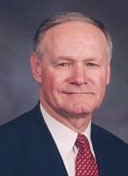
A Safir Place… Former NYC Police commissioner Howard
Safir speaks at Lufthansa cargo gathering.
With participation from the U.S. Transportation
Security Administration (TSA), Massachusetts Institute of Technology (MIT),
Airline Pilots Association (ALPA), the American Association of Airport
Executives and Howard Safir, the CEO of Safir Rosetti, former NYPD Commissioner,
the program offers presentations and discussion in a focused immersion
activity aimed at furthering understanding and even possibly breaking
some new ground.
“Our approach is to build quality, one step
at a time.
“This dedicated air cargo security gathering
explores many avenues and calls for initiatives to be brought forward
to benefit everyone in air cargo,” Harald Zielinski insists.
 “Lufthansa Cargo cooperates closely with
international authorities, airports, the security industry and its cargo
customers to develop innovative and airfreight-specific security technologies,
and optimize existing systems.
“Lufthansa Cargo cooperates closely with
international authorities, airports, the security industry and its cargo
customers to develop innovative and airfreight-specific security technologies,
and optimize existing systems.
“Around the clock, about 100 people worldwide
work exclusively for our air cargo security.
“But we are also putting what we have learned
into action.
“As example, Lufthansa Cargo is deploying
500DT trace explosives detectors that were recently endorsed on the TSA
qualified products list, to all 18 of our U.S. airport locations by acquiring
Ionoscan 500DT dual trace explosives detectors from Smith Detection.
“Lufthansa Cargo is the first to deploy
these advanced desktop detectors for ground-to-air cargo screening in
early accordance with the TSA rule requiring all cargo in passenger planes
be screened by 2010.
“Smiths Detection's Ionscan 500DT is a second
generation system designed to identify small amounts of explosives from
a single sample in a matter of seconds.
All destinations served by Lufthansa Cargo in
the U.S. market (New York; Newark, NJ; Boston; Philadelphia; Washington,
D.C.; Detroit; Charlotte; Orlando; Miami; Houston; Chicago; Dallas/Ft.
Worth; Atlanta; Denver; San Francisco; Portland, OR; Seattle and Los Angeles)
as mentioned are getting state-of-the-art explosive trace detection capability
from the third quarter 2008.
“By implementing the regulation ahead of
schedule, we are already guaranteeing the highest security standards.
“Additionally, Lufthansa Cargo has transformed
its bases in Chicago and Los Angeles into security hubs with installation
of physical access barriers as well as comprehensive video surveillance
and use of explosive detection equipment, biometric checks and security
guard patrols.”
For the record Lufthansa Cargo has already converted
its bases in Frankfurt, Munich, New York and Shanghai into similar circumstance.
 Harald
Zielinski it turns out is a pretty regular guy who instead of being a
Doctor Strangelove, looks a bit like the actor Robin Williams, with a
face that breaks into a warm smile despite his almost relentless determination
to get this security thing right. Harald
Zielinski it turns out is a pretty regular guy who instead of being a
Doctor Strangelove, looks a bit like the actor Robin Williams, with a
face that breaks into a warm smile despite his almost relentless determination
to get this security thing right.
Harald is a former beat cop who served in the
streets of Frankfurt, Germany as did his father Leo before him.
Having covered some local police precincts we
know that uniformed street cops are a different breed whether here in
New York, Mumbai or in Frankfurt.
They can see things, sniff out situations and
often have sharper instincts than many others in law enforcement.
Street cops at times not only seem to have eyes
in their feet, they are always thinking up ways to tighten down loose
and potentially tough security situations whether it is neighborhood or
factory.
Once while supposing what the ideal environment
for checking out cargo prior to flight Harald said:
“Never mind using just dogs and other similar
methods to check out freight.
“What air cargo needs is a giant sniffer
that can surround and detect entire containers of freight in one felled
swoop.”
As Harald, the dreamer and doer sees advanced
security as an emerging reality, you detect an impatience to get to 100%
secure air cargo.
In a business that can often put narrow company
or self interest as paramount, air cargo is lucky to have this guy working
to move security to greater heights.
Geoffrey
Quote
Of The Week

 George
W. Bush will be remembered for symmetrical disasters. George
W. Bush will be remembered for symmetrical disasters.
His presidency began with the destruction of the
Twin Towers and is ending with the devastation of the Twin Trillions
(Iraq 653 billion and counting and the (700 billion) bailout of
the financial industry).
Joe Klein
Time Magazine
October 6, 2008 |
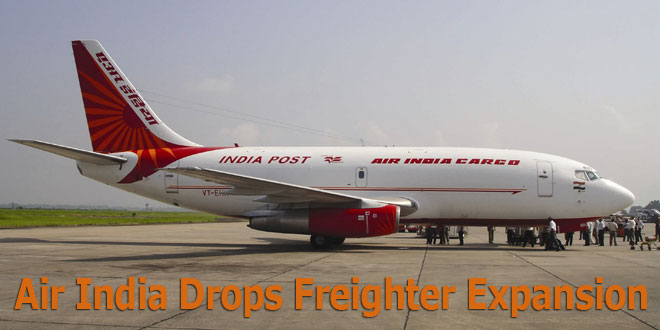
(New Delhi)—Air
India Cargo (AIC) delivers a major jolt by dropping further expansion
plans of its own to add all cargo lift, at least in the near term.
Whilst the carrier operates dedicated
cargo flights to France, Germany and Saudi Arabia, the airline has put
forward a Request for Proposal (RFP) for lease of two of its Airbus A-310Fs
that have just been converted to freighters in Germany.
A senior AI official told Air Cargo
News FlyingTypers the carrier “could not find profitable routes
within the country,” hence, the need to immediately lease out the
planes.
But the carrier has a leasing agreement
for the six Boeing 737s that it operates for the nation's postal department—India
Post (reported in ACNFT) –and for logistics major Gati.
So Air India's leasing of cargo
planes may turn out to be a successful part of a business plan that could
be quite a money-spinner for the airline.
India Post (IP), for example, has
expressed the desire to lease three more freighters, in addition to the
one it already has, by the end of this year.
The planes will be used to support
IP services to some 15 major cities in the country.
The IP result is quite positive
as it launched its first aircraft a bit over a year ago on August 29,
2007.
In addition to IP, Air Cargo News
FlyingTypers learned that AIC has an arrangement in place with the aforementioned
express delivery outfit Gati to charter up to five or more aircraft over
the next several years.
Reportedly AIC also has plans to
lease out freighters elsewhere to postal services of some east European
countries as well as possibly even the U.S. Postal Service.
However it must be said that an
underlying factor in all of this is realization that Air India has not
really been able to cash in on the air cargo growth in the country.
According to the ministry of civil
aviation, the total cargo traffic in all airports in the country increased
21.5 per cent in 2006-07 from a 15.6 per cent growth factor in 2005-06.
Private carriers like Jet Airways
and low-cost passenger carrier such as Spicejet and others have captured
increasing percentages of air cargo growth here.
Tirthankar Ghosh
| 
 
Shanghai Pudong
International Airport Air Cargo Terminal Co., Ltd., (PACTL)
has reported that it handled 91,513.8 tons in August, up 96 percent
year-on-year . . . Meantime China
Eastern Airlines and Korean Air
launch charter flights between Huangshan
and Incheon from October 1 through
to November 30 . . . BA
Chairman Martin Broughton met Shanghai
Mayor Han Zheng on Wednesday to discuss the expansion of
flights from five to six a week, with a view to eventually moving
to seven a week . . . Siliguri
Jalpaiguri Development Authority is developing a cargo complex
for perishable commodities at North Bengal's
Bagdogra Airport that is expected to commence operations
from early next year . . . Aloha
Airlines comes up off 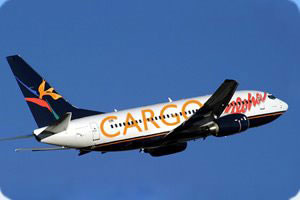 the
mat as the Honolulu-based cargo operator now adds the
mat as the Honolulu-based cargo operator now adds  same-day
express service routes between Honolulu,
Kahului, Hilo
and Kona. Although the airline no longer
carries passengers Aloha Air says it does provide transport to animals
including sheep, miniature horses, potbelly pigs, turtles, seals,
rare native birds and pheasant chickens .
. . All Nippon Airways that
is launch customer for the B787 now expects to receive its first
Boeing 787 Dreamliner in August 2009,
15 months later than originally planned while Japan
Airlines said its first B787 will arrive (fingers crossed)
in October 2009 some 14 month late . . . Reports
are also circulating late Saturday that Japan
Airlines is planning to cut back its all-cargo flights into
New York City. The move is not a surprise.
Air cargo business at JFK dropped an
unbelievable 10% in June as numbers across Asia
dipped 4 to 6%. Downward pressure to make a buck on all-cargo operators
flying even "newer generation” B747-400s with oil selling over
USD$100 a barrel has been devastating as the older B747-200Fs are
disappearing from the skies almost faster than it takes to read
this. But the JAL move whatever it is, might not be as dramatic
as what could happen at Northwest Cargo.
NWA began the year with a dozen B747-200s and has retired three
since June. Now Northwest is about to be re-branded as Delta,
an airline that has not operated an all-cargo airplane since a man
named Collett E. Woolman (he died 42
years ago, September 11, 1966) pioneered the airline and maybe flew
the freighter himself. Given the Delta takeover, Northwest could
very well end up out of the freighter business altogether .
. . Geoffrey same-day
express service routes between Honolulu,
Kahului, Hilo
and Kona. Although the airline no longer
carries passengers Aloha Air says it does provide transport to animals
including sheep, miniature horses, potbelly pigs, turtles, seals,
rare native birds and pheasant chickens .
. . All Nippon Airways that
is launch customer for the B787 now expects to receive its first
Boeing 787 Dreamliner in August 2009,
15 months later than originally planned while Japan
Airlines said its first B787 will arrive (fingers crossed)
in October 2009 some 14 month late . . . Reports
are also circulating late Saturday that Japan
Airlines is planning to cut back its all-cargo flights into
New York City. The move is not a surprise.
Air cargo business at JFK dropped an
unbelievable 10% in June as numbers across Asia
dipped 4 to 6%. Downward pressure to make a buck on all-cargo operators
flying even "newer generation” B747-400s with oil selling over
USD$100 a barrel has been devastating as the older B747-200Fs are
disappearing from the skies almost faster than it takes to read
this. But the JAL move whatever it is, might not be as dramatic
as what could happen at Northwest Cargo.
NWA began the year with a dozen B747-200s and has retired three
since June. Now Northwest is about to be re-branded as Delta,
an airline that has not operated an all-cargo airplane since a man
named Collett E. Woolman (he died 42
years ago, September 11, 1966) pioneered the airline and maybe flew
the freighter himself. Given the Delta takeover, Northwest could
very well end up out of the freighter business altogether .
. . Geoffrey |
|