


|
|
|
| |
||
|
||
 |
|
Vol. 7 No. 113 WE COVER THE WORLD Monday October 13, 2008  |
It’s pretty scary stuff
all right.
The last couple of weeks have brought a tsunami
of world stock market economic news each day that seems to outdistance itself
for pure shock value, as big banks and businesses seem caught in an ever downward
tailspin.
Some people discover as they land from a flight
that the value of their portfolio driven by home values has landed on them.
Where and when the situation will moderate at
this writing is still an open question.
So is there any good news?
Maybe carriers will start to realize some benefit
as oil continues its downward spiral.
Capacities seem to be falling faster than volume
of passengers at this point.
However some airlines who leveraged fuel at
$100 when oil was trading at $140 this past July, could get squeezed for a
time as prices dipped to about $80 last Friday (October 10).
The information stream is vital right now.
That is where we come in.
Our sense is that waiting for some panel at
a trade show or a club meeting may not be soon enough to get a better feel
for what everything going on all around us means to air cargo.
So Air Cargo News FlyingTypers is talking
to leaders in the transportation business and will report back to you dear
reader, in the days and weeks ahead.
We also encourage your comment and thoughts.
 In
Germany, Ruediger Ostrowski, General Manager and Board Member of the Association
of Forwarders and Logistics Providers of North Rhine Westphalia puts current
conditions this way:
In
Germany, Ruediger Ostrowski, General Manager and Board Member of the Association
of Forwarders and Logistics Providers of North Rhine Westphalia puts current
conditions this way:
“The global economy seems to be in a state
of shock, reducing the activities at main functions.
“The financial crisis is like a cancerous
tumor that infects business after business.
“First it was the investment bankers,
followed by banks and insurance firms.
“Now the consumers are becoming cautious
by postponing their spending in new cars, furniture, washing machines and
other goods that are not needed immediately.
“This will affect transports and logistics
sooner or later because the volumes will go down.
“Prior to the crisis we already had a
cyclical downturn of the economy with car producers like Opel, General Motors
and Ford slowing down their production.
“On top of this downturn comes now the
financial crisis, making things more than worse.
“However, I am fully convinced that the
logistics sector will not be hit as hard as other businesses.
“But times will get tough in Q1 2009 after
the upcoming peak season because of Christmas.”
Professor Boris Bjelicic, of DVB Bank, Frankfurt
notes:
 “U.S.
logistics providers will have a tough time, I suppose, because the imports
from China and Far East will decrease notably.
“U.S.
logistics providers will have a tough time, I suppose, because the imports
from China and Far East will decrease notably.
“Further, the stronger dollar will affect
USA exports negatively making them more expensive.
“On the other hand, for the European industry
this could lead to increased demand for their products since the euro is not
as expensive any more as it used to be some months ago.
“Falling oil prices are a sign of hope,
too, making production and transports less costly.”
 Uli
Ogiermann, CEO Cargolux has an airline view:
Uli
Ogiermann, CEO Cargolux has an airline view:
“The crisis affects every cargo carrier.
“However, I am convinced that operators
like Cargolux with only freighters in their fleet are somehow in a better
position compared to so called combination airlines that possess both freighters
and passenger aircraft.
“These carriers are highly dependent on
passenger demand and cannot react or be as flexible by shifting capacity or
changing routes as we can do.”
Jo Frigger, CEO & President, Emo Trans U.S.A.
is a leading forwarder:
 “You
can imagine that the big boys listed at stock exchanges will have problems
since their value decreased dramatically as a consequence of recent market
activity.
“You
can imagine that the big boys listed at stock exchanges will have problems
since their value decreased dramatically as a consequence of recent market
activity.
“If the value of your enterprise shrank
by about 30 percent or so, you will not be able to secure credit to finance
your business as easily as before.
“On the other hand those companies that
are not listed at the stock exchange and run by their owners should experience
less problems.
“But all business will suffer and everyone
in the logistics industry will be affected sooner or later.”
Stan Wraight is often on aviation panels at
trade shows at industry events around the world.
In a long and distinguished career he has served
at top management for KLM Cargo, Atlas Air and Air Bridge Cargo and Cargoitalia.
Currently at GE both in real estate development
and GE Aviation, Mr. Wraight also serves as an advisor to the chairman of
Malev Hungarian Airlines and as a board member of Unitpool.
“The shake out in all-cargo airlines has
been acute and received a lot of press attention, but the "massacre"
in the passenger business has receive less attention by our industry and is
significant as well as far as available lift on certain routes.
“All cargo carriers Gemini, Tradewinds
(since rescued), Kitty Hawk, (what’s going to happen to ABX and Astar
after the DHL move to fly USA cargo via UPS,) are signals that the U.S. industry
is never going to be the same again.
“Arrow, Variglog and World seem to have
found a savior in Matlin Patterson, but will they really go the next step
and provide the massive funding that is needed to make them global players?
“Centurion seems to be holding its own
under Alphonso Ray’s leadership, moving into MD11Fs to be competitive.
“Fans of all cargo can only wish them well as they undergo the change
process as the U.S. certainly needs some strong competitors.
“In Europe we have seen MK and Cargoitalia struggle and those challenges
apparently will continue.
“Elsewhere Flyington Freighters in India
with a reported 20 aircraft order for A330F appears now to be uncertain with
reportedly no management and most likely no future.
“Big headlines abound with Asiana disposing
of 747-400Fs as fast as they come off lease and both Japan Airlines and ANA
dropping freighters to New York, the one time gravy runs for both.
“Come to think of it I would not like
to be in the hot seat of cargo management of a lot of Asian Airlines as they
take delivery of the multitudes of converted Boeings and new freighters that
they ordered.
“Rumors surround Jade Air Cargo, as the
parent Chinese airline reportedly rethinks its involvement and the cash drain
falls to Lufthansa.
“How long that situation will be tolerable
is anybody’s guess.”
All of this begs the question:
Is there any good news out there?
“I think that there still exists a lot
of niches and routes and networks that can be built when all this financial
upheaval comes to an end.
“But we should not look for any overnight
solutions in fact the business squeeze will continue and predictably run its
course.
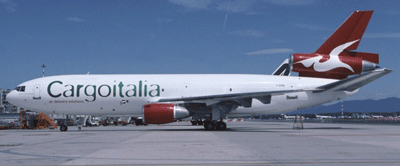 “It typically will take 18 to 24 months before you can get a "NEWCO"
airline up and running but there are opportunities.
“It typically will take 18 to 24 months before you can get a "NEWCO"
airline up and running but there are opportunities.
“Some examples are the "geographically
challenged" for existing legacy carriers in Europe regions like Italy
and the emerging Eastern European markets. “Italian forwarders are begging
for an all cargo airline that is viable and has a future, especially in Milan.
“Eastern Europe will see a flood of investment
in the coming years as manufacturing is repatriated to Europe versus the now
high cost Chinese factories.
“I believe direct airlift will be and
is right now needed to serve the North American and Asian markets.
“Dozens of trucks leave daily from these
points, and the manufacturers and forwarders are begging for a solution.
“Elsewhere despite some recent setbacks
the business case for the Indian Subcontinent is strong and will rebound.
“Plus don’t forget Russia and the
former Soviet States.
“All are rich in natural and human resources,
the world can utilize, no matter what the current political climate.
“Anyone who has written Russia off due
to recent financial and geopolitical turmoil is making a huge mistake. “Russian
imports will be strong as the economies open up to goods and services they
cannot provide themselves.
“One word of caution for the endless
lineup of folks who are in love with starting up a new airline be it all-cargo
or otherwise.
“No one should ever, ever, underestimate
the amount of capital that is required to make a success of a new airline.
“This is not a business for the faint
hearted, and the leasing companies and OEM Manufacturers at this point and
into the future of how deals are done will not provide aircraft to those they
are not assured have financial wherewithal.
“That is the new reality and will be
the real test in the coming years.
“We are in for a rough ride at least
until 2010.
“Those who have the ability and resources
to start building now, or restructuring at once will be perfectly positioned
for the recovery, and it will come.
“Last but not least we also need to restructure
our mindset when it comes to airports.
“The industry needs practical airport
operations and doesn’t need airports built on the scale and grandeur
of the Taj Mahal.
“Also strong future airline companies
will feature solid partnerships, both strategic and tactical.
“One key to sustained future success
is serving markets that pay a fair and profitable return.
“The other is maximum cost control and
driving unit costs down to a level that at least offers breakeven in bad times
which always come in this cyclical business.
“This can only be achieved through scale
in a lot of cases, and that means outsourcing and also strategic partnerships.
“Note I said strategic, not tactical,
something that is entirely different.
“Realizing that indeed there is a vital
difference is often painful for management because that sometimes means staff
redundancies and a change process that challenges the status quo.
“Everyone need realize that basic change
has come with a host of drivers demanding hard choice management from this
point forward.
“With the airports all cargo airlines
in particular have to sit down with the forwarders and logistics companies
and face reality.
“If the forwarders and logistic companies
continue to only want cargo delivered via extremely high cost airports that
are centered on legacy carriers’ belly capacity needs, they are by that
demand complicit in not helping to make the changes all cargo airlines need
to survive.
“However I can’t help but wonder,
wouldn’t it be nice if the major airport authorities finally realized
that cargo cannot pay the at times exorbitant operating and other fees that
they demand, not because they don’t want to, but because their clients
cannot provide sufficient return.
“Air cargo can only wonder as airports
seem intent on bending over backwards at providing bargain cost facilities
and landing fees for the Low Cost Carriers (LCC’s).
“The question should be raised—why
not offer the same deal for air cargo as well?
“Certainly the business case requires
it, no matter what carrier that dominates a particular airport might think.
"Cargo friendly airports are available,
but not used because forwarders don’t support them in most cases.
“This has to change as it’s in
the forwarders own interest that a healthy all cargo airline system exists.
“The lower yield and offline trucking
that these airports force the airlines to bear kill the idea.
“Global calamities such as SARS, the
Gulf Wars, and economic downturns that we are experiencing all take down belly
lift.
“Think of what the world would be like
for the vast multitude of forwarders if all-cargo airlines such as the ones
mentioned here and others cannot operate profitably in future and many or
all cease to exist?
“That’s when the boardrooms of
all the global integrators will be smiling again, with their all cargo organic
lift.
“At that point the traditional cargo
business will have de facto handed the integrators the business they have
struggled so long to get.”
Geoffrey