 |
 |
 |
| |
||
 |
||








 |
|
Vol. 8 No. 15 WE COVER THE WORLD Friday February 6, 2009  |
TSA Belly To Belly Takes Hold
In case you are keeping track
of that 50% belly screening mandate for USA cargo that TSA ramped up into
reality this week may have been undersold or over stressed as having potential
cataclysmic results.
Now that a number of days are behind us, light
is starting to surface on the actual readiness of industry in complying with
the mandate.
Over at Lufthansa Cargo, the top European freight
carrier says that it continues to dedicate resources in fostering full compliance
for the U.S. Congressional mandate.
 “We
have experienced limited operational impact to date,” said USA cargo
chief Klaus Holler (right)..
“We
have experienced limited operational impact to date,” said USA cargo
chief Klaus Holler (right)..
“However it is apparent to us that some
entities within the industry are not implementing the regulation as required
in an effort to continue operations as before or close to it.
“But, we are all aware that our industry
has changed and will continue to change until the full phase of this mandate
is complete.”
Meantime at LAX, Mercury Air Cargo has TSA nod
to be the USA’s first Independent Cargo Screening Facility (ICSF) meaning
that by utilizing its on-airport facility, Mercury can accept unscreened cargo
from freight forwarders street side, screen it in a secured environment, and
then transport it anywhere on the airport, keeping all operations within the
airport's security perimeter.
"ICSFs play an important part in helping
small- and medium-sized Indirect Air Carriers meet the new requirements,"
said TSA's Air Cargo Division General Manager Ed Kelly.
The government is giving air carriers and cargo
shippers several options to ensure that cargo is screened, according to TSA
spokeswoman Ann Davis.
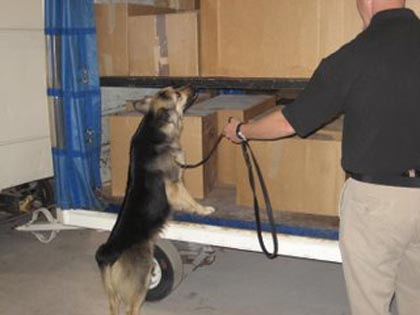
They include using explosives detection systems,
bomb-sniffing dogs and privately operated cargo screening facilities.
TSA says that it has worked with industry to
establish facilities in 18 cities across the country where cargo can be screened.
But a look around the markets reveals that in
Houston, Texas only six companies have been certified as cargo screeners out
of 900 doing business in air cargo there.
The Houston Chronicle reported that
Atlas Freight Systems, one of the six, is meeting the new regulations and
is considering expanding the cargo screening beyond just Houston.
“The new rules are a paradigm shift for
our industry,” Mike Middleton of Atlas Freight said.
“Those that are late to the table stand
a chance to lose a lot.”
Elsewhere Continental Airlines said it has worked
closely with TSA and the industry to develop standards and to train staff.
“We are well-prepared and complying with
the new rules and will continue to invest in advanced screening technology
and training to meet every security need,” the airline said.
It’s worth noting that a main driver adding
to the complexity of this mandate is the phased approach that in fact has
left an enormous amount of interpretation amongst almost every group in air
cargo in exacting how to achieve compliance.
“That problem will become a mute point
when the law on August 3, 2010 limits any further interpretation.” Mr.
Holler notes.
“One-hundred percent, is one-hundred percent,
period.”
Still many questions have surfaced when it comes
to interpretation of the new regulations and it is evident that the interpretation
of which is 'right', is what one wants to hear.
Mr. Holler thinks that time and a bit of open
dialogue of acknowledged best practices will serve air cargo during the time
leading up to 100% next year.
“Once TSA inspectors in the field commence
compliance audits for the protocols, we expect these interpretations to reduce
drastically.
“Lufthansa Cargo remains confident that
our security and operational measures initiated as part of this mandate are
implemented in the full spirit of the law and the U.S. Congressional intent.
“We are engaged with TSA daily on the
protocols we have initiated in the field and will continue to address concerns
where the regulations may impact operations.”
As TSA 50% takes hold it is tough to get air
cargo people up to their ears in a down business climate and also involved
in running as fast as they can toward compliance, to say much.
For his part Mr. Holler seems to have the big
picture in sight.
Last year Lufthansa Cargo stood alone amongst
all airlines—international and domestic, and even organized air cargo
by spending the time, effort and money to host a one-day air cargo security
conference at a hotel near John F. Kennedy Airport in New York that was packed
to the rafters with industry stakeholders and panels of experts discussing
the very changes taking place this week.
“It should be clearly understood that
the new TSA Security regulations change how the air cargo business is conducted.
“From a business perspective, impact is
not from actual screening itself but from the way cargo is transported within
the system in order to be screened effectively.”
So as we close the first week of the next big
thing in USA air cargo and beyond with one mandate in effect and a 100% mandate
on the horizon, there is no silver bullet, non-restrictive bulk level screening
available on the open market. For those that may consider the industry business
as usual, they may want to discuss the regulation with their TSA industry
 representative.
“Lufthansa Cargo will continue to invest
in security even in these difficult economic times,” Klaus Holler insists.
“Future plans include additional equipment, facility and resource investments
in the area of security.
“This investment is for our customers,
employees and operational integrity.”
Describing the August 2010 mandate for screening
palletized cargo as “ a burden on industry," Asa Hutchinson, (left)
chairman of the Safe Commerce Coalition said the exact cost of the 2010 mandate
is hard to predict because it could include higher consumer prices, flight
delays or lost business opportunities.
Mr. Hutchinson also questioned how foreign governments
and foreign air carriers will react to the mandate.
Hutchinson, who served as the first Homeland
Security undersecretary for border and transportation security, did not express
optimism that the government would "pick up the burden." But he
called the 100 percent cargo screening mandate "a burden being placed
on an industry that is struggling."
 Elsewhere
unintended consequences and market forces may have created a loophole of sorts.
Elsewhere
unintended consequences and market forces may have created a loophole of sorts.
In a free fall economic atmosphere where lift
abounds and every delay and penny of cost counts as never before, there is
speculation that some U.S. flags having achieved 100% narrow body screening
last October, may now be able to use that 100% in figuring 50% average TSA
compliance.
The advantage of sidestepping delay and cost
of screening international traffic as prescribed in the newly enacted TSA
mandate as compared to foreign flags serving the USA market could be considerable
as international flag competitors must screen a hard 50% of all their belly
cargo.
Wondering about that, we wrote to American,
United and Delta Cargo wondering how much of their international cargo is
screened in the new mandate?
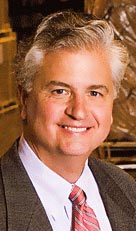
American Cargo President Dave Brooks (left)
noted:
“Because we're restricted by the TSA as
to what we can say about security, all I can tell you is that we're compliant
with TSA rules and regulations here at AA Cargo.”
Likewise a security gag rule we suppose would
not allow Delta Cargo a detailed response.
 But
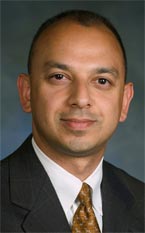
DL Cargo President Neel Shah (right) did advance:
But
DL Cargo President Neel Shah (right) did advance:
“I cannot comment on any details but I
can say that we are screening well in excess of 50% of all cargo tendered
to Delta Air Lines.”
Much of the same from United Airlines Cargo
as Scott Dolan President Cargo (left) replies:
"We are in compliance with Change 5 of
the AOSSP (TSA Aircraft Owners Standard Security Practice outlined in 2005),
and we are screening international freight from U.S. origins in compliance
with the AOSSP.”
Duh what?
To be fair—in a highly charged regulatory
downdraft (not to mention DOJ and other law enforcement hiding in the bushes
ready to slap fines) we appreciate that these airline cargo executives respond
to any questions these days, best as they can.
Dialogue, whatever you think of what is said,
means people are talking and that can’t be bad.
Geoffrey

 Regulatory
Authority (AERA), the agency charged with building an airport business
model based on fair play for India.
Regulatory
Authority (AERA), the agency charged with building an airport business
model based on fair play for India. Patel, according to sources in the Civil Aviation
Ministry, likes former Air India boss V Thulasidas (left). However,
Thulasidas, one of the senior most aviation bureaucrats in the country,
is believed to have said that he is not interested.
Patel, according to sources in the Civil Aviation
Ministry, likes former Air India boss V Thulasidas (left). However,
Thulasidas, one of the senior most aviation bureaucrats in the country,
is believed to have said that he is not interested.New Delhi Funding Construction
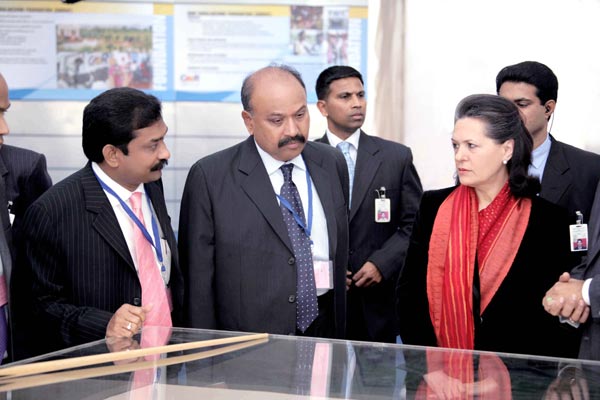
Casting aside business slow down
fears, the operator of the International Airport at New Delhi said it is going
ahead with its plans to expand cargo facilities.
This, despite the financial crunch faced by
the GMR Group, which has the responsibility of operating the Delhi
International Airport Limited (DIAL).
About a month ago, DIAL had sent out a distress
call to the Ministry of Civil Aviation that the modernization work at the
airport would have to be stopped by the middle of February this year if it
could not raise funds.
That modernization and upgrading of the Delhi
airport, that began in 2006 by the GMR-led consortium, is expected to cost
a whopping Rs 9,000 crore.
Between July and November last year, Delhi experienced
domestic passenger traffic dropping 16 percent and international traffic by
2 percent.
Apparently the world financial crises hurdle
has not deterred those looking after air cargo infrastructure at DIAL.
In fact, the planned modernization and upgradation
process has been expanded to now include creation of the second cargo terminal.
Request for proposals (RFP) notices for the
construction of that second cargo terminal have been sent out.
The RFPs are basically aimed at those with experience
in the cargo handling business to come forward with proposals on the design,
the development and the finances to build and operate the new terminal for
a 25-year concession period.
DIAL has also asked for separate proposals to
upgrade the present cargo terminal.
The last date to submit the bids is February
16.
The second terminal would have an area of more
than 70,000 square meters.
It would have state-of-the-art handling and
processing facilities and will, according to projections, handle a million
tons of cargo a year.
The present terminal spans over 70,000 square
meters and handled 4,00,000 metric tons of cargo last year.
The growth in air cargo from Delhi airport has
been 10 percent annually for the last four years.
Tirthankar Ghosh