



|
|
|
| |
||
|
||
 |
|
Vol. 8 No. 84 WE COVER THE WORLD Monday August 10, 2009  |

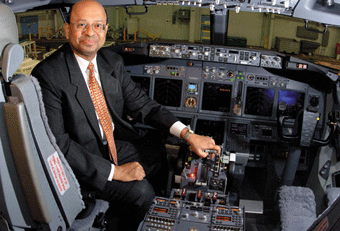 Boeing,
despite the continuing downturn and reports that aircraft are being parked
and airlines are bleeding cash, continues to remain bullish on India.
Boeing,
despite the continuing downturn and reports that aircraft are being parked
and airlines are bleeding cash, continues to remain bullish on India.
In the current market outlook unveiled recently
by its Senior Vice President, Boeing Commercial Airplanes, Dr. Dinesh Keskar—who
has since been posted (upped) to New Delhi as President, Boeing India—the
aircraft manufacturer sees a quicker market recovery in the country’s
aviation industry fortunes than elsewhere.
Dr. Keskar said that over the next 20 years,
the Indian market would require 1,000 commercial jets, valued at approximately
$100 billion–a market that represents over 3 percent of Boeing Commercial
Airplanes’ market worldwide.
Despite all the current gloom and doom—India,
he said, remains one of the strongest growing economies in the world.
The good news, Dr. Keskar said, was the record
growth in air travel, which expanded rapidly in the last eight years due to
liberalization and favorable economic environment and was now going back to
the high levels of 2007 after the recent downturn.
“There is strength and resilience in the
Indian commercial aviation sector over the long term, and the potential for
future growth of air travel, both domestically and internationally, is among
the greatest in the world, and Boeing will continue its efforts to be India’s
preferred partner and aerospace provider,” said Keskar.
“If you take a realistic and broad look
at the India market, what resonates is that there is more positive than negative,
and the prospect for continued long-term growth remains high,” he added.
Even though Keskar was very measured in his
response, the fact that Boeing’s market outlook painted a fairly positive
picture has not been lost.
In this context, he said the June 2009 traffic
data showed that the bottoming out was virtually over and there could be a
pace towards recovery.
Dr. Keskar did not specifically mention the
number of freighters that would be needed in India but his optimistic forecast
saw a reflection in a recent analysis of the Indian Air Cargo Market from
Frost & Sullivan.
The analysis is part of the Aerospace Growth
Partnership Service program, which also includes research in the following
markets: Indian Air Cargo Market, Indian Commercial MRO Market, and Indian
Airport Infrastructure Market. According to the report, the total air cargo
(domestic and international) was about 1.77 million tons in 2007-08 and was
expected to grow at a compound annual growth rate of about 8.3 percent by
2013.
The analysis mentioned that Indian air cargo
had remained at negligible levels, in comparison to the global standard, due
to various factors such as cost, type of cargo and infrastructure.
All this was set to change in the next three
to four years with the Indian economy on a growth path and the liberalization
of the aviation sector. India, the analysis pointed out, was set to emerge
as a cargo hub, due to its geographic location between SE Asia and EU nations.
According to the analysts, the Indian market
is likely to receive a boost with more foreign participation and the government
opening the gates for up to 74 percent stake in Indian cargo airlines.
This along with the liberalization moves would
encourage investments in the air cargo industry and facilitate the setting
up of the necessary infrastructure. It will also help establish multi modal
cargo hubs for quick and efficient transportation of cargo.
The analysis advises that those wanting to invest
in the Indian air cargo market would need to focus on establishing integrated
air cargo complexes, including warehouse, and storage facilities across the
country.
They would need to work towards ensuring improved
aviation facilities for cargo handling and increasing the number of freighter
aircraft in India.
The aircraft would be needed when the country’s
dependence on the three key international gateway airports—Mumbai, Delhi,
and Chennai—move away to the new Greenfield airports at Bangalore and
Hyderabad and the proposed air cargo hub at Nagpur. Though
international air cargo traffic was much higher than domestic traffic, the
latter offered greater potential for Indian investors.
This would be the segment to watch out for,
given the current robust growth in the secondary towns and the need for increased
connectivity for cargo movement between these towns to the main cargo hubs.
Tirthankar Ghosh
|
August 9:
All-electric medium-duty commercial truck set for USA production in
September will be pressed into general use by year end.
August 9: JAL lost a billion dollars during the April June quarter and is about to suspend or slash 10 international routes-cut domestic flights on six routes axing 10 others
|
|
|||||||
Key To Our Heart
Geoffrey Arend II
and Zooey Deschanel stars of the movie "500 Days Of Summer"
in national USA release right now were presented the Key to Los Angeles
last Friday Aug 7. |
||||||||
|
 Air
Cargo News FlyingTypers leads the way again as the world’s first
air cargo publication to connect the industry to the broadly expanding
and interactive base for social commentary—Twitter.
Air
Cargo News FlyingTypers leads the way again as the world’s first
air cargo publication to connect the industry to the broadly expanding
and interactive base for social commentary—Twitter.
 .
. August
7: Air India Express opens low-cost
domestic operations from mid-September to 24 cities via161weeklies.
August
7: Air India Express opens low-cost
domestic operations from mid-September to 24 cities via161weeklies.
 August
7: Saying he is not happy with his
performance after numbers slipped, Finnair President and CEO Jukka
Hienonen resigned on Friday giving six months notice.
August
7: Saying he is not happy with his
performance after numbers slipped, Finnair President and CEO Jukka
Hienonen resigned on Friday giving six months notice. August
7: Turkish Airlines opens Jakarta
in September and flights to Manila and Ho Chi Minh City via Bangkok,
in 2011; gets 19 new aircraft (2011/2012) Of 132 aircraft, 49 are
long-haul.
August
7: Turkish Airlines opens Jakarta
in September and flights to Manila and Ho Chi Minh City via Bangkok,
in 2011; gets 19 new aircraft (2011/2012) Of 132 aircraft, 49 are
long-haul.





 Contact!
Talk To Geoffrey
Contact!
Talk To Geoffrey