
Fifth In A Series
Here we continue our exclusive wider
view of the world we operate in and what that means to air cargo.
In case you missed the first installment
of the series—just
click here. For the second installment, just
click here. For the third installment
just click here. For the fourth installment click
here.
Gordon Feller, who’s been watching
and worrying about Asian cargo in particular and industry developments
in general for more than 25 years, has created this MegaTrends
series exclusively for Air Cargo News FlyingTypers.
Gordon did his formal academic training
at Columbia University in New York City, where he was a Wallach
Fellow and a Lehman Fellow, and completed graduate work in international
affairs.
But as he likes to say—his real-world
training has come from the "school of hard knocks. "
Gordon Feller has written analysis and
commentary for the FT of London, Reuters, Thomson, Informa, Journal
of Commerce, McGraw Hill—and many others.
We welcome your comments and suggestions.
Geoffrey

IT Tech Innovates
Future
Technology developments
in the past few decades have significantly transformed the way
people live and communicate, and the way businesses operate across
the globe.
Of the 6.5 billion people in the
world, about one half have mobile phones and almost a quarter
have internet access. Arguably, the pace of change continues to
accelerate.
The ubiquity of the internet and
mobile communications, the massive available processing power,
and the almost unlimited bandwidth and data storage are creating
applications and opportunities that were unthinkable 5 or 10 years
ago. The cost of devices has tumbled with advances in silicon
technology, and their usability has risen significantly with advances
in miniaturization.
Portable communication and information
devices have become a convenient and affordable day-to-day reality
for millions. Information is now available to almost anyone, anywhere
at anytime — and, as Web 2.0 becomes ever more common, almost
everybody can contribute.
Digitalization and technology go
far beyond the consumer.
Businesses have adopted digital
technologies to improve their productivity, to develop new products
and services and, in some cases, to create new business models
that have transformed major industries (e.g., Google’s search
technology revolutionized online advertising and had a huge knock-on
effect on old media). Technology also drives convergence across
industries: the computing, entertainment and telecommunications
industries have converged with the launch of the Apple iPhone,
and healthcare and energy (among others) find common ground in
nanotechnology.
Business knows that technology will
drive profitability (in fact, 68% of global executives in a McKinsey
study believed a faster pace of technological innovation would
have a positive or very positive impact on profitability) —
their question is how best to realize this gain. Realizing cost
efficiencies — through a reduction in labor and effort,
an increase in automation, and computerized inventory control,
for example — is one of the early-adopted and obvious gains,
but there are far more sophisticated trends playing out.
One of these is analytics –
a new wave of sophisticated computing and mathematical techniques
and tools being embraced by mainstream business.
Seen by some as the new frontier
in decision science, it is attracting large business and intellectual
investments (including software vendors, university research and
business books). Analytics has proven a powerful tool for many
companies: Capital One, the U.S. credit card company, pioneered
its use, running hundreds of experiments every day to understand
the effects on their customers of, for instance, changes to interest
rates or minimum balances; using this data the company claims
to have ultimately driven down the cost of acquiring new customers
for their savings business by 83% and increased customer retention
by 87%.
Many industry sectors (e.g., financial
services, health care and airlines) and fields (e.g., risk management,
price optimization and financial analysis) have widely adopted
the use of analytics. Despite considerable progress in the past
few years, analytics is still a nascent category with a promising
future.
The trend is fuelled by the increasing
digitalization of information, ever faster and cheaper computing,
the explosion of online networks and data collection, the use
of new tools for analyzing unstructured data (e.g., text, audio,
video), and new approaches (e.g., neural networks, artificial
intelligence).
A global platform
New technologies have also created
a global collaboration platform that eliminates barriers of geography,
distance and time. Companies are embracing new organizational
models and are becoming globally distributed by selectively choosing
the location of their corporate functions (e.g., headquarters,
R&D, production, call centers) based on almost any criteria
but proximate physical locality.
Technology has been a formidable
driver of growth for preferred offshoring locations such as India
and Eastern European countries.
Emerging countries have also played
a more prominent role in the development and diffusion of new
technologies as their businesses and consumers pass by older technology:
there are more mobile phones in India than landlines and moves
to bring cheap computers to Africa have focused primarily on wireless
and laptop technology, bypassing PCs entirely.
Most experts believe we are only
at the early stage of the digital technology revolution.
As technology gets more open-sourced,
and emerging countries contribute to innovation to a greater extent,
the scale of innovation will increase.
The impacts and uses of software
as a service are only just beginning to be understood.
Cloud computing and virtualization
— broadly, technologies enabling users to obtain their computer
resources (processing, storage, software) virtually, and pay only
for what they use — are likely to transform the IT industry.
They will allow organizations to
substantially reduce the amount of physical devices that are needed
for computing functions.
In turn, this will advance the green
IT agenda, reduce the need for packaged software and allow start-ups
(and others) to right-size their server capacity almost instantly
without great infrastructure investment, facilitating the success
of many innovative new ideas and businesses.
In response to this new computing
model, risk management and data security are also likely to evolve
as organizations try to limit their data vulnerability.
The astonishing pace and increasingly
global nature of change creates opportunities, but also risks
for technology players.
The route to market may be easier
for new entrants in an era of impressive and often cheap technology,
but with so many players, it takes something truly innovative
and sustainable to win.
Gordon Feller
|







 When
Dutch freighter specialist Martinair Cargo landed a Boeing 747-400
ERF in Chennai on July 2 for the first time, it was not an easy decision
– especially during a slowdown. But as Harm Winkeler (Vice President,
Asia Pacific) of Martinair Cargo put it, “we take pride in calling
ourselves the ‘Can Do Crew’ and with good reason."
When
Dutch freighter specialist Martinair Cargo landed a Boeing 747-400
ERF in Chennai on July 2 for the first time, it was not an easy decision
– especially during a slowdown. But as Harm Winkeler (Vice President,
Asia Pacific) of Martinair Cargo put it, “we take pride in calling
ourselves the ‘Can Do Crew’ and with good reason."

 In
USA Con-way Freight said Dale Duncan is Grand Champion at the 72nd Annual
American Trucking Association’s National Truck Driving Championships,
held in Pittsburgh August 18-22.
In
USA Con-way Freight said Dale Duncan is Grand Champion at the 72nd Annual
American Trucking Association’s National Truck Driving Championships,
held in Pittsburgh August 18-22.



 Air
Cargo News FlyingTypers leads the way again as the world’s first
air cargo publication to connect the industry to the broadly expanding
and interactive base for social commentary—Twitter.
Air
Cargo News FlyingTypers leads the way again as the world’s first
air cargo publication to connect the industry to the broadly expanding
and interactive base for social commentary—Twitter. August
26: During the summer of "Staycations"
AirFest ’09 on the UPS ramp at Rockford, Illinois drew 160,000
as A380, F22s and exotic aircraft ruled.
August
26: During the summer of "Staycations"
AirFest ’09 on the UPS ramp at Rockford, Illinois drew 160,000
as A380, F22s and exotic aircraft ruled. August
25: “Latin American carriers
out performing the market" (passenger, -4.7%; cargo, -14.2%) IATA
DG & CEO Giovanni Bisignani in Buenos Aires.
August
25: “Latin American carriers
out performing the market" (passenger, -4.7%; cargo, -14.2%) IATA
DG & CEO Giovanni Bisignani in Buenos Aires.

 August
23: Lufthansa readies Oktoberfest with
crew in traditional dress including stylized dirndls in navy blue and
yellow (of course).
August
23: Lufthansa readies Oktoberfest with
crew in traditional dress including stylized dirndls in navy blue and
yellow (of course). August
22: Q2 USA trucking company failures
were 370 vs 970 recorded a year earlier but bankruptcy improvement isn't
better, analysts warn.
August
22: Q2 USA trucking company failures
were 370 vs 970 recorded a year earlier but bankruptcy improvement isn't
better, analysts warn. 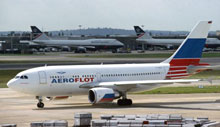 August
21: Oil rich Russia to privatize Aeroflot
& form another airline to foster competition. Putin maintains 75%
control of aircraft building.
August
21: Oil rich Russia to privatize Aeroflot
& form another airline to foster competition. Putin maintains 75%
control of aircraft building. Contact!
Talk To Geoffrey
Contact!
Talk To Geoffrey