


|
|
|
| |
||
|
||
 |
|
Vol. 7 No. 98 WE COVER THE WORLD Friday September 5, 2008  |
IATA said that passenger traffic
on international markets showed clear signs in July of being damaged by the
deepening economic weakness becoming evident now in Europe and elsewhere.
Growth slowed to a 5-year low of just 1.9%
in July, following first half growth close to trend at 5.4% and growth of 7.4%
in 2007.
IATA also said that air cargo weakened to
a much greater extent than passenger markets in July with a -1.9% decline, the
second consecutive month of market shrinkage.
“This partly reflects temporary losses
for Chinese airlines as a knock-on effect of the visa restrictions.
“However, it also suggests world trade
is slowing sharply as economic weakness widens.”
IATA is now forecasting net losses will
total $5.2 billion this year and that a further $4.1bn will be lost in 2009.
Other points brought forward include:
*
Oil prices have fallen back from $147/b peak but expected to stay relatively
high at $113/b this year and $110/b in 2009.
*
Fuel bill will rise to $186bn (36% opex) this year and $223bn (40% opex) in
2009.
*
Oil prices down because economic growth outlook much weaker, particularly for
2009.
*
Costs are not as high as feared in previous forecast, but downside is that traffic
and revenues are weaker.
*
Traffic growth revised down significantly from 3.9% to 2.8% this year and 4.5%
to 2.9% in 2009.
*
Airlines responding by restructuring which will cut U.S. capacity 3.4% and limit
global capacity growth to 2.2% in 2009.
*
But weaker economic environment and relatively high oil prices limit reduction
of losses in 2009 to $4.1bn.
“Spot oil prices fell back $30 a barrel
from their peak of $147/b in July, as part of the futures market-driven
bubble generated in May-July was deflated by profit-taking and growing concern
about economic weakness.
“The much weaker economic outlook has led
to a fall in all commodity prices and few now expect oil prices to return to
July peaks over the next 18 months.
“Some major forecasters are now projecting
oil prices at $91- 94/b in 2009.
“Oil futures markets have fallen from 2009
prices of over $140/b to around $120/b.
“Our oil price forecast, based on a consensus
of experts, is $110/b for 2009 following an average of $113/b this year.
“The price of oil is still very high, implying
jet fuel prices of $136/b in 2009. “Moreover, hedging will offer less
protection.
“As a result the fuel bill is forecast
to rise to $186 billion or 36% of operating costs this year, but then further
to $223 billion or 40% of operating costs in 2009.
“IATA also notes that profitability deteriorated
dramatically in the first half of 2008.
“Results from a sample of 28 major airlines
show operating profits have fallen from $7.6 billion in the first half of 2007
to $2.3 billion in the first half of this year.
“The decline of net profits has been even
sharper with losses of $2.7 billion in the first half of 2008.
“The largest deterioration, with net losses
so far this year of $2.5 billion, has been for U.S. airlines.
“The U.S. industry has been sharply squeezed
from rising fuel costs and shrinking domestic markets.
“Relatively low hedging levels left airlines
fully exposed to the rise in dollar fuel prices, while the collapse to 28 year
lows in U.S. consumer confidence led to a fall in travel on domestic markets.
“The deterioration of operating profits
has not been as severe for airlines in other regions.
“During the first half of the year hedging
and U.S. dollar weakness provided some offset to the rise in fuel prices.
“Moreover, economic growth started the
year strongly in Europe and Asia.
“That growth is now slowing sharply and,
although fuel prices have fallen, hedging levels are diminishing and the U.S.
dollar is strengthening.
“Results so far are consistent with our
new forecast for industry net losses this year of $5.2 billion.”
|
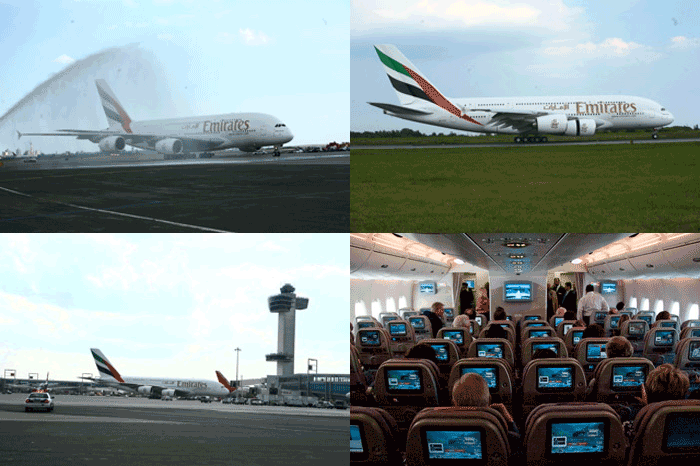
It has been about a month
now but the sight of the A380 arriving several times a week from Dubai
and landing right down the slot at John F. Kennedy International Airport
in New York City still stops most other activity as the giant comes
and goes. |
 Talk
about an end-to-end attitude adjustment, the Emirates experience by any
measure is something else! Talk
about an end-to-end attitude adjustment, the Emirates experience by any
measure is something else!But it is the A380 both as an experience as mentioned to watch from the ground and enjoy from aloft that makes flying fun again. The world's biggest jetliner brings back the golden era of air travel that once or maybe never was. No other airplane in the world can fly you New York-Dubai roundtrip with the hot showers, massaging chairs, 1,000 channels and seven-course meals served on china and linen and a bar with a waterfall. But if you might think what about coach consider greater comfort than anyplace else aloft with personal 9-inch TV and 500 channels, plus plenty of overhead luggage space and even gyroscopic cup holders. Emirates said, that it is adding service from Dubai to San Francisco and Los Angeles by the end of the year. Nice. Geoffrey |
If you have cargo bound for Belgorod,
Beloyarsky, Vologda, Ingushetia, Kaliningrad, Kirov,Kursk, Mirny, Nalchik,
Neryungri, Noyabrsk, Nyagan, Polyarny, Stavropol, Sovietsky, Surgut, Syktyvkar,
Tyumen, Ulyanovsk, Usinsk, Ukhta, Khanty-Mansysk or Cherepovets have we got
an airline for you!
Once upon a time going to Siberia was a tough
trip.
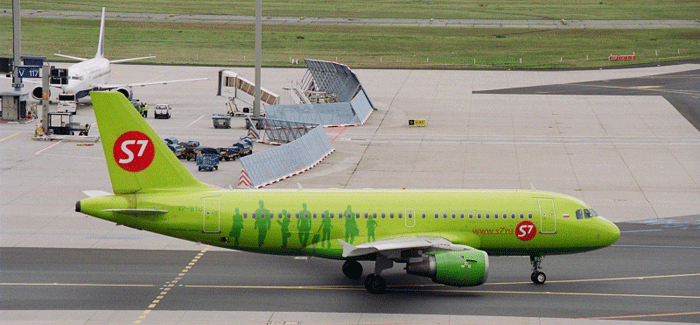
Last month as Sibar Airlines or S7 as the number
two Russian airline is now called, bellied up to the table whilst making an
overture for a stake in Austrian Airlines, the carrier came into world view.
Sibir Airlines is the descendant of Aeroflot’s
largest regional subsidiary set up in Tolmachevo, Novosibirsk in 1957. Its
first passenger flights were between Novosibirsk and Moscow with Tu-104s.
In May 1992 a state-run enterprise called Sibir
Airlines, based at Tolmachevo airport, was created by the decree of the Russian
Ministry of Transport. In August 1994, Sibir Airlines received its international
IATA code, S7, and in 2001 it became an active member of the International
Air Transport Association.
Since 1998, the company has been growing rapidly.
Since 2002, Sibir has been Russia’s leading
domestic carrier.
Today S7 is one of the world’s 50 biggest
domestic airlines, and one of the top 100 in terms of key performance indicators.
Last year the company conducted over 40,000
flights, carrying 4,900,000 passengers and more than 28,000 tons of cargo
and post to every major city in Russia and the rest of the CIS.
S7 operates scheduled flights to Europe and
countries in the Asia-Pacific region, as well as charter flights to 20 countries
around the world.
S7 aircraft include Airbus À319 and A310s,
Boeing 737s, Tupolev Tu-154Ìs and Ilyushin Il-86s.
More: www.s7.ru.