



|
|
|
| |
||
|
||
 |
|
Vol. 8 No. 16 WE COVER THE WORLD Monday February 9, 2009  |
 Just
when you thought the paperwork jungle in air cargo was beginning to see the
value of the digital communications era, came that TSA mandate for USA air
cargo that demands 50% screening compliance enacted in early February as preamble
some think for a more draconian date with 100% screening ramping up in a little
over a year and half down the road.
Just
when you thought the paperwork jungle in air cargo was beginning to see the
value of the digital communications era, came that TSA mandate for USA air
cargo that demands 50% screening compliance enacted in early February as preamble
some think for a more draconian date with 100% screening ramping up in a little
over a year and half down the road.
We spoke to a well respected senior industry
consultant who isn’t so sure that stakeholders both inside and outside
and, depending on the air cargo industry are not in for a rough ride from
this point forward.
“There seems to be more developing
as we speak, things we either did not know but should know, or attorneys making
things up which is not good for any shipper in this country,” says Albert
Saphir.
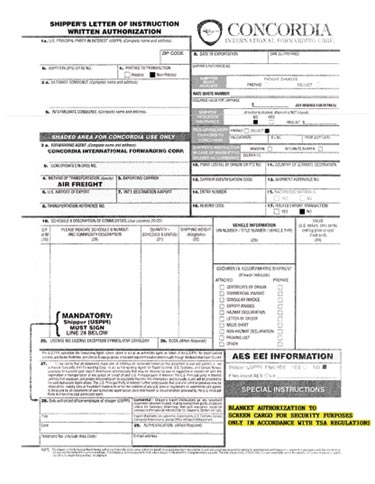
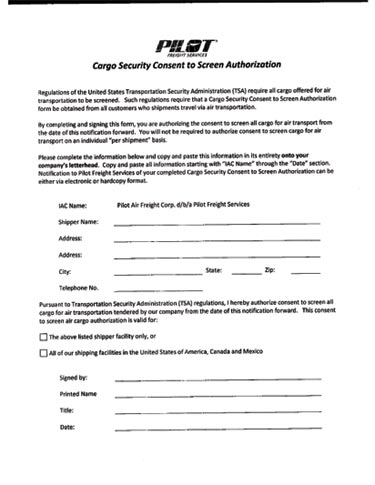
“Here are two sample authorization
forms that shippers received last week from air freight forwarders.
“No one had seen anything like this
from TSA before or knew it was coming.
“Nothing like this was mentioned
by TSA at any of the meetings I attended, so you can think that this comes
as a complete surprise to shippers in this country, if indeed it is accurate.
“We can only wonder what is going
on?
“Has TSA required any such authorizations?
“Or are some lawyers going crazy.”
|
Albert Saphir is a consultant with 30
years of management experience in international air and ocean freight forwarding,
domestic and international transportation management, domestic and international
parcel shipping and benchmarking, logistics and supply chain analysis, trade
compliance and customs security compliance.
He has worked in sales and operations
management positions for multi-national logistics and regional companies during
his career in freight forwarding in Germany and the U.S.
For over 10 years now, he has been an
independent logistics, transportation and trade compliance consultant for
domestic and international manufacturers, distributors, importers, exporters
and global transportation companies.
His work focuses on transportation negotiations
and procurement, value analysis, freight and audit/billing management for
all modes of domestic or international transport.
Combined with his services for customs
and trade compliance, including complete C-TPAT and ISF 10+2 (Importer Security
Filing) program developments, he strives to offer “Supply Chain Harmony
– Logistics and Trade Compliance Synchronized for Optimal Performance”
to his customers.
“The point is that these forms could
open a whole lot of cans of worms.
“If indeed TSA needs such a form,
it has to be made public by the TSA and also it needs to be determined who
should sign them.”
“The Pilot Form seems professionally
written; sounding very official using the wording ‘Cargo Security Consent
to Screening Authorization’.
“I must admit before now I had not
heard that phrase anywhere before.
“Right now every shipper should
review what is probably a forest of new forms entering the market with their
legal department before signing them.
“Who knows what can happen here?
“In my view the Concordia Form is
unfortunately misleading and inaccurate I am sorry to say!
“First of all, there is absolutely
no legal requirement for a USPPI (U.S. Principal Party of Interest) to sign
a SLI (shippers letter of instruction)!
“Also incorporating the TSA screening
authorization in the format and wording used seem out of place in my view.
“In any case it is worth pointing out
that so much of our exports are considered “export routed transactions”
per 15CFR Part 30, which really puts a whole new spin on things as the forwarder
really has no agreement with the U.S. shipper (USPPI) but rather with the
FPPI (Foreign Principal Party of Interest).
“So technically, would it not be the
FPPI who would need to sign such consent forms and be responsible for any
losses or damages as titles are transferred to them upon pick-up from the
loading dock of the U.S. supplier?”
“But just to get a sounding about
all of this I spoke to a few smaller IACs (indirect air carriers). They are
not aware of any such requirement from TSA.
“Others indicated that they had
received some instructions of similar nature from their head office but did
not know their meaning or their source.
“Come to think of it, not even the
airlines they are using are asking for anything like this. So why the need
for the IAC?
But getting TSA screening right while
leveling the playing field will take some time.
“Now we have heard today (Friday
February 6) that Lufthansa discontinued their screening fee.
“It really is an extremely competitive
business environment out there right now, air freight volumes are down dramatically.
“Airlines need to cut cost right
now, not increase it, hopefully they will make it through these times financially.
“Also, some may have difficulties
with screening, possibly purchased the wrong equipment.
“Personally I think ETD (explosion
trace device) are most practical for cargo screening, but many airlines purchased
other, even more expensive equipment and that may prove now to be more difficult
and costly to operate.
“I also feel for IACs at the many
non TSA pilot airports, they are “stuck between a rock and
a hard place”, as they are for now completely left out of the screening
program, which can put them at a significant competitive disadvantage.
“Many puzzle pieces that still need
to come together.
“I am optimistic eventually all
will work out well, but in the interim we are facing very turbulent times
here in the U.S. on the air cargo side.”
Geoffrey
 A
move that is certain to boost India's image as an atmosphere for investment,
La Poste GeoPost Group, the express parcel arm of La Poste, has been cleared
by the Indian government to buy into in express parcel delivery firm Continental
Air Express.
A
move that is certain to boost India's image as an atmosphere for investment,
La Poste GeoPost Group, the express parcel arm of La Poste, has been cleared
by the Indian government to buy into in express parcel delivery firm Continental
Air Express.
GeoPost now holds a 60 percent stake in the
privately-held Indian company. The clearance has come, however, with a restriction:
GeoPost will only deal in Business-to-Business
express parcel deliveries with each parcel weighing more than two
kilograms.
GeoPost's willingness to take a stake in the
Indian company had been rejected a number of times by India and the permission
came, according to senior officials in the Finance Ministry, came only after
an intervention from the French Ambassador to India, Jérôme Bonnafont
(right).
 The
Ambassador wrote a letter to the then Finance Minister P. Chidambaram (left,
he is now the Home Minister) asking him to personally intervene in the GeoPost
case.
The
Ambassador wrote a letter to the then Finance Minister P. Chidambaram (left,
he is now the Home Minister) asking him to personally intervene in the GeoPost
case.
The objections to the investment had come from
the agency that looks at foreign investors, the Foreign Investment Promotion
Board.
The Board had been told by the Indian Department
of Posts—which would face direct competition, if GeoPost was allowed
to operate in the country that the action would go against international postal
conventions if it came in to the country.
Indeed, the rules are clear: any postal agency,
which wants to operate in any country outside its own, must have an agreement
with the postal operator of that country.
GeoPost's stand, however, was equally clear.
It said that its operations would not pose a
challenge to India Post since it focused on the premium express parcel segment
and did not deliver letters and postal parcels or express parcels weighing
more than two kilos.
GeoPost also pointed out that there were no
objections to DHL India operations—a company owned by Germany's Deutsche
Post.
According to industry-watchers, the permission
to GeoPost could trigger a change in the India Post Office Act.
Apparently, one of the amendments to the act
seeks to limit foreign investment in express and courier companies to 49 percent
from the present 100 percent.
Now all of that is changed.
Tirthankar Ghosh
 The
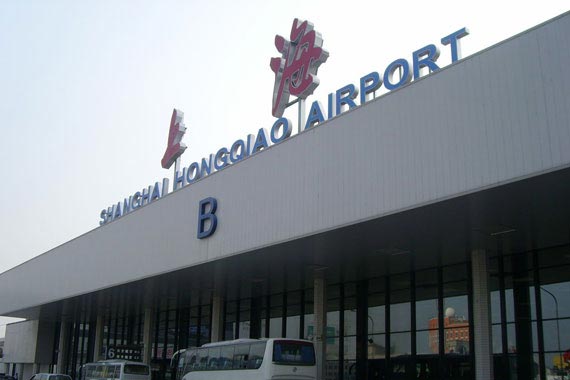
RMB15.3-billion invested expansion project of Shanghai Hongqiao Airport is
making remarkable progress, as the new terminal, key part of its expansion,
celebrated the building’s structural roof-sealing recently.
The
RMB15.3-billion invested expansion project of Shanghai Hongqiao Airport is
making remarkable progress, as the new terminal, key part of its expansion,
celebrated the building’s structural roof-sealing recently.
"Operational and technical testing is planned
to start this July or August on the new terminal and runway to prepare for
their opening around the end of next March," Hu Jianzhong, a chief project
engineer of Shanghai Rainbow Investment Corp, operator of the expansion project
told Air Cargo News FlyingTypers.
The second terminal and runway are expected
to help double the airport's current turnover of nearly 20 million passengers
a year, and expand its cargo capacity to 1 million tons from the current 0.4
million.
Besides this new terminal and runway, the government-invested
project also involves a multi-level traffic center (pictured right) connected
to the new terminal.
The traffic center includes a railway station
for future express lines from Shanghai to Beijing and Nanjing.
The land hub also incorporates five Metro lines,
two bus centers and underground parking lots.
Mr. Hu said:
“Construction of the underground waiting
hall for the express train station, a key step in the project, was mostly
completed and work would start soon on platforms and rail tracks.
“The station will be shared by future
Shanghai-Beijing and the Shanghai-Nanjing express lines.”
China is investing more in civil aviation to
stimulus the economy, building, modifying and expanding more domestic airports.
As part of the huge economy stimulus package,
China adds RMB200 billion to the planned RMB100 billion investment in civil
aviation construction for 2009.
David










 previously
announced range of US$4 billion to US$4.3 billion
. . . Air Tanzania
gets new partners and airplanes as Tanzanian government plans to sell
49% stake to China Sonangol International
which would buy 49 percent of the airline
. . . Nippon Cargo Airlines
said it plans to resume suspended flights between Tokyo
and New York although
previously
announced range of US$4 billion to US$4.3 billion
. . . Air Tanzania
gets new partners and airplanes as Tanzanian government plans to sell
49% stake to China Sonangol International
which would buy 49 percent of the airline
. . . Nippon Cargo Airlines
said it plans to resume suspended flights between Tokyo
and New York although
 the
carrier did not reveal a start up date
. . . Asiana
that lately has been one busy cargo airline in and out of JFK
in New York, elsewhere as an airline reported a net loss of 163.3 billion
Won (US$118.2 million) in the October-December period, compared with
a net profit of 19.2 billion Won a year ago
. . . Bahrain Airport
Company in a partnership with SITA
to develop information and communication technology will see the delivery
of technical integration with the existing ICT infrastructure and the
newly-developed strategic master plan at the airport
. . .
the
carrier did not reveal a start up date
. . . Asiana
that lately has been one busy cargo airline in and out of JFK
in New York, elsewhere as an airline reported a net loss of 163.3 billion
Won (US$118.2 million) in the October-December period, compared with
a net profit of 19.2 billion Won a year ago
. . . Bahrain Airport
Company in a partnership with SITA
to develop information and communication technology will see the delivery
of technical integration with the existing ICT infrastructure and the
newly-developed strategic master plan at the airport
. . .