What Drives The Shape We Are
In?
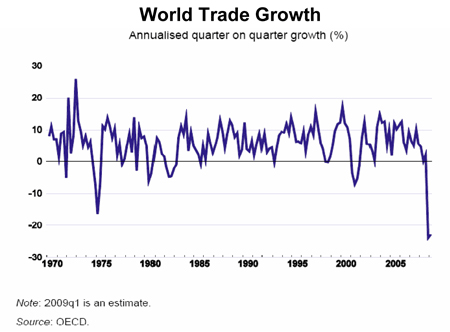 We know now that world trade 'collapsed' in the last quarter of 2008.
The Organization for Economic Cooperation and Development (OECD, says
values fell by more than 20% in annualized terms (see chart 1 right).
We know now that world trade 'collapsed' in the last quarter of 2008.
The Organization for Economic Cooperation and Development (OECD, says
values fell by more than 20% in annualized terms (see chart 1 right).
Maybe worse, the WTO is projecting a continuation
of the slump in 2009, with trade volumes falling 9% for the year, due
to three factors: the synchronized nature of the world downturn, a higher
cost of trade finance, and the effect of international supply chains.
During the 'Great Moderation' of the two
decades leading up to the global financial crisis, world trade growth
outstripped GDP growth, and buoyed the world economy.
But now the tables have turned: during
the 'Great Recession' the contraction in world trade is outstripping that
of
GDP, and worsening the recession.
The influence of international supply chains
(ISCs) on the world trade and GDP cycles is important and should not be
overlooked.
In the pre-ISC era, when most of the value
added in an export widget was created within the borders of one country,
the following would happen.
Say U.S. demand for Chinese exports fell
by $100. Then Chinese exports and GDP would each fall by $100. And world
trade would also fall by $100.
Now, in the ISC era, when U.S. demand for
Chinese exports falls by $100, Chinese exports again fall by $100.
But now goods are 'Assembled in China',
not 'Made in China'.
So Chinese exporters who are losing export
orders cut their imports of parts, components and materials fromAsian
neighbors by $95.
Result? Chinese GDP falls by $5. World
trade falls by $195.
As the 'foreign trade multiplier' takes
hold, there will of course be further rounds of export and import cuts,
and corresponding GDP cuts.
But the important point to note is: a given
collapse of world trade no longer has the same impact on world GDP as
it once did, because so much of trade nowadays consists of intermediate
goods, rather than consumer and capital goods destined to meet final demand.
 So the world trade 'collapse' is of concern, but needs to be kept in perspective.
One of the paradoxes of the current world
recession is that export-dependent economies have been suffering worse
slumps than economies at the epicenter of the financial crisis.
So far at any rate.
Why?
See the chart showing quarterly growth
rates (or in most cases, rates of contraction) for December quarter 2008.
Notice how Asia's newly industrializing
economies and many Latin American economies have entered deep slumps that
would warrant the term 'depression' if they continue.
Meanwhile, the advanced economies, many
of which suffered the biggest financial implosions, are taking it tough,
but nowhere near as tough as some of the emerging markets, which almost
completely escaped the financial crisis - even countries like Thailand,
where political risk has been escalating.
One reason seems to be the interconnectedness
of the world economy.
The crisis-hit advanced economies are de-leveraging
and cutting back their consumption and investment.
What that means is lower demand for exports,
and consequently large setbacks for export industries in emerging markets.
The result is: the day of reckoning is
at least as bad for the thrifty suppliers of export goods as for the spendthrift
customers, who have now had to tighten their belts.
Many emerging markets are feeling aggrieved
by this, arguing that they are innocent bystanders.
Still, there is reason to believe that
they will bounce back fairly quickly from their horrible fourth quarter.
The data suggest that, in response to the
cut in demand from advanced economies, emerging economies cut export production
even more severely, and ran down stocks.
Once their de-stocking is complete, they
will have to crank up production again.
Why are China, India and Indonesia managing
relatively well?
They are not as trade-dependent.
And in China especially, the government
is rolling out a big fiscal stimulus.
Perhaps the biggest surprise is the Philippines
- an open economy heavily dependent upon workers' remittances and earnings
from export industries like IT and business process outsourcing.
Despite this, it has managed to outgrow
every other economy.
The Philippines will undoubtedly suffer
further hits from the world recession this year, but does seem destined
to perform well.
G. Feller
Coming
Attraction
  Upcoming
in Air Cargo News FlyingTypers . . . ACNFT Publisher Geoffrey Arend
(left) Up Close & Personal in a new video with Leisure Cargo
Managing Director Ralf Auslaender (right) from LaGuardia Airport
in New York City. Upcoming
in Air Cargo News FlyingTypers . . . ACNFT Publisher Geoffrey Arend
(left) Up Close & Personal in a new video with Leisure Cargo
Managing Director Ralf Auslaender (right) from LaGuardia Airport
in New York City.
Beginning today June 1, Air Europa
the second largest carrier in Spain has awarded Total Cargo Management
contract to Leisure Cargo.
Now Leisure Cargo is responsible worldwide
for Air Europa sales and marketing of the carrier’s belly
cargo capacities.
The arrangement includes direct management
of worldwide cargo handling contracts, road feeder services, cargo
revenue accounting, interline relations, claims processing and settlement
as well as supply of management information data.
In a separate announcement Air Europa
launches daily service into JFK from Madrid via an A330-200 starting
today.
Stay tuned for this exclusive video
coming Wednesday June 3.
Only in Air Cargo News FlyingTypers.
|
|






 Also in attendance were executives of several
airports and carriers.
Also in attendance were executives of several
airports and carriers.  Mr.
Li Jiaxiang (left) brought good news on Chinese carriers: “China’s
stimulus package has shown positive impact on civil aviation, resulting
profits of RMB1.94 billion for domestic airlines in the first four months.”
Mr.
Li Jiaxiang (left) brought good news on Chinese carriers: “China’s
stimulus package has shown positive impact on civil aviation, resulting
profits of RMB1.94 billion for domestic airlines in the first four months.”
 “Return
Civil Aviation Government Funds collected in the second half of 2008 and
the first half of 2009 to airlines (Total RMB4.29 billion )
“Return
Civil Aviation Government Funds collected in the second half of 2008 and
the first half of 2009 to airlines (Total RMB4.29 billion ) 
 Contact!
Talk To Geoffrey
Contact!
Talk To Geoffrey Geoffrey,