|

(Exclusive Krasnoyarsk)-Punctuality,
discipline and reliability—these attributes are generally associated
with German people and their industry.
Last Thursday (June 4) this was proven once
again by Lufthansa Cargo and its maiden flight from Frankfurt via Krasnoyarsk
Airport to Osaka in Japan with 59 tons of air freight on board.
It was 11:59 am when the craft touched down
at the Siberian airport for a technical stop. ‘Exactly one minute
prior to schedule,’ nodded with satisfaction Christian Becker, the
carrier’s regional manager Russia and CIS countries.

Let ’em Eat Cake said Marie Antoinette, and the dreamers
and doers of the world have never stopped. Here as all-cargo flights began
from Krasnoyarsk came another slice of life as (left to right): Herr Ruhnau,
Minister Pashkov, KJA Airport Director Kondratiev, and Bernhard Kindelbacher
of LH Cargo celebrated the event.
The new routing is a result of a severe
political controversy between the governments in Moscow and Berlin. The
trouble began with Russia forbidding LH Cargo to cross Siberian airspace
unless the carrier would land for a stopover at either Krasnoyarsk or
Novosibirsk airport. In retaliation Germany threatened to ban Aeroflot
from its sky and territory.
This happened in fall 2007. After this eruptive
political occurrence over aviation matters both sides came slowly back
to normal and sat down together to mutually straighten things out for
a resolution to the problem. Eventually the German side agreed on transferring
Lufthansa Cargo’s operation from Astana in Kazakhstan to Krasnoyarsk
as soon as the infrastructure at the Siberian airport would be brought
up to technical standards to guarantee smooth operation even with poor
weather conditions. This has been accomplished by setting up an instrument
landing system (Cat. II) that provides precision guiding to any landing
aircraft in case of fog, heavy snowfall or hard rain.
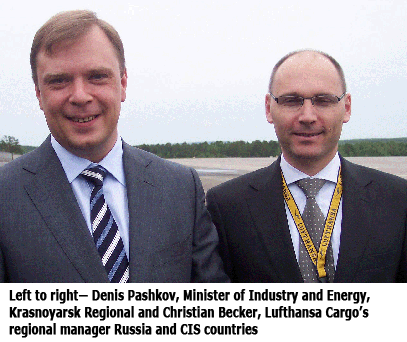
“We spent 10 million U.S. dollars
for installation of the ILS,” stated Denis Pashkov, Minister of
Industry and Energy at Krasnoyarsk’s regional government. Lufthansa
Cargo invested roughly €2.5 million euros for necessary technical
equipment at their new Siberian hub.
 There
the MD-11 freighters are only allowed to be refueled and line-haul maintained
after having touched down. Further activities are presently prohibited
due to the restrictive aviation treaty between Russia and Germany. There
the MD-11 freighters are only allowed to be refueled and line-haul maintained
after having touched down. Further activities are presently prohibited
due to the restrictive aviation treaty between Russia and Germany.
“This has to be changed to allow Lufthansa
Cargo commercial activities in addition to technical services. The carrier
should be able to unload and load shipments at Krasnoyarsk by officially
legalizing this,” claimed former Lufthansa CEO Heinz Ruhnau who
came to Krasnoyarsk in his present role as Russia representative of the
German airline. Minister Pashkov backed his initiative by announcing his
strong support for liberalizing the bilateral treaty.
Presently LH Cargo operates seven weekly
flights via the Siberian city of one million inhabitants. Commencing in
July, when Astana will not be served any longer, this will go up to as
many as 22 flights per week.
“By then we are going to deploy all
flights between Europe and Fareast via Krasnoyarsk,” announced Bernhard
Kindelbacher, Senior VP Network at LH Cargo.
“By routing our aircraft via Krasnoyarsk
we save 12 minutes in average each flight. “This saves fuel and
hence money and it diminishes air pollution because of less fuel burn,”
Herr Kindelbacher added.
According to Heinz Ruhnau, Lufthansa is
currently not eager to lure a Russian airline into the Star Alliance.
This however, is a touchy topic after their exclusive candidate Air Union
went broke. It has left Star Alliance without a local partner for interlining
passengers at Moscow or other major hubs.
According to aviation experts it is a disadvantage
compared to competing SkyTeam Alliance. SkyTeam has former Russian state
carrier Aeroflot on board. Oneworld, the other alliance has announced
that Siberia’s S7 Airline is scheduled to join their alliance soon.
“Who says we need one partner? Maybe
we’ll team up with two or three if necessary, to cover the Russian
market,” Ruhnau indicated the newest strategic vision of the Star
Alliance for playing an increasing future role at Moscow, St. Petersburg,
and Krasnoyarsk.
Heiner Siegmund
Huchler
Was Electric At CNS
 In
case you missed it FlyingTypers’ parent publication Air Cargo News
published in America since 1975 has now completed one year as the air
cargo industry’s first global virtual monthly with original content
and full- featured capability. In
case you missed it FlyingTypers’ parent publication Air Cargo News
published in America since 1975 has now completed one year as the air
cargo industry’s first global virtual monthly with original content
and full- featured capability.
In a tough world business climate here is
the most efficient, fastest way available on the planet to talk to the
entire world air cargo industry.
Our virtual electronic global air cargo
magazine format allows for turning pages, enlarging content for easy reading
and even the emailing of articles from our virtual pages to colleagues
anywhere in the world.
Here is a story created exclusively for
our recent May 2009 issue.
We invite your inquiries, comments and other
input.
ACN Digital is an American original just
like our tabloid newspaper was in 1975.
But once again leading the way in a new
century communications format, Air Cargo News looks forward to all challenges
while further serving the world air cargo audience with all new original
content every month.
Now Geoffrey Arend and Air Cargo News/FlyingTypers
is the first air cargo publication on Twitter.
If you like your news fast and short, our
daily 140 character or less update is just for you.
To be added to any of our services including
receiving FlyingTypers thrice weekly: Air Cargo News Digital monthly or
Geoffrey on Twitter Daily, write to us –Geoffrey@aircargonews.com
and your address will be added.
Please specify service you would like to
receive.
Thanks for your continued support.
Geoffrey & Sabiha Arend
 As
the 2009 version of IATA’s CNS Partnership Conference met last week
in Carlsbad, California, it seemed the respite from the economic downdraft
must have been lifted by a breeze and carried out to sea. As
the 2009 version of IATA’s CNS Partnership Conference met last week
in Carlsbad, California, it seemed the respite from the economic downdraft
must have been lifted by a breeze and carried out to sea.
Predictions were many, but no one, including
the well-esteemed keynoter former American Airlines CEO Robert Crandall
(profiled elsewhere in this issue) was sure of much outside of the fact
that air cargo, like the rest of the world, can look forward to more economic
challenges. Mr. Crandall intoned that everyone might as well develop or
continue to refine their approach to business. The ultimate goal is to
fall like felines, our business bodies twisting so that we can land feet
first when this dark economic time eases.
At CNS Partnership there were many panels
and a rich parade of well-meaning air cargo professionals who discussed
various scenarios.
The commencement of sessions discussing
Cargo 2000, CASS, E-Freight and other topics of unique common interest
drew a picture as to why this conference has become a must-attend A-list
event, along with World Cargo Symposium.
Simply put, CNS Partnership is without parallel,
and one of the best upper and middle management level annual air cargo
networking events on the planet.
Nowhere else can you meet and rub elbows
with as many top level managers of the world air cargo enterprise all
in the same place.
During CNS there were meetings and sub-panel
events that underscored the importance of the conference itself.
While CNS Partnership is a great place for
carriers and forwarders to get close, it is also a great place for conferees
to conduct their own company meetings.
So in addition to getting, say, a USA sales
team on the same page, managers can walk around and talk up ideas and
programs while measuring reactions to schemes and dreams amongst a concentration
of peers not found anywhere else.
That is exactly what happened in many cases
during May 3-5 in Carlsbad, California.
As mentioned, there were many speeches and
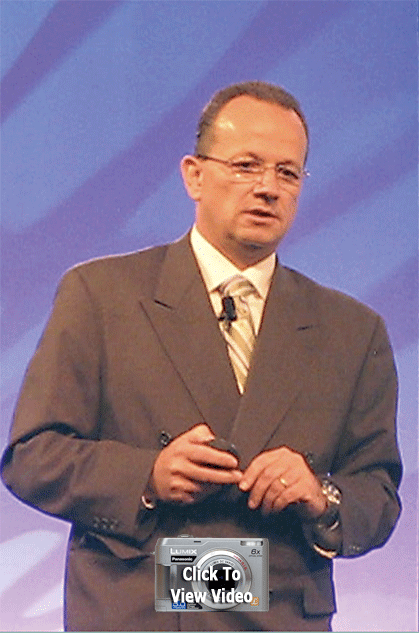
presentations, but our favorite was an early morning talk by Thomas Huchler
of EMO Trans, a midsized USA forwarder.
Mr. Huchler spent much time outlining the
needs and hopes of both EMO Trans and other smaller and larger companies
as TSA cargo security edicts tighten.
He also praised and entreated CNS to deliver
a square deal for the smaller forwarders.
But at one portion of his speech, Mr. Huchler
began to tick off some ideas that might actually be useful out of the
box for people in the audience.
“We have 26 offices as properties
that we either own or rent.
“We looked at the rented units and
went to each landlord, offering them a bit of our reality as an air cargo
business in 2009 with the idea of renegotiating our leases.
“The results were excellent.
“It may be hard to believe,”
Herr Huchler said, “but in most cases landlords would rather accept
less as a viable alternative to empty warehouses and office inventory.”
As Herr Huchler spoke (he also talked of
EMO realizing some great opportunities in Mexico), we wondered if the
import of his words was sinking in to an audience that half filled the
hall.
Glancing around the room, we noted that
very few conferees were flipping or fooling around on their cell phones
or PDA’s. A good sign, we thought.
In CNS Partnership’s deliverance of
a forum for conducting business and networking, they also provided a place
for sharing some of the best practices for advancement of air cargo.
The reaction here in a snap survey amongst
several attendees was positive uplift.
But we are still wondering if some people
from that session took the advice home and contacted their landlord to
paraphrase that ubiquitous personality from the movie “Network”:
“I’m sick and tired of paying
too much and I’m not going to take it anymore!”
It was an extraordinary moment in a year
when the best and worst of times should long be remembered.
At CNS there was also time to think about
things apparent but perhaps not always properly contemplated, a time to
see what condition your condition was in.
We were walking with Jim McKeon, the new
cargo boss at Continental Airlines. After conducting a video interview
on Tuesday, May 5 (which can be seen elsewhere in this issue) we were
trolling for lunch.
CNS had put up a Cinco de Mayo spread out
near a pool that seemed too good to miss and was, in fact.
As we walked along Jim noted some deep purple
flowers clustered in bunches that traced the length of our path and wondered
aloud what they were.
We asked some people, including employees,
if anybody knew what the flowers were called, when a thought occurred:
Here is a top executive with a huge daily
lift to business enterprise and thousands of customers and employees underneath
him.
The pressure to deliver might make it possible
for Jim to flatten the flowers like Superman with a mere glance of his
powerful vision.
But, it seems at CNS Partnership, there
is time and space for Mr. McKeon to stop and smell the flowers.
Maybe some part of what we take from CNS
Partnership 2009 should be that we all need each other, no matter how
big or small the person next to you may be.
CNS Carlsbad paid forward at a time when
air cargo needed it most.
As an industry we should try to listen and
help each other, taking time to wonder and always, discovering
. . .
Geoffrey/Flossie Arend
Color
IATA AGM Red
 "We
face a demand shock... you will see more dark red. "We
face a demand shock... you will see more dark red.
“We have probably touched the
bottom but we have not yet seen an improvement.”
As International Air Transport Association
(IATA) begins its 65th Annual General Meeting in Kuala Lumpur, Malaysia
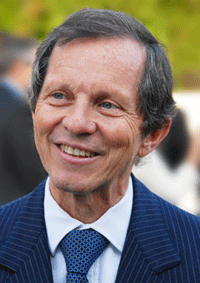
yesterday June 7, Giovanni Bisignani Director-General said airlines
are facing an 'emergency situation' and should be given greater
commercial freedom to serve global markets and consolidate.
He said 50 major airlines reported
$3.3 billion in net losses in the first quarter of 2009 alone and
that the global airline industry faces even deeper losses as weak
demand down 7.5% during the January-April period with cargo minus
22% continues.
“Full-year losses are now expected
to be 'substantially worse' than the $4.7 billion that we forecast
in March,” Mr. Bisignani said.
“It's time for the governments
to wake up.
“We do not ask for bailouts
but all we ask is, give us the same opportunity that other businesses
have,” he said.
Mr. Bisignani said he supports a bid
by American Airlines and British Airways and others to cooperate
on trans-Atlantic flights.
American Airlines wants immunity from
U.S. anti-trust laws so it can cooperate with BA, Iberia Airlines,
Finnair and Royal Jordanian on trans-Atlantic flights.
“It makes no sense that governments
should determine which markets airlines can serve.
“But we are stuck with a bilateral
system that is nearly seven decades old.
“It is time for change.
“Our Agenda for Freedom initiative
launched a year ago is working with progressive governments around
the world to affect change.
“Along with progressively freeing
up market access, we must also change the outdated ownership restrictions
that prevent airlines from consolidating across borders,”
Mr. Bisignani said.
IATA AGM continues until Tuesday June
9.
|
Patel India's
Aviation Builder
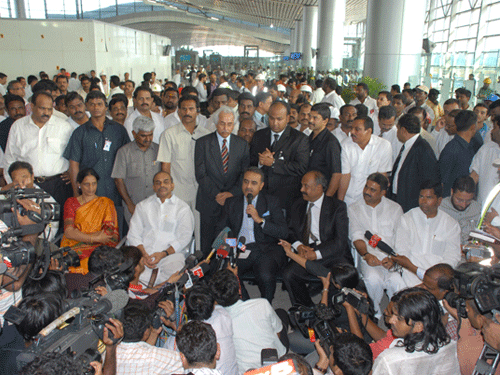 Civil Aviation Minister Praful Patel (second from right)
at the inauguration of the new International terminal building at
Jaipur Airport on February 25, 2009.
Civil Aviation Minister Praful Patel (second from right)
at the inauguration of the new International terminal building at
Jaipur Airport on February 25, 2009. |
Those India general
elections also delivered a second term to Praful Patel as Minister of
Civil Aviation.
Whether or not the reprise will be as successful
as the first go around is yet to be determined.
Mr. Patel is confronted with an industry
losing money and international shippers losing patience with airport infrastructure
that is backward to the point of exasperation.
But on the upside, what is certain here
is that the last five years have seen civil aviation growing by leaps
and bounds.
Many people here feel that much of the credit
for this unmatched period of growth goes entirely to Minister of Aviation
Praful Patel.
As he begins his second term, Praful Patel
has been rushing about from one corner of the country to another, laying
foundation stones for the modernization and upgrading of some 35 non-metro
airports.
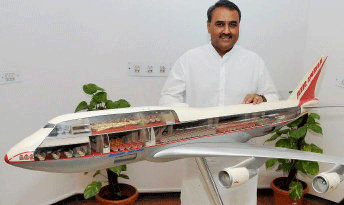
Air India is selling 11 of its Airbus A320 planes as new planes from
Boeing Co. and Airbus are delivered while adding 15 more new Airbus planes
to its fleet in the current financial year that began April 1, according
to reports.
Minister Patel emphasized that the number
of airports serving India is rising from the present 85 to around 400
in the next 10 years.
As he told Air Cargo News/Flying Typers:
“We have 500 passenger airplanes and
nearly 85 operational airports now.
When I began in 2004, we had 110 aircraft
and 45 airports.
“We need to build airports for all
of India by going into to the remotest regions so that our farmers can
look at exporting agricultural and farm-related products to the world.”
This time for India will come," he
forecast.
Five years of the Praful Patel regime in
Rajiv Gandhi Bhavan (the headquarters of the Civil Aviation Ministry)
at Delhi have changed the aviation scenario and that includes air cargo.
“Continuity with change” are
the new watchwords of Civil Aviation Ministry, says Praful Patel today
(June 8).
Three key areas in focus, Mr. Patel said
are safety in the skies, building up of more and better infrastructure
and strengthening Air India.
Patel declared that the government might
consider bringing out an initial public offer (IPO) to jack up funding
Air India but it would not be aimed at diluting the carrier’s public
sector character.
But all of what is to come can also be viewed
in what Patel has built as a record here since 2005.
Air Cargo News FlyingTypers asked
two important stakeholders in the air cargo business for an impartial
assessment of the Praful Patel years.
A freight forwarder of repute, the Mumbai-based
Raajeev Bhatnagar of UTi Worldwide is all praise for Minister Patel’s
role in promoting the growth of the air cargo industry.
He said that India has indeed come along
way since independence.
“We are almost in the 19th year of
the post-liberalisation era.
“India has had a great run through
these 19 years, and almost every sector has seen growth,” he said.
It is only in the last few years that the
country’s skies have opened up, with Praful Patel spearheading a
bulk of the change.
“He has done a lot, and we think that
under the given circumstances (a multi-party government), what he has
accomplished is no mean stuff.” Bhatnagar
specifically mentioned cargo and said that Minister Patel is the first
Civil Aviation Minister who understood cargo, and its role and importance
in the aviation business.
“He was the first to recognize the
importance of airport infrastructure and steered privatization.
“We have seen the benefits of it,
and through his efforts I think he has set a tone for what one can expect
for the future.”
Bhatnagar, however, has a grouse.
“How could a minister as understanding
and appreciative as Praful Patel miss to provide industry status to the
cargo business, or bring cargo under the aviation umbrella.
Unfortunately, even today, it is slightly
unclear as to where the freight forwarders belong,” he said.
The express industry too has found the Praful
Patel years beneficial.
Said Anil Khanna, Managing Director, Blue
Dart:
“Air cargo and, in particular air
express distribution, is a barometer of industry and economic health.
“In more mature economies, where air
transportation is the prime mover of high-value goods, there is a co-relation
between air cargo and GDP growths, with air cargo growing at approximately
a multiple of 2.3 times GDP.
“This is not the case with India,
because of the lack of focus on the sector.”
“The lack of focus has resulted in
negligible growth of infrastructure.
“Despite the slow growth, Khanna said,
“we are glad that the government has realised the potential of the
cargo industry in India and taken up the issue of infrastructural challenges
seriously.
“The government has robust plans in
place, which would enable us overcome bottlenecks while providing cargo
stakeholders greater opportunity to facilitate trade and commerce in the
country.”
He was, however, quick to point out that
despite Praful Patel’s pro-active approach, challenges remain and
much work lies ahead for the Minister’s second go around.
“Infrastructure, both air and surface,
continues to be the main hurdle for our sector.
“We are constrained by the sizes of
the facilities at the airports, as they have remained the same while our
loads have increased fivefold.
“In addition, parking bays, airside/city
side access and traffic congestion adversely impact costs, as well as
service quality. Volatility of fuel prices is also a concern.
“The government also needs to address
cumbersome customs clearance procedures,” Mr.Khanna said.
Praful Patel never at a loss, seemingly
is ready with his eyes fixed firmly on the prize.
“The time of one airport for a region
is gone.
“Now we have to look at a situation
where one airport will have to compete with another for business.”
Ready or not the next chapter for India
commercial aviation just took off.
Geoffrey/TG
|