| 
 Afghanistan-licensed
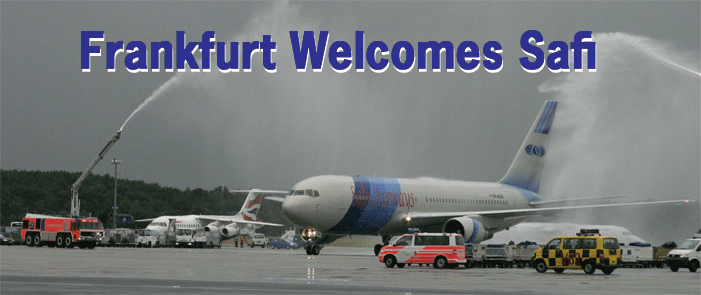
Safi Airways commenced scheduled flights June 15, between Kabul and Frankfurt
by deploying a B767-200ER. Afghanistan-licensed
Safi Airways commenced scheduled flights June 15, between Kabul and Frankfurt
by deploying a B767-200ER.
The formerly Air China-owned aircraft is
equipped with 18 biz and 196 eco seats. The plane can transport up to
14 tons of air freight depending on passenger loads and the number and
weight of their luggage.
“We calculate with 10 tons each flight
in average as soon as the route has been established,” states Klaus
Lederer (left) of GSA Aircargonet GmbH.
On the maiden flight it was 2.7 tons that
were lifted into the belly-hold compartments of the plane for carriage
to Kabul.Cargo is a one way business into Afghanistan.
Because of security reasons not a single
box or package is allowed to be flown out of the Taliban terrorized central
Asian state.
 Only
exceptions permitted are personal effects, diplomatic goods and air mail,
nothing else, confirms Claus Fischer, (right) Chief Commercial Officer
of privately owned Safi. Only
exceptions permitted are personal effects, diplomatic goods and air mail,
nothing else, confirms Claus Fischer, (right) Chief Commercial Officer
of privately owned Safi.
“We expect a substantial contribution
by the cargo business to our overall turnover on this intercontinental
route,” he said in an exclusive interview with ACNFT.
According to GSA Lederer just about everything
is flown into Afghanistan, be it consumer goods, machinery parts, medical
instruments, automotive parts or supplies for the armed forces and the
many civil foreign servants working in that country.
“Frankfurt-Kabul is a highly interesting
relation but it needs expertise to be successful on this specific trade
lane and get access to this complicated market,” Lederer emphasizes.
The Aircargonet manager knows exactly what
he’s talking about because his former client was state carrier Ariana
Afghan Airlines.
Says Lederer:
“Problem was their unreliability so
you never could tell when their flights would arrive in Frankfurt.
“This annoyed quite a number of our
cargo clients.
“Safi however, announced to be different
and offer reliable scheduled services,” Lederer said.
This view is confirmed by commercial manager
Fischer who makes very clear that his airline intends to be a quality
carrier that sticks to its announcements. “Service quality is going
to be the big difference between us and Ariana, Pamir Airways, as well
as Kam Air the other three Afghanistan-based carriers.”
Main difference between privately owned
Safi and their national competitors is the ICAO compliance Safi has achieved
making it the first Afghan carrier to meet recognized international safety
standards.
Next step will be the IOSA audit that is
supposed to happen this year, Fischer announces.
“This will be our door opener enabling
charter flights for the United Nations and for carrying UN officials as
well as diplomats and their goods.
Members of the United Nations are only officially
permitted to fly on board of IOSA audited airlines while pursuing their
diplomatic missions,” he indicates.
These certifications could well turn out
to be sort of a unique selling point for Safi.
The newly introduced Frankfurt route will
be served three times a week. In addition Safi offers scheduled flights
between a number of Afghan cities and the Emirates (Dubai, Abu Dhabi).
The operational base of Safi is Dubai but
equipment and staff will have to transfer to Kabul after the carrier’s
future headquarters is ready for moving in.
According to Claus Fischer there are plans
in the drawer for expanding the three aircraft comprising fleet (two B737-330s,
one B767-200ER).
“It’s undecided yet whether
we will opt for Boeing or Airbus variants,” he said. Worth mentioning
is that freighters are on the purchasing list as well but rank a decided
second behind the rolling over and expansion of the airline’s passenger
fleet.
Heiner Siegmund
 Air
Cargo News/ FlyingTypers leads the way again as the world’s
first air cargo publication to connect the industry to the broadly
expanding and interactive base for social commentary—Twitter. Air
Cargo News/ FlyingTypers leads the way again as the world’s
first air cargo publication to connect the industry to the broadly
expanding and interactive base for social commentary—Twitter.
Here are updates from Twitter so
far this week. To be added to this 24/7/365 service at no-charge
contact: acntwitter@aircargonews.com
June 17: LEJ and SVO service resumes
tomorrow (June 18) after five year lull as Blue Wings launches
A320 twice a week. Aeroflot opens SVO/DRS July 3 with A319s.
June 17: Boeing
has not announced a single airplane order at Paris Air Show. Report
company is "defiant" as criticism over B787 delays mount.
June 17: Asia Airfreight
Terminal Hong Kong said tonnage numbers dropped 31% for first
five months of 09-impacted in part by new Fedex hub in Baiyun,
less than.
June 17: At Paris
Air Show Qatar Airways CEO Akbar Al Baker said QR could "walk
away" from its 60 B787 contract if delivery delays continue.
June 17: HOT Summer
of Jade Cargo debut on new routes including Johannesburg Bangkok,
Vienna and Tribilisi with three of the carrier’s B747-400ERFs.June
16: Swiss adds 2X daily A319s (ZRH-OSL 6/19) lifts Scandinavian
commerce & “our trademark dedicated air cargo solution
focus,” says Urs Stulz, Swiss Mgr.
June 16: China Eastern
(CEA) adds Kunming-Katmandu via B737 July 17. Service operates
Tues/Fri/Sun. CEA via KMG-REP, HKT, KIX,SIN VTE, PNH & CCU.
June 16: TNT Post
Germany buys into Georg von Holtzbrinck, boosts letter delivery
from 26 to 40% of all German households.
June 16: NCA to
save fuel adds 7.8 kg pallet nets from AmSafe. Airline also experiments
with Nordisk Aviation lightweight pallets.
June 16: At LeBourget,
Airbus predicts drop of 25% in factory output over next two years
without mass layoffs (for now).
June 16: At Paris
Air Show, Qatar Airways orders 24 A320 family Airbus aircraft
worth $1.9 billion for delivery starting November 2009.
June 15: The National
Aviation Company (Air India) has slowed payment of June salary
to its 31,000 employees 15 days due to severe liquidity crunch.
June 14: Cargo dips
more than 20% worldwide in 2009 so Boeing re-calibrates its crystal
ball, says air cargo will be plus 5.4% to 2028.
June 14: Another
Dubious Award as Hartsfield Atlanta named Best Cargo Airport at
Munich Air Cargo Europe. FlyingTypers
6/15.
June 14: Agility
Logistics (Kuwait) with $6.8 bn annual rev-$121 mill profit first
quarter & 550 offices in 120 countries added 90,000 sq ft.
at ORD
June 14: Lufthansa
Cargo's sales at 50% via 12 Partners. Agility won 2009 DLH Planet
Award for satisfied customers, growth, market share & loyalty. |
|
| |
 |
|
Hi Geoffrey,
Loved your editorial on awards.
We simply refused to play the game –
when invited and our customers did wonder why we are not too bothered?
It is a complete scam- clearly tied to
advertising spend.
To us any award that can be bought is
not worth having.
Name Withheld
Dear Geoffrey,
InAvia Aviation Consultants is a company
based in Germany serving both airports and airlines in commercial
matters
We are also heavily involved in the air
cargo business.
I love your comment in today's FT about
the Air Cargo Europe award going to ATL and the Reality Checks!
You don't know how much I agree with you!
With Best Regards,
Thomas Stuenkel
Managing Partner
INAVIA Aviation Consultants GmbH
St. Toeniser Str. 42
D-47918 Toenisvorst
Germany
www.inavia.aero
Dear Name Withheld,
We have nothing against air cargo awards.
Flying Typers just thinks most big event
awards are less than rewarding for among other things , the reason
you mentioned.
Some people don't like that we take issue
with air cargo awards.
But our we figure that our job is to survey
the scene and tell it like it is.
We are hopeful that IATA Cargo or somebody
will create better more transparent air cargo industry awards.
Meantime we will continue looking out
for you—the industry stakeholder.
Geoffrey
|
|







 As
for the national carrier, Air India has lost Rs 5,000 crore for the
same period. It is not without reason that Praful Patel (below), India’s
Minister for Civil Aviation, is keen on a bailout package—in fact,
a soft loan—from the government for the airline.
As
for the national carrier, Air India has lost Rs 5,000 crore for the
same period. It is not without reason that Praful Patel (below), India’s
Minister for Civil Aviation, is keen on a bailout package—in fact,
a soft loan—from the government for the airline. If
reports emanating from Rajiv Gandhi Bhawan, the headquarters of the Civil
Aviation Ministry, are to be believed, the government has agreed to pump
in funds into the flailing carrier.
If
reports emanating from Rajiv Gandhi Bhawan, the headquarters of the Civil
Aviation Ministry, are to be believed, the government has agreed to pump
in funds into the flailing carrier. 


 Contact!
Talk To Geoffrey
Contact!
Talk To Geoffrey