| 
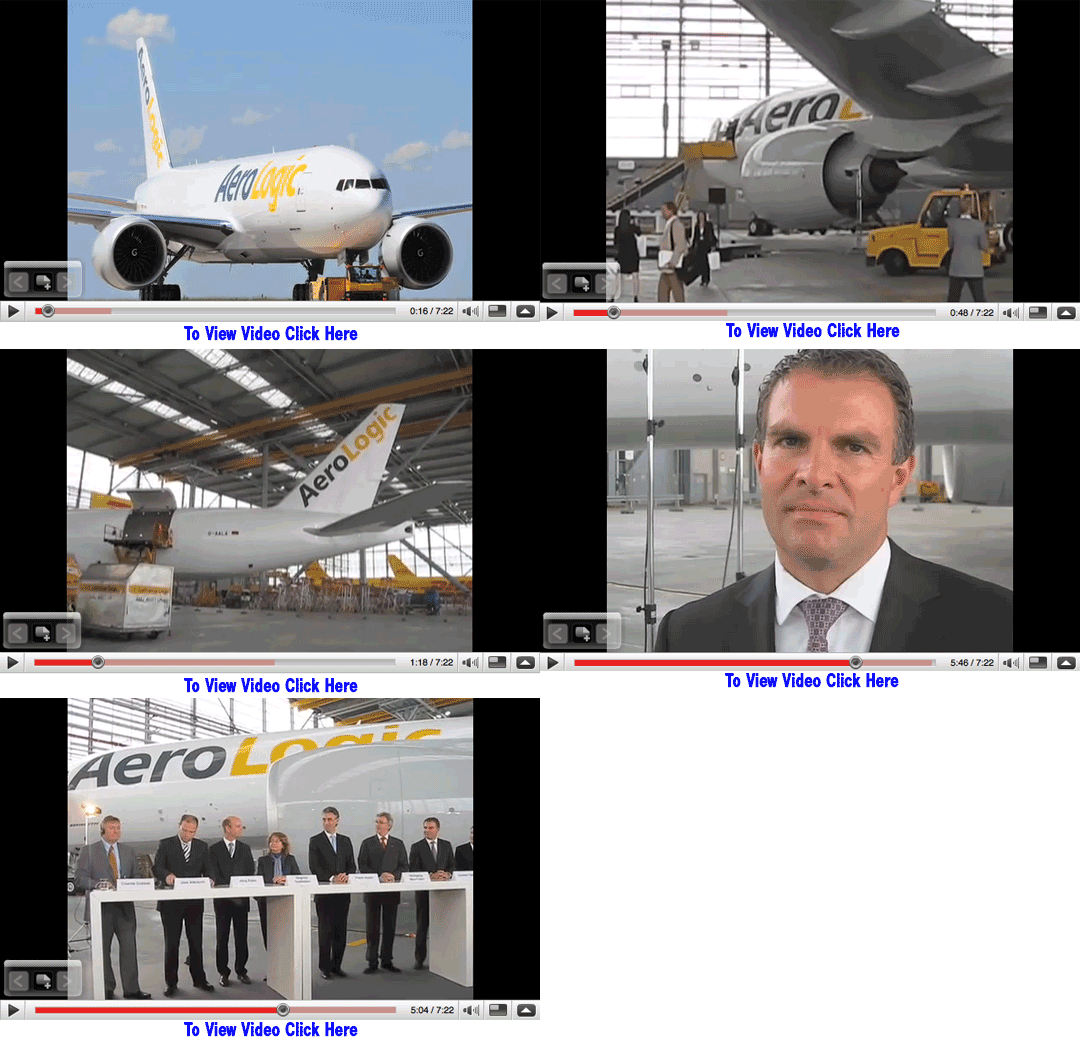
The speaker’s panel in DHL's huge
hangar at Leipzig/Halle Airport was jammed with highly important CEOs
and Managing Directors with plenty of smart things to say.
But the real star, Boeing’s newest
long range air cargo lifter, the B777F stood silently just behind the
stage.
During these uncertain times when the 800-pound
gorilla at every business meeting is the economy, that shiny new airplane
and this bold step toward the future were reassuring.
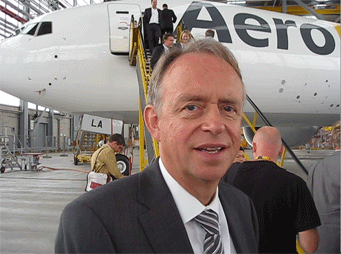
 “This
aircraft is an enabler giving AeroLogic a competitive advantage in the
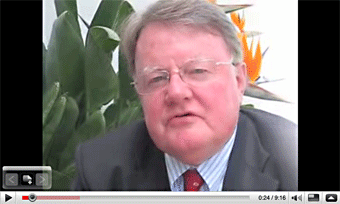
global market,” lauded CEO Frank Appel (left) of Deutsche Post,
parent company of DHL. “This
aircraft is an enabler giving AeroLogic a competitive advantage in the
global market,” lauded CEO Frank Appel (left) of Deutsche Post,
parent company of DHL.
 The
prediction was supported by Lufthansa Cargo’s CEO Carsten Spohr
who, himself a pilot, highlighted the economy of the triple seven freighter
that can zip 9,038 km nonstop (4,880 nm) with a full payload of 103 tons. The
prediction was supported by Lufthansa Cargo’s CEO Carsten Spohr
who, himself a pilot, highlighted the economy of the triple seven freighter
that can zip 9,038 km nonstop (4,880 nm) with a full payload of 103 tons.
B777F, we learned, also provides a 20 percent
fuel-burn savings while contributing to substantial emission reduction
and can lift 37 pallets per flight giving the craft an additional payload
of 15 percent as compared to Lufthansa Cargo’s flagship MD-11F.
“It’s the best equipment in
this category of twin-engined aircraft,” Lufthansa CEO Wolfgang
Mayrhuber (right) noted.
Something else Herr Mayrhuber said about
the big picture to some business students in China recently came to mind.
“Values are what counts.
“The pioneering spirit of managers
and staff is one of the keys to a company’s success.”
This first AeroLogic B777 freighter will
depart Leipzig/Halle on her maiden schedules June 29, en route to Bahrain,
Hong Kong and back to Germany.
In July a second B777F is expected and a
third and forth coming in December.
Next year another four of Boeing’s
longest-range freighters will be added to AeroLogic’s fleet bringing
the total number of aircraft to eight.
 “By
then the company will be ranked fourth place among Europe’s cargo
airlines,” said Herr Spohr. “By
then the company will be ranked fourth place among Europe’s cargo
airlines,” said Herr Spohr.
All aircraft are leased from a subsidiary
of German DVB Bank.
Originally AeroLogic envisaged as many as
eleven B777Fs but scaled the fleet back to eight units due to the weak
market situation.
However, at the Leipzig event last Friday
managers did not exclude adding additional equipment as the global economy
rebounds and prospects brighten.
Wait and see while things recover, one gets
the feeling, is prudent but also an absolute fact of life at least in
the near term ahead.
But here, as numbers tumbled all around
and Boeing Company sat all week at Le Bourget in Paris without an order,
was a new airplane and cargo airline and a hangar full of people out to
celebrate that fact of life for both.
In total, Deutsche Post and Lufthansa expect
expenditures between €15 to 17 million euros until the new carrier
is in full swing.
“But we calculate to spend less money
due to an intelligent cost managing program,” said Lufthansa’s
Herr Spohr.
The new carrier commences commercial activities
in a highly unfavorable environment with international markets down everywhere.
  Taking
to the air at these times is quite a challenge, admitted both Managing
Directors Thomas Pusch (right) and Thomas Papke (left) of AeroLogic GmbH,
but “we believe it to be opportune to invest in new capacity also
in gloomy periods for improving our competitiveness,” argued Frank
Appel of Deutsche Post. Taking
to the air at these times is quite a challenge, admitted both Managing
Directors Thomas Pusch (right) and Thomas Papke (left) of AeroLogic GmbH,
but “we believe it to be opportune to invest in new capacity also
in gloomy periods for improving our competitiveness,” argued Frank
Appel of Deutsche Post.
Appel further emphasized the geographic
closeness of the nearby East European markets that are expected to grow
substantially in mid- and long-term perspective, making Leipzig/Halle
in South-East Germany a good choice for establishing a cargo airline.
Thomas Pusch confirmed that the original
business set up about a year ago is still fully valid despite the three
months delayed delivery of the first aircraft by U.S. manufacturer Boeing
that kept AeroLogic grounded until now. “We intend to turn a profit
sometime next year,” said Pusch when asked by ACNFT.
DHL Express and LH Cargo will share the
capacity of the fleet.
The integrator will utilize the plane Monday
to Friday while Lufthansa Cargo will take over on weekends deploying the
freighter within its own network.
Both AeroLogic owners (50/50%) however,
can load their own shipments each time if needed, whether the craft is
flying on DHL routes or within Lufthansa Cargo’s network.
 This dual use guarantees a basic revenue
payload which minimizes the financial risks for both DHL Express and Lufthansa
Cargo.
This dual use guarantees a basic revenue
payload which minimizes the financial risks for both DHL Express and Lufthansa
Cargo.
The launch of AeroLogic was widely lauded
by politicians at the Leipzig event.
“Our entire region is developing more
and more into an automotive and logistics cluster creating thousands of
new jobs,” said Leipzig’s Mayor Uwe Albrecht (right).
He added that this was triggered by DHL
when the integrator decided to abandon Brussels because of tight night
flight restrictions and move to the city in Saxony where cargo operations
are possible 24/7.
“We wish other airports that we heavily
utilize would also refrain from imposing curfews,” exclaimed Carsten
Spohr indirectly addressing Lufthansa Cargo’s home-base Frankfurt
Rhein/Main.
About those night flights at FRA—a
court will decide soon if restrictions will be imposed or exceptions allowed
enabling LH Cargo and other carriers to continue operations between midnight
and dawn.
(Heiner Siegmund/Geoffrey Arend) |






 Air
Cargo News FlyingTypers leads the way again as the world’s first
air cargo publication to connect the industry to the broadly expanding
and interactive base for social commentary—Twitter.
Air
Cargo News FlyingTypers leads the way again as the world’s first
air cargo publication to connect the industry to the broadly expanding
and interactive base for social commentary—Twitter. June
20: As DHL helped launch AeroLogic June 19 former DHL
hub at BRU saw cargo drop 41.3 in May with all-cargo flights down by 50%
.
June
20: As DHL helped launch AeroLogic June 19 former DHL
hub at BRU saw cargo drop 41.3 in May with all-cargo flights down by 50%
.
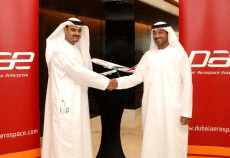 firm
DAE Capital. Here HH Ahmed bin Saeed al-Maktoum, Emirates CEO and DAE
group managing director HE Dr. Omar Bin Sulaiman celebrate the arrival.
firm
DAE Capital. Here HH Ahmed bin Saeed al-Maktoum, Emirates CEO and DAE
group managing director HE Dr. Omar Bin Sulaiman celebrate the arrival.
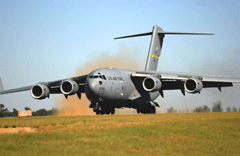 June 19: DHL Life Science and Healthcare Competence Center
to debut at Shanghai PVG will include a “core team of industry experts,”
DHL said.
June 19: DHL Life Science and Healthcare Competence Center
to debut at Shanghai PVG will include a “core team of industry experts,”
DHL said.
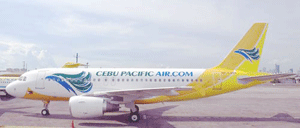 June 18: Airbus won at Paris Air Show adding 31 firm orders
24 A320 to Qatar Airways and 10 A350s to AirAsia X. Cebu Pacific ordered
five A320s.
June 18: Airbus won at Paris Air Show adding 31 firm orders
24 A320 to Qatar Airways and 10 A350s to AirAsia X. Cebu Pacific ordered
five A320s.