
Vol. 8 No. 74                                         WE COVER THE WORLD                                                       Wednesday July 15 , 2009

Rules Of Attraction
In Latin America

     When the World Economic Forum met in Davos some months ago, as usually is the case, there followed a flurry of studies and meat and potato issues beyond the immediate financial and national leaning headlines playing on television and in business journals .
    Whilst looking at new markets, some answers to the question, “Can Latin America upgrade airports and cargo facilities with private capital it attracts from around the world.” gained some further understanding in a World Economic Forum study titled, “Latin America: Benchmarking National Attractiveness for Private Investment in Infrastructure,” authored by Irene Mia, Julio Estrada and Thierry Geiger.
    The study assesses the main drivers of private investment in infrastructure projects for ports, airports, roads and electricity covering 12 economies in Latin America and the Caribbean.


     This is the first time that the World Economic Forum has developed an index specifically analyzing the investment environment for infrastructure.
    Chile, Brazil, Colombia and Peru lead the region with respect to the attractiveness of their private investment climate for infrastructure.
    It’s worth noting that Peru follows the top three closely, while Venezuela, Bolivia and Dominican Republic have the least attractive environment.
    Extensive and high-quality infrastructure is an essential driver of competitiveness, impacting significantly on economic growth and reducing income inequalities and poverty in a variety of ways.
    In this regard, a well-developed transport and communications infrastructure network is a prerequisite for the efficient functioning of markets and for export growth, as well as for poor communities’ ability to connect to core economic activities and schools; similarly, improved water infrastructure can considerably reduce child mortality rates and boost overall health levels.
    Indeed, a 1996 study found that over 30% and 40%, respectively, of the growth differential between Africa and East Asia and low and high growth countries could be traced back to differences in the effective use of infrastructure.

     Latin America has made progress in the quality and extension of its infrastructure network in the last decade, especially in terms of improved access to water and sanitation, electricity and communication.
    However, at the same time, the region has lost ground with respect to other regions of the world, with the partial exception of water and sanitation.
    In 1980, Latin America displayed a more extended road, electricity and telecommunications infrastructure than the East Asian Tigers; in 2004, however, the latter had overcome the former by a factor of three to two.
    This important infrastructure gap hinders the region’s growth prospects and poverty alleviation strategies: it has been estimated that an upgrade of Latin America’s infrastructure to the level of South Korea would generate annual GDP per capita increases on the order of 1.1-4.8% and could reduce inequality by 10-20%.
    The reasons for the widening infrastructure gap between Latin America and East Asia have much to do with the drastic fiscal adjustment programs adopted in the region in the aftermath of the debt crisis of 1982.
    The governments in the region, faced with the necessity of reducing their expenditures, opted for significantly cutting their investment in infrastructure, politically easier than cutting salaries and pensions.
    As a consequence, public investment in infrastructure fell from above 3% of GDP in 1988 to 1.6% in 1998.     Considering that the public sector had traditionally catered for the bulk of infrastructure investment for political and social reasons, the region found itself with the need to rethink the infrastructure-financing model followed until then, by adopting regulatory and financial innovation that would allow delegation of financing, as well as infrastructure provision, to the private sector.
    Public-private partnerships (PPPs) in infrastructure financing increasingly became the norm in the region, varying from full privatization to different degrees of private participation (concessions, management or lease contracts).
    In general, the region has been fairly successful in developing PPPs, attracting half of the total US$ 786 billion that went to the developing world in PPP financing between 1990 and 2003, and has significantly transformed the infrastructure provision paradigm. Indeed, by 2003, private utilities were managing 86%, 60% and 11%, respectively, of telecoms subscriptions and electricity and water connections.
    Still, the private investment flowing to the region was never enough to compensate for the fall in public funding and tended to benefit only selected countries (Argentina, Brazil, Chile, Colombia, Peru and Mexico accounted for around 90% of all investment in Latin America) and sectors (mainly telecommunications, followed by energy and transport) in the region.
    Against such a background, it is estimated that Latin America needs to invest between 2.5% and 6% of GDP to upgrade and extend the regional infrastructure.
    Considering that a substantial increase in government spending is limited by the still-high public indebtedness levels and low taxation capacity, and that lending from multinational development banks has recently been falling, it is of utmost importance for governments in the region and multinational institutions alike to promote and rethink PPP financing models, taking advantage of the considerable growth of private capital markets, which in 2003 accounted for 360% of global GDP.
Gordon Feller

Brazil An American Address


     AA has grown exponentially, anchored in part by its trunk routes across USA and also via a spirited schedule of line flights and alliance frequencies via a global network that at this point stretches into Asia all the way around to Europe and beyond that north and south in the air, everywhere .
     Recently AA, that now is also the major player at Miami where it dispatches scores of daily flights in and out of Central and South America, entered into a code share agreement with Brazil-based GOL Airlines.
     Although much of the news about that arrangement centered on the passenger virtues, "Mr. Air Cargo," at American, Division President Dave Brooks says that AA Cargo is no stranger to working with GOL:
     "It should be noted," Dave said, "that American Cargo has an interline agreement that has been in place with GOL for several years.
     "We frequently utilize the service to extend reach from points in Brazil and Argentina to Paraguay and Bolivia."
     GOL, by the numbers provides service to 49 destinations within South America connecting the most important cities in Brazil and nine major destinations in South America utilizing Boeing 737s with nearly 800 daily flights.
     For the record American Airlines offers more flights to Brazil than any other U.S. airline, serving five destinations in Brazil from Miami International Airport, New York's John F. Kennedy International Airport and Dallas/Fort Worth International Airport.
     American has expanded its service levels to Brazil in recent months, adding both flight frequencies and new destinations to its worldwide network.
     In November 2008, American began service from its Miami hub to Belo Horizonte, Recife and Salvador.
     In all, American offers 58 weekly flights to and from Brazil.
     Asia is a primary market for the shipment of automotive parts and perishables from Brazil.
     It's not uncommon for AA to ship 10 tons of frozen coffee or frozen lemon juice to Japan, for example.
     For both perishable and non-perishable items, connections through Miami, Dallas-Fort Worth and New York are available.
     In some cases, items can be shipped on flights from Dallas to Asia the same day.
     AA Cargo supports important markets in Asia with freight from other origins in Latin America such as Buenos Aires, Argentina; Santiago, Chile; Lima, Peru; San Jose, Costa Rica with connections through the United States.
     American Airlines Brazil service includes: Summar/Sao Paulo-Dallas/Fort Worth , New York/ Rio de Janeiro-Miami/Belo Horizonte -Recife and Salvador.
     "American has a rich history in Brazil dating back nearly 20 years, with many valued customers," Dave Brooks, said.
     "Our customers drive us to excel, and continue to challenge us to offer new technologies and enhancements to our products," he said.
     "We've remained focused, even in these tough economic times, on bringing more value to our customers through on-time, careful delivery of cargo daily—no matter the commodity, no matter the destination around the world."
Geoffrey

     The concept of an industrial airport serving as a hub is becoming more central to Brazil’s national economic strategy.
International airports at Galeão in Rio de Janeiro, Tancredo Neves (named in honor of the 34th President of Brazil) in Minas Gerais, Sao Jose dos Campos in São Paulo (as well as other airports in the cities of Brasilia and Petrolina) are, at least in theory, already industrial airports.
     These have been authorized as such by a Presidential Decree.
     The work underway at the Viracopos Airport in São Paulo ranges from building a second runway, to readying the areas that will be made available for industries.
     But this seems to be only the beginning of the process.
     Brazil’s government-owned airport company, Infraero, has responsibility for regulating industrial airports and implementing national air transport policies related to both cargo and passenger flows.
     In order to become operational, industrial airports need to offer advantages to attract industries, such as: adequate infrastructure, production cost savings, transportation options and security.
     On the other hand, an industrial airport will increase revenue and employment to the local community.
     The industrial airport projects also foresee increase in air traffic at airports with the addition of the creation of clusters formed by companies that export products with high added value, similar to what already occurs in countries like the United States and Europe.
     The expectation is that the first companies to join in the projects will be from the computer, jewelry, pharmaceutical and aircraft maintenance sectors.
     By definition an industrial airport will host companies working in a free zone, operating under condition of a bonded customs warehouse and will not have to pay duty on imported components.
     After passing through customs, imported inputs are transferred directly to the assembly line at company’s premises.
     The end products may be exported without paying duty.
     In a similar fashion, local components are also free of taxes when incorporated into a finished product, which is then exported.
     Import duty and local taxes are only applied to finished products sold into the domestic market.
     According to the Infraero, in the last two years the company has invested more than US$29 million in improvement of the terminal and purchase of new equipment.
     The industrial airport at Confins near the Tancredo Neves International Airport in metropolitan Belo Horizonte will be the first of its kind in Brazil.
     According to Luiz Antônio Athayde, (right) State Economic Development Secretariat, Tancredo Neves International Airport is being developed into an important multimodal logistics hub, the first step to develop the Airport City.
     The venture is the result of an agreement signed between the state government and Infraero that stipulated that the state fund an initial outlay US$ 7 million for the first phase of the project as well as having created an industrial district in Confins last year.
     The negotiation was subject to some degree of controversy when faced with the need for approval of an environmental permit for an area of 46 thousand square meters of government property, later transformed into a special area of development.
     The industrial airport project was approved by the Brazilian Internal Revenue Service and has been operating as such since August 2006 with the opening of a pilot tenant project with Clamper, a manufacturer of electrical circuit breakers.
     It is now ready for an expansion, which will enable it to house new tenants.
     The Gol Airlines Aircraft Maintenance Center, one of Boeing’s most modern maintenance centers in the world has also been operating since July 2006.
     This particular center meets Gol’s aircraft maintenance needs that used to be outsourced and will also provide services to other airlines.
     The company invested approximately US$ 20 million in this project and expects a savings of about $1 million annually by doing its own fleet maintenance.
     Last year Gol started expansion of its facility that should grow three times its original size, that reinforces the importance of the industrial airport and emphasizes the goal to attract additional business to Confins.
     According to CODEMIG – The Minas Gerais State Economic Development Company-, at least 50 companies have already confirmed interest in establishing operation at the airport industrial site.
     According to Mr. Athayde, the Minas Gerais State Economic Development Secretary for International Affairs, some of sectors most interested in opening plants within the Confins Airport industrial area complex are from the biotechnology, electronics, jewelry and pharmaceutical sectors.
     With fewer taxes on production activities, these companies can sell to the domestic market or export with higher profit margins.
     Among the measures announced to encourage companies to establish their operations within the airport complex are tax incentives, improved infrastructure and electronic tax clearance.
     The area should be ready for further occupancy by the second half of 2009.
     Manufacturers of goods with high added value, such as microelectronics and biotechnology will have priority.
     "The project is very good, and the state government is looking forward to hosting anchor companies such as semiconductor manufacturers that are considering Brazil to establish their plants," said Lincoln Gonçalves, the chairman of the Council of Economic Policy of the Federation of Industries of Minas Gerais (Fiemg).
     According to Gonçalves, the amount of investment generated from companies interested in setting up operations in Confins could reach US$ 1.2 billion.
     Studies show that metropolitan Belo Horizonte is the geographical crossroad of airways, road and railroads in the middle of one of the most developed region of Brazil, emerging as a natural multimodal logistics platform.
     Tancredo Neves International Airport is considered to be the one facility that is best suited to receive air traffic from Congonhas Airport (São Paulo), to become a "hub", and to centralize operations and re-route flights to other parts of the country (such as the North, Northeast and Mid-West).
     The major objective of the industrial airport project is to develop the metropolitan Belo Horizonte logistics platform complementing the Dry Port located in the city of Betim; encourage hi-tech manufacturing plants (especially those that depend upon fast, reliable and efficient air transportation) to install facilities within the airport industrial complex and to benefit from federal and state tax exemption on imported components on finished product exports.
     This airport project will urbanize the surrounding area, construct warehouses and update airport infrastructure.
     The sites will be open for bidding by companies interested in establishing operations.
     One advantage which the industrial airport hopes to promote is its role as a multimodal logistics hub for Brazil and South America.
     This may be important for those companies already engaged in international trade, including some which are dependent on global suppliers and are reliant on air transportation to ensure speed, agility and accessibility to both suppliers and consumers.
     With the momentum generated by industrial activities, other service such as hotels, restaurants and suppliers also tend to establish themselves in the area. Airport expansion, and the generation of associated new businesses, including hi-tech industries, is expected to create new demand for imported equipment and services, including from the United States.
GF

     Continental Airlines goes daily B767 nonstop between IAH and Rio de Janeiro (GIG) August 1, 2009.

The carrier also offers daily 767 nonstop service between IAH and Sao Paulo (GRU).
     "This new flight links important energy centers with convenient nonstop service," said John Slater, staff vice president Latin America and Caribbean. "It also provides the most direct routing from numerous western points being that it is the only nonstop flight between Houston and Rio west of the Mississippi.
     “Continental’s B767 Brazil services move ten tons plus of cargo seven days a week as dependable lift for shippers from Europe and Asia and elsewhere to Latin America’s biggest market,” Mr. Slater told ACNFT.

     Air Cargo News FlyingTypers leads the way again as the world’s first air cargo publication to connect the industry to the broadly expanding and interactive base for social commentary—Twitter.
     Here are updates from Twitter so far this week. To be added to this 24/7/365 service at no-charge contact: acntwitter@aircargonews.com


July 14:  Cathay Pacific Airways says recession is like none other in history with an unsettling lack of visibility in Cathay Cargo business.

July 14:  Indian Rail 213 million freight tons for April-June 2009, 5% more than a year ago. June traffic at 72 million tons was 10 % above 2008.

July 14:  Lufthansa Cargo widens security noting upgrades worldwide noting Premium Security Station (PSS) certification augers change. PSS in place at FRA, MUC, JFK, ORD, PVG

July 14:  Follow the money . . . British Airways 50/50 deal to merge with Iberia as IB covers shortfall in BA pension fund & financial headquarters is Madrid.

July 13:  Aeroflot may go private as Russian President Vladimir Putin reportedly ponders dropping carrier from a list of strategic enterprises.
July 13:  On the financial ropes Thai Airways drops routes, furloughs employees, asks Airbus to delay delivery of first three of six A380 planes by one year to late 2012.

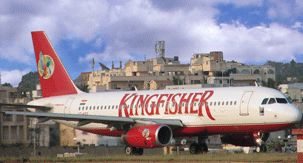
July 13:  Kingfisher drops BLR/LHR & BLR/CMB 9/15, adds BOM/SIN and BOM/HKG. Wants DEL/LHR, DEL/BKK, DEL/DXB, BOM/BKK, BOM-DXB and BOM/CMB in Fall.

July 13:  SkyChain Mercator's end to end cargo solution recently went live with SriLankan Airlines.

July 13:  Let’s play Monopoly . . . China Eastern buying rival Shanghai Airlines, in a $9 billion deal that nets more than half of all the business at PVG.

July 13:  Delta raises eyebrows and tempers not offering new red-dress uniforms to flight attendants over size 18. Navy blue offered up to size 28.