 |
I was born in Toledo, Ohio in 1941, so I’ll admit I carry a little Buckeye pride. And that’s why I’m honored to start this series with a story that touches aviation history and helps redefine it.
Most of us know the headline: The Wright Brothers from Ohio were first in flight. In 1903, in Kitty Hawk, North Carolina, the Wright brothers proved a machine could lift off, stay up, and land under control.
Proving something is possible is only step one. The bigger question is, what do you do with it afterward? When does flying stop being a stunt and start being a tool?
Not long after powered flight became real, the idea of air cargo moved from imagination to reality, and it happened thanks to people in Ohio.
Let’s rewind to Columbus, Ohio, around 1910.
Airplanes are still the kind of thing you go out of your way to see, like a performance. People have heard of the Wright brothers, sure, but for everyday life, flying still feels distant.
Aviation is not yet business or infrastructure. It’s mostly spectacle.
Then a businessman in Columbus starts thinking differently. His name is Max Morehouse, and he runs a retail home store called the Morehouse-Martens Company.
Like everyone else, Max has been following newspaper stories about aviation.
Then he lands on a practical question: if an airplane can leave one city and arrive in another on purpose, why can’t it carry merchandise on purpose?
Morehouse has a real need, not a publicity stunt. He wants a same-day delivery of fabric like ribbon and silk from a supplier in Dayton called Elder and Johnstone.
So he reaches out to the Wright operation and asks, can you move this shipment through the air?
The Wright Company is thrilled. This is exactly the kind of “next step” they want the public to see.
Their associate, Roy Knabenshue draws up an agreement for what becomes the first documented air cargo shipment in history. And the fee is almost unbelievable: five thousand dollars.
Now, that price wasn’t about saving money. The point was to prove something else entirely: that an airplane could generate revenue by being useful.
In a world where aviation income often meant giving one person at a time a joy ride, cargo had the potential to change the conversation.
Flying wouldn’t just be entertainment. It could become part of how commerce works.
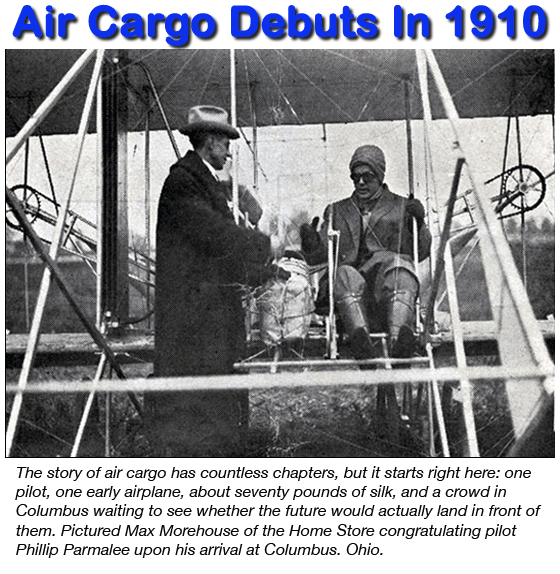
The cargo itself sounds modest, but it was meaningful: ten bolts of silk, packed into two bundles, around seventy pounds total.
Heavy enough to count, valuable enough to matter.
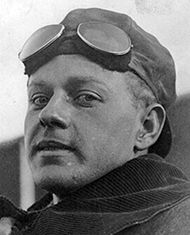 The first air cargo flight pilot was Phillip Parmalee, trained under the Wright brothers at their flying school.
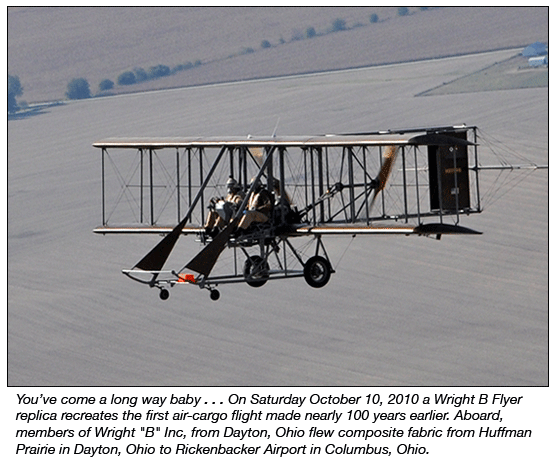
He operated a Wright Model B, one of those early open-frame aircraft that looks, even today, like it’s negotiating with the laws of physics. There’s no underfloor cargo bay.
No enclosed compartment. The shipment is strapped under the seat. Weights and balances, were at best, an eyeball call.
The cargo was not “in” the plane the way we think of it now.
The cargo rode along with the pilot.
On November 7, 1910, Parmalee took off from Dayton and headed to Columbus. He landed at Driving Park, and Max Morehouse was there to receive the goods in person.
At the handoff—the proof-of-delivery moment, the media went wild.
Welcome to the first air cargo revenue, an early version of what we now take for granted: moving value from one city to another on a schedule.
One detail from that day has always stuck with me.
One bolt of the silk was dark pink. And instead of just putting it into inventory and moving on, they cut it into tiny swatches and attached them to commemorative cards. Little pieces you could hold between your fingers. Not only proof that a plane flew, but proof that something arrived. It was the future, reflected in a receipt.
Thinking about it a bit more, for aviation there’s a poetic connection here, too.
Early pilots, especially around World War I, became famous for those white silk scarves streaming behind them.
Once you know the first air cargo was silk, it’s hard not to feel like silk and flight were linked right from the beginning.
And yes, I can’t help imagining those iconic scarves in dark pink, matching that bolt from the shipment.
We celebrate the Wright Brothers for proving humans could fly, and we should.
But they also were all over this 1910 delivery, marking another leap: proving there was a reason for flight on an ordinary day.
Because once the Wright-trained pilot Philip Parmalee demonstrated that his Wright Model B could move goods; air cargo and express and of course, U.S. Mail scaled up from there. Urgent deliveries. Wider markets. Eventually, international supply chains built around speed.
The next time you track a shipment and expect it to arrive, remember part of that expectation traces back to Ohio, to November 1910, to seventy pounds of silk strapped under a seat in an open-air airplane. A small cargo, a short hop, and a quiet pivot that helped the world start moving faster, and it never really slowed down again.
 |
If you want to go deeper on this specific shipment and the broader early history, there are detailed accounts—one by Janet B. Arlege focused on that November 7, 1910 delivery, and another by Foster Lane that explores cargo flight history more broadly.
Janet B. Arlege, “The World’s First Commercial Air Cargo Shipment, November 7, 1910” (Columbus, OH: Ohio History of Flight Museum, 1985).
Foster Lane, “Cargo Flight: An Adventure into Flying History” (Columbus, OH: Prop Press Associates, 1986).
|


 Welcome to Air Cargo Chronicles from Air Cargo News Flying Typers.

 100%
Green