 |
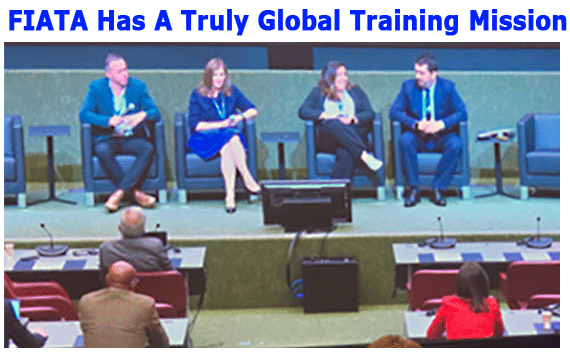
Let me start this new section about FIATA’s HQ with the picture of the FIATA Logistics Institute (FLI) session, where FIATA’s initiatives in training and education were presented. Second from left of the screen you can see Inessa Platonova, Chair of the Management Committee of the FIATA Foundation, who pierced not only the screens, but also our hearts, with her report on Ukraine’s teaching: it was promising, despite the difficult situation in her country: training has been an opportunity for those who “go outside of the Ukraine to secure a job, without being obliged to take lower kinds of jobs.” These were more or less her words, much more moving, as they were discreetly spoken, than I could ever try to describe here. The sense of gratitude for what FIATA has been able to organize in these years was quite clear in her speech and everyone in the room felt the same. This calm and yet strongly committed specialist captured our attention with her graceful spell. Inessa added that flexibility is “very important for our students: we need a clear structure,” suggesting that specialization should be conducive to an educational system in tune with each and every person’s requirements. I thought her message was so important and moving that I wanted to start this article by this citation.
The echo of the HQ meeting still reverberates on social media. LinkedIn pages are still full of articles and posts about the event, which took place at the end of March. Kudos to FIATA’s Members for keeping their association so high on our agendas and to the ladies in the Secretariat, who miss no opportunity to inform us on each and every initiative. Understandably, wars, and not only in Ukraine, if not openly mentioned, were present at least in our thoughts at each session and reunion, almost as if this was a backdrop against which we were stuck during our meetings.
I am now writing quite a few days later, listening to the news about the Strait of Hormuz, a water channel we have sufficiently cited in our previous article. It has been opened and then closed and then opened again and now . . . ? As though it was the traffic light of international trade, no longer able to show a green light to the rest of the world, it was on everyone’s thoughts. Let us hope the next chapter of this saga comes to a peaceful end, but now let me go back to FIATA’s typical business, surely a more hopeful topic for this article.
The FLI panel that is portrayed on the screen above includes Alperen GÜLER, the FLI Chairman from Türkiye, who released a short statement for us after concluding his neat performance on stage:
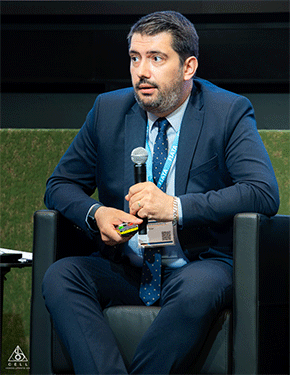 “The session on Building Effective Digital Learning, moderated by Alperen Güler (FIATA Logistics Institute – FLI Chair), brought together FIATA member associations at different stages of their digital learning journey, with contributions from Adam Butler (IFCBAA, Australia), Inessa Platonova (UKRZOVNISHTRANS, Ukraine) and Mariana Vale (APAT, Portugal). The session opened with a presentation of the ongoing work on the e-Learning Handbook, outlining its role as a supportive, non-prescriptive framework designed to help associations adapt to digital delivery while maintaining alignment with FIATA Minimum Standards. The panel discussion provided a practical and experience-driven exchange, reflecting on different modes of training delivery. The discussion highlighted key challenges such as engagement, quality assurance and institutional readiness, while also underlining the opportunities offered by digital learning. A central takeaway was that, although there is no single model for success, there is a shared need for credible and well-structured learning environments. The session emphasized the importance of collaboration within FIATA, as associations progress at different speeds, but toward the common goal of maintaining high training standards in an evolving digital landscape.” “The session on Building Effective Digital Learning, moderated by Alperen Güler (FIATA Logistics Institute – FLI Chair), brought together FIATA member associations at different stages of their digital learning journey, with contributions from Adam Butler (IFCBAA, Australia), Inessa Platonova (UKRZOVNISHTRANS, Ukraine) and Mariana Vale (APAT, Portugal). The session opened with a presentation of the ongoing work on the e-Learning Handbook, outlining its role as a supportive, non-prescriptive framework designed to help associations adapt to digital delivery while maintaining alignment with FIATA Minimum Standards. The panel discussion provided a practical and experience-driven exchange, reflecting on different modes of training delivery. The discussion highlighted key challenges such as engagement, quality assurance and institutional readiness, while also underlining the opportunities offered by digital learning. A central takeaway was that, although there is no single model for success, there is a shared need for credible and well-structured learning environments. The session emphasized the importance of collaboration within FIATA, as associations progress at different speeds, but toward the common goal of maintaining high training standards in an evolving digital landscape.”
There was indeed debate about the equivalence of digital vs. classroom tuition, without forgetting FIATA’s evergreen discussion whether the words freight forwarder or logistics should prevail in the standards. Clearly what matters is the unchangeable spirit of the FIATA Diploma and this was safely reaffirmed. “The meaning of the minimum standards is that you include the required concepts in the courses either in the class or online. The standards relate to the content, not the way it is delivered,” concluded the Chair. The digital learning strategy and the concept that “technology follows knowledge” were suitably presented during the entire session . . . in FIATA’s training, there is no question of tail wagging dog . . .
 |
From the Netherlands there was a request on whether the standards should include elements of IT as an integral part of the programme, given the growing importance of IT in our work. It was noted that the courses would evolve in time, as it happened in the past with the concept of sustainability, which found its way into the standards in 2024, entering into force this year. Adan Butler from Australia suggested that ‘digital’ is better, when considering flexibility, whilst asynchronous learning would never be given up, as it helps build a community and has a considerable social aspect. A delegate from Iran lamented that in his opinion the quality of online courses was decreasing, their level not the same as the classroom’s, but he consented that the applicable policy should be seen case by case and country by country.
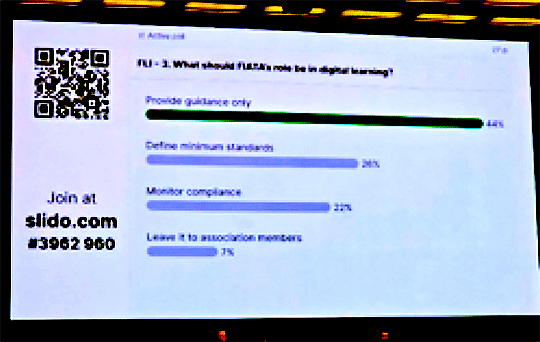
The Chair maintained that the digital version is not mandatory, actually being the choice of the association building the programme. The manager in charge, Sophia Aiche, clarified that for those who are employed, the online option is actually more interesting, as these students are not free during working hours. In conclusion, the prevailing opinion of those in the attendance (44%) was that FIATA should limit itself to providing guidance only regarding digital learning.
For the record, the usual update on the validation and revalidation of FIATA training courses was provided. This is another element reassuring us that everything old is new again in time: springtime brings blossoms and sprouts . . . and FIATA validation records.
For those who are not completely aware of the mechanism, suffice to say that FIATA develops the training standards and the local and regional associations develop the courses on the ground. The validation/revalidation mechanism ensures the adherence to the standards and the continuity of the training materials with regard to the relevance of the courses. I would say this is, if not perfect, a very effective system to ensure a reasonable and comparable level of logistics training all over the world. This produces the coveted “FIATA Diploma”, a document which in many countries creates realistic opportunities of employment.
As you may know, or have understood by now, this ritual happens every springtime during the HQ and, albeit sometimes overruled by more stringent necessities, it is in my view one of the most significant and important activities that FIATA carries forward. This programme, almost as old as everyone in the meeting if not more, still works as clockwork and produced generations of well trained professionals all over the world.
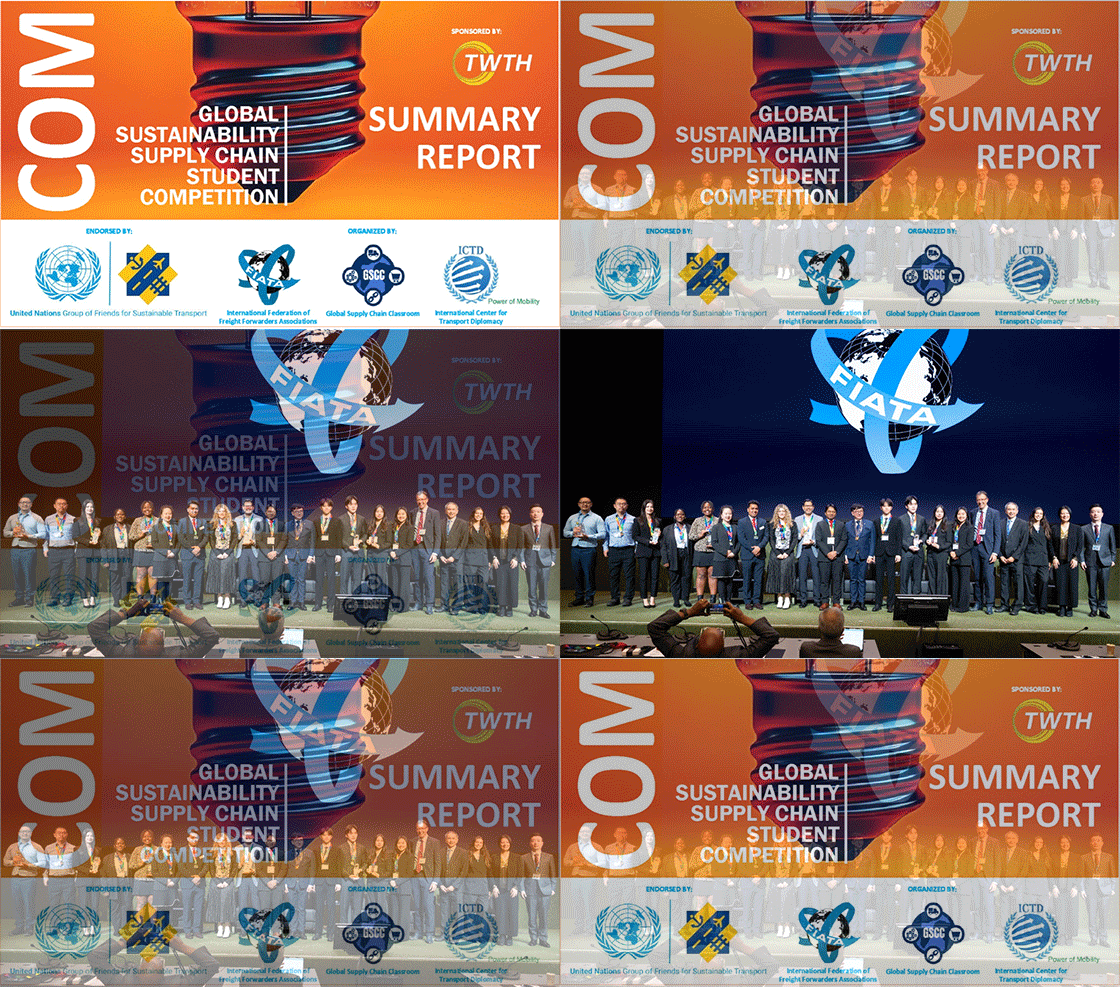 |
 If you look at other initiatives that pertain to training and younger generations, there was also much anticipation for the GS3 competition, which would culminate with the awards presented at the closing ceremony. Starting from the end, the University College of London secured the gold medal, so your curiosity is already appeased, in case you had missed the final press release. If you had not followed this closely, you may wonder how did all this come to such a brilliant conclusion? If you look at other initiatives that pertain to training and younger generations, there was also much anticipation for the GS3 competition, which would culminate with the awards presented at the closing ceremony. Starting from the end, the University College of London secured the gold medal, so your curiosity is already appeased, in case you had missed the final press release. If you had not followed this closely, you may wonder how did all this come to such a brilliant conclusion?
This is a competition which is held by the Global Supply Chain Platform in cooperation with FIATA, rapidly growing in members’ attention.
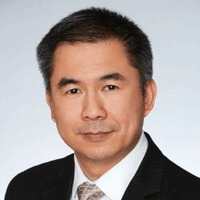
At FT, we have the privilege of a short interview with Professor Chung Tam, (above) who is President of the Global Supply Chain Classroom, the distinguished personality behind the remarkable achievement.
FT: Please elaborate on UN Global compact, World Bank and FIATA’s role in the promotion of the competition and the role of the sponsors within the organization.
CT: As a well-established and highly respected organization in the global supply chain industry, FIATA brings significant credibility and prestige to GS3. Support from its leadership and staff has been instrumental to the competition’s success. Many FIATA members including yourself, along with Stéphane Graber, have contributed their valuable expertise by serving on the judging committee. FIATA also enhances the student experience by hosting the Awards Ceremony during its Annual HQ Meeting and organizing educational activities in Geneva, including visits to United Nations Economic Commission for Europe, International Trade Centre, Geneva Airport cargo facilities, and Geneva Freeport. Most importantly, these opportunities allow students to engage directly with industry leaders, making the experience truly life-changing. Through its communication channels to members and media, FIATA also actively promotes GS3, strengthening global awareness of the competition.
Support from the United Nations Global Compact’s Principles for Responsible Management Education (UN PRME) has been instrumental in helping us expand our network into regions where we may not have strong connections with universities. With over 800 signatory member institutions—comprising business schools and universities worldwide—UN PRME provides a valuable platform for outreach. GS3 is closely aligned with UN PRME’s principles, which strengthens our collaboration. UN PRME supports the promotion of the competition through its Regional Chairs, and its representatives also serve on the judging committee, contributing their expertise in sustainability.
The World Bank has also supported the competition by providing both judges and case studies. Their involvement offers valuable insight into the urgent global challenges they are addressing and helps guide the overall focus of the competition. The generous sponsorship of TWTH Express enables the winning teams to travel to Geneva to participate in the Awards Ceremony. TWTH also contributed two cases for the most recent competition and supports the development of the Sustainable Supply Chain Leadership Program, the educational component that accompanies GS3. Through these initiatives, TWTH demonstrates a strong commitment to nurturing the next generation of sustainable supply chain leaders.
FT: The GS3 award is marked with a strong forward looking character: “The competition, recognized by the UN, awarded student-driven solutions focused on sustainable logistics and carbon reduction.” These perfectly complementary objectives seem today more complicated to achieve. Is there an issue for this kind of competition to remain relevant in a world that changes at the speed of light?
CT: GS3 was envisioned as an educational initiative rather than a competition to select winners. It embodies the spirit of the German saying “Der Weg ist das Ziel” — the journey is the goal. Through participating in the competition, students learn about sustainable supply chain design, cross-cultural collaboration, systems thinking, and the integration of environmental, social, and business considerations into real-world decision-making. More importantly, they develop global leadership skills, ethical awareness, and the confidence to engage constructively with complex sustainability challenges. In this sense, GS3 is not about who wins a trophy; it is about shared growth and collective progress — which is why I believe GS3 will remain relevant in a fast-changing world.
There are many competitions available for students, including well-established events supported by major corporations and leading universities, often offering attractive prizes—many in the form of cash awards. In contrast, GS3 has relied on minimal promotion. Awareness of the competition is primarily generated through the Global Supply Chain Classroom’s (GSCC) network within the supply chain education community and the industry network of FIATA. Our strategy has been to prioritize the continuous improvement of the competition, ensuring a meaningful and positive experience for all participants.
Students choose GS3 for several key reasons. From the outset, GS3 was designed as a truly global competition. Recognizing that English is not the first language for much of the world—yet remains the default language of business—we adopted a standardized six-page PRFAQ format for written submissions to help reduce language barriers. The competition is conducted entirely online, eliminating the need for travel and increasing accessibility. Participants can select from multiple real-world supply chain challenges, allowing them to focus on topics most relevant to their interests and local contexts. Presentation schedules are designed with flexibility in mind to accommodate different time zones, and judging panels include experts from around the world. These features collectively contribute to GS3’s success as a global competition.
Much of GS3’s growth has been driven organically through referrals from students and educators. The competition has since gained recognition from organizations such as the United Nations and the World Bank, reflecting its mission to advance education and make sustainable supply chain knowledge more accessible worldwide. This recognition attests to GS3’s quality and impact which will help attract more participants.
On these inspiring words, let me come to the conclusion of this new, and please forgive me rather long, feature about FIATA’s HQ session. FIATA is effectively defending its Members’ interests, but it has always incorporated an even higher, more inspirational spirit of service. With its training activities that date back in time by several decades, FIATA has laudably maintained the flame of knowledge burning within its wide-ranging ranks across the globe. The FIATA Foundation contributed to developing courses in areas of the world that were less equipped than others to deliver training and tuition, thus providing bridges to the disparities that modern life has yet failed to absorb.
As we have said more than once in this article, this year’s HQ session happened in a period that will not go down in history as a peaceful one; many delegates could not or would not attend due to disruptions and difficulties, when they were not directly affected by the operations on the ground. Yet, it was a completely meaningful assembly, which was a live testimony of the resilience of our sector in its continuing operations, even during times of perturbing tensions. So let me close this page with another shot of the same scene we have used at the opening.
This is again the FLI panel, a shining example of the constructive, positive looking debate that was capable of lifting the attention of the participants above the objectionable contingency of belligerence and take them into the domain of education and learning, a content by definition ripe with hope and expectation.
The hopeful faces of the participants in the GS3 competition, participating from all corners of the world, represent the very essence of hope and this is a commodity that today is more required than ever . . . Thucydides said that hope is an expensive commodity, not in FIATA apparently . . . That is where it comes in abundance.
I wonder what Mrs. Thatcher, who had her own special understanding of hope, would say at this point . . . The concept of hope can be controversial, as it means so many different things for different people, but the way hope can shape our future, in particular when assisted by prudence and sound judgement . . . well, it can make our future appear closer and more desirable.
In 1968 a man who never managed to become President of the USA was killed before he could be elected. During his funeral these words were spoken. If you have eight minutes to spare, please listen and watch. This short audio-visual will tell you a lot about what we were, what we are and what we could be, depending on the way we understand the meaning of hope.
Marco Sorgetti |










 100%
Green
100%
Green