FRA Emerging
As New World Power
 Building
on a legacy of excellence, FCS is building new friends for Frankfurt
air cargo in the 21st century. But whether in the air or on the ground,
it’s all one big airplane at Frankfurt.
Building
on a legacy of excellence, FCS is building new friends for Frankfurt
air cargo in the 21st century. But whether in the air or on the ground,
it’s all one big airplane at Frankfurt.
Often the question is raised:
“What has our local airport done
lately?”
From our vantage point, Frankfurt, Germany
has emerged as the aerial gateway epicentre to Europe and the world
for the 21st century.
Change and growth have come fast and furious.
Right now Fraport, the Frankfurt International
Airport operator is involved with major construction projects to handle
ever increasing volumes of air cargo and passenger business at home,
while at the same time expert managers from the airport operator are
fanning out around the globe with ambitious initiatives to spread hard-won
German expertise and airport know-how to other airports around the world.
Fraport has acquired Frankfurt Hahn, an
ex-U.S. Air Force base.
From that association Hahn has emerged,
as landing strip to white-hot, discount carrier Ryanair and a low cost
passenger hub on the continent is born and leading the way to tomorrow
with plenty of cargo action to boot.
Fraport is managing several airports in
Europe, one in Latin America and will continue to offer all kinds of
airport related know how and services abroad.
To be sure this expansion has not always
been a bed of roses.
Fraport cannot again invest big money
that has to be written off, as it did in Manila.
But long term when you speak to top management
here, the target is to produce about 50 percent of all revenues outside
FRA.
A big part of future expansion plans can
be witnessed in Fraport’s Jacksonville, Florida operation.
The local airport authority in that Florida
U.S. city, asked for help.
Fraport of course was all too happy to
provide assistance.
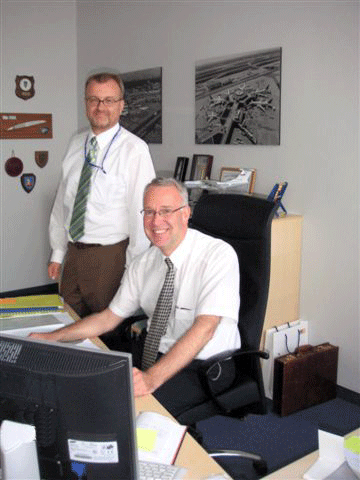
Overlooking the busy ramp in front of terminal one
at FRA is the office of Peter Schmitz, who once upon a time served as
a logistics specialist with the German Air Force. With Herr Schmitz
is Winfried Hartmann, managing director of Fraport Cargo Services GmbH.
These executives see their success at FRA as blueprint for a growing
number of airports served by Fraport worldwide.
Fraport Executive Vice President
Aviation Ground Services & Logistics, Peter Schmitz relates how
the Jacksonville involvement is progressing:
“We sent people to Florida to design
and operate a baggage handling system that serves some 5 million passengers
yearly at JAX:
“Jacksonville turned out to be a
challenging and interesting showcase to demonstrate our abilities in
North America.
“For the time being we work for
the JaxPort authority exclusively.
“But as we gain better understanding
of how ground services are operated in America, (the requirement is
quite different from Europe) we will offer our skills to other airlines
and gateways as well.”
The downward pressure to save money has
not relented since 911 but in fact has heightened as the cost of fuel
continues to rise.
By now one is aware that world streams
of aviation, and especially cargo following foreign trade, have shifted
to the Far East.
As example we can see at Le Bourget in
Paris that overcapacity is opening the cost/revenue scissor even wider.
It can be said that the growth of cargo
volume is over proportional at FRA s well.
We imagine ebullient airline reps rushing
into Fraport Managing Director Cargo Services, Winfried Hartmann’s
office shouting:
“Yippee – I’ll soon
have five freighters here for you instead of the three,” and being
met with a smile and a quizzical glance as the next sentence follows.
“What discount can we expect now?”
Frankfurt, while welcoming everyone is
feeling the pinch in terms of slots, a squeeze that will be lessened
when FRA finally builds an additional runway.
But as mentioned, expansion and new ideas
have not always worked as planned although the search for new revenue
streams continues.
Tradeport Frankfurt as example had a promising
start and seemed to take off but flattened out.
Maybe Tradeport logistics activities rubbed
a bit too close to the domains of the strong German forwarding industry.
But lessons were learned including that
forwarders with the strongest margins in the airfreight chain comprise
a powerful not to be intruded upon force in the air cargo business.
The positives here are an entrepreneurial
spirit willing to explore new territory.
Nothing ventured, nothing gained.
But where does Fraport move in the future?
Ground handling fees offer little room
for growth because the reality is, return will not exceed 5%, max 7%
of the total cost.
“There is more business to be had
from around the world especially as the culture of our service quality
is better understood,” Mr. Hartmann said.
One possible change heard in whispers
right now is that Fraport Cargo Services may find a European or global
partnership to offer a broader menu of services.
But in any case these well-versed executives
are eager, excited, animated and thinking about tomorrow.
Fraport
Learns A New Dance
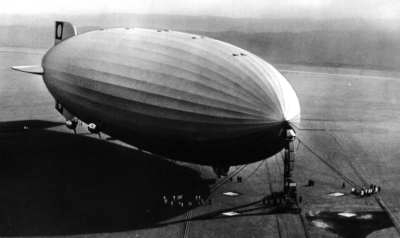 The
Graf Zeppelin on its moveable anchor at Frankfurt just before both the
hangars and the Graf were broken up by government order on May 6, 1940.
The
Graf Zeppelin on its moveable anchor at Frankfurt just before both the
hangars and the Graf were broken up by government order on May 6, 1940.
Frankfurt am Main was the
venue where German civil aviation developed faster than in other regions
of the country.
Here was the docking base for the giant
Zeppelin Airships located southwest of the city, and the old airport
as well.
Both sat on the site of the current international
fair grounds, “The Messe Frankfurt.”
Back in the early 1930’s a pair
of zeppelin hangars and a grand passenger terminal transformed the landscape
into a new European landmark for air travellers, who flocked to the
field in some cases just to dine around a reflecting pool and watch
the air show.
Deutsche Lufthansa was here at the beginning
too ensconced in hangars and buildings that were owned and managed by
the airport company,
Flughafen Frankfurt Main AG which in turn
was entirely controlled by civil institutions.
Consequently all airport employees were
public servants – a fact that played a major role in airport development
post World War II.
Although Frankfurt operated what was generally
referred to as a “soft” monopoly, “The United States
of Europe” the European Union or EU, overruled the FRA scheme.
The EU said member countries would dance
to a new tune.
 European
Commission also said that there would no longer be monopolies in ground
handling at major European airports.
European
Commission also said that there would no longer be monopolies in ground
handling at major European airports.
Airports just like the rest of Europe
would open up for competition under the new EU ground handling directives
as of 1998.
Global as well as local third party ground
handling providers blitzed the market looking for new business.
Competition grew as seemingly endless
double-digit growth rates in tonnage were recorded at FRA.
But then 911 caused a big drop in business
and rate slashing became the norm here.
The fallout from all of this activity
was that the highly trained and respected professional workforce at
FRA, who had held employment almost as a birthright at FRA since its
start-up some sixty years ago, were caught in a big squeeze in the new
Europe as losses mounted all around.
The challenge was how to keep the workforce
and make its business profitable.
After about 18 months of negotiating with
the airport unions an agreement was reached to out-source the entire
activity and a subsidiary, Fraport Cargo Services GmbH was formed on
July 1, 2004.
The service provider today is a 100 percent
subsidiary of Fraport AG, a major tenant of facilities in “Cargo
City South.”
Elsewhere at the gateway, Lufthansa Cargo
busy with its own freight, manages to handle about 9 percent of the
third-party cargo throughput at FRA.
Somehow the integrators coming to FRA
must be considered like exotic birds.
FedEx moves the second largest amount
of cargo through FRA after Lufthansa.
Third in volume is Korean but moving up
fast are Emirates, Asiana, Cathay Pacific amongst the top ten leaders
at FRA.
Meanwhile competitors on the ground for
Fraport Cargo Services include WFS, Globe, Swissport, Aviapartners and
others.
Remember LUG that was formed during the
1960’s to relieve import problems?
Well they are still here too providing
cargo handling.
LUG, which may be the best name ever invented
in any language for an air cargo company, is expanding its cargo warehouse
and handling center at Frankfurt Airport's CargoCity South by about
2,000 square meters of office space.
The four-story 6,000 square-meter building
will grow a new wing and, simultaneously, a fifth story over the expanded
building.
Costs are also mostly unchanged although
impact from the IT-systems has lessened the blow a bit.
Warehouse and ramp shift-regulated jobs
and the share of labor on the cost-side of all providers are extremely
high.
Fraport has learned the new dance sometimes
the hard way.
“We have experienced quite an encouraging
year,” Managing Director Winfried Hartmann said.
“FCS continues to offer premium
service.
“We serve the same customers as
before the outsourcing.
“Our objective is to serve 50 percent
of the freehand volume, some 18 percent of the entire tonnage at FRA.”
(Günter Mosler)