  USA
Air Cargo Bashing USA
Air Cargo Bashing
At FIATA Dubai
With the Rugby World Cup
set to finish in France tomorrow night, the Europeans today got a head
start on another of their favorite sports at the FIATA World Congress
2007 – American bashing.
The first session got underway in Dubai
with the question: 100% Transportation Security – Myth or Reality?
The topic is always an emotive one, not
the least because – to the non-American freight community anyway
– it seems as if the U.S. decides on security legislation and then
imposes it not only on its own cargo industry, but on every cargo industry
in every country with which it trades.
Which includes most FIATA members. And,
more importantly, which costs said FIATA members, their businesses and
their governments a lot of money.
Richard DiNucci of the U.S. Customs &
Border Security was the first speaker and sole American on the panel,
which also included representatives from the European Community (EC),
DP World and FIATA.
In response to the question of the day,
he said that U.S. Customs favored a “layered approach”.
“It is possible,” he said, “with
layers that if you have 80 percent success on all levels you significantly
increase the potential for success. 100 per cent security is not something
that will necessarily occur because threats are always changing.”
Nature Of Trade
Second speaker Roeland Van Bockel, Director
General for Transport & Energy, EC Directorate for Security, pointed
out that 100 percent security had never existed in Europe’s long
trade history and it certainly didn’t exist now.
He acknowledged that in the last 20 years
a number of issues – most notably 9/11 – had changed that
nature of trade.
“Freight forwarders like complications,”
he said, “because they can make more money from having them because
freight forwarders are the brightest in the supply chain.”
However, according to Van Bockel, terrorism
is not the main threat for European freight forwarders.
Rather, it is theft of their cargoes.
He advised forwarders not to focus on having
100 percent security, but instead to try and get the most money out of
the security measures they were forced to implement.
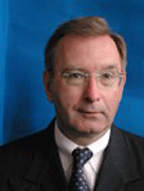 When
it was time for Jean-Claude Delen, Chairman of the FIATA Working Group
on Security, to speak he promised to be provocative. When
it was time for Jean-Claude Delen, Chairman of the FIATA Working Group
on Security, to speak he promised to be provocative.
The man did not disappoint.
In his opening remarks he referred to the
U.S.’ goal of scanning 100 percent of all containers entering the
country as a joke.
“It will never be achieved,”
he declared, before going on to dismiss the promise to do so as “political
window dressing”.
“What is different about an aircraft
coming into the U.S.?
"All terrorist actions have come from
inside, not outside, the countries in which they happened,” Delen
cried.
“The U.S. Customs have moved the U.S.
borders to several countries outside of the U.S., yet there is no evidence
that cargo coming from outside the U.S. is any more dangerous than that
leaving the U.S.”
“Europe has tried to cooperate with
the U.S. for seven years but it has not been easy,” lamented Van
Bockel moments later.
As one European delegate pointed out (or
accused), the U.S. security measures impact taxpayers all around the world.
The high cost of security which airports and ports overseas are forced
to implement are passed on to the taxpayers in those countries.
“In Europe there are 27 countries
and all of them have their own stake in the U.S.,” sighed Van Bockel.
“It is very difficult to deal with U.S. Congress – not only
for others, but Americans also.”
When he finally had the chance to answer
some of the critics, DiNucci pointed out that the U.S. has to ask, not
just demand, other countries scan goods bound for the U.S.
“If they don’t, we have to take
action stateside.”
Siobhan Oswald
|