



|
|
|
| |
||
|
||
|
||
|
Vol. 7 No. 31 WE COVER THE WORLD Tuesday March 25, 2008  |
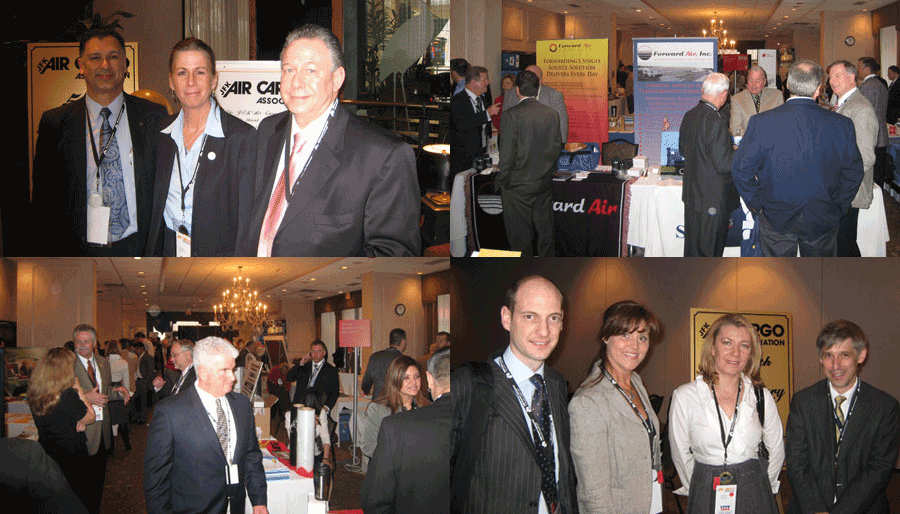
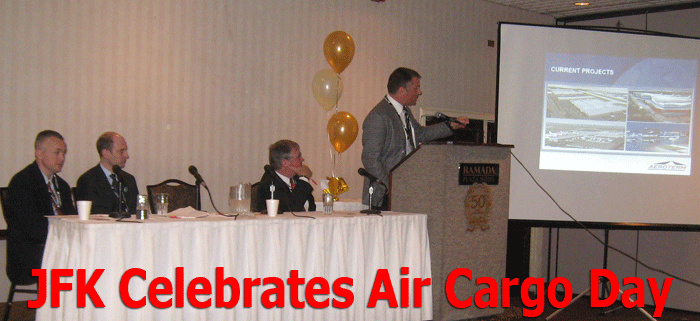
They celebrated a ninth annual
Air Cargo Association Air Cargo Day at JFK International Airport in New York
last week on Thursday March 19.
At a grand luncheon during the compact one day
event, Willie Mercado who serves as top Aer Lingus Cargo executive in USA,
although cast in the unlikely role of master of ceremonies, delivered a list
of thanks to the many people that helped make this annual touchstone of springtime
here a success.
Willie also led everyone in a simple yet haunting
tribute to New York air cargo stalwart and transportation icon Bill Greenway
who died on March 7 at 87 years of age.
But perhaps the most revealing thing that Mr.
Mercado said was in a personal public aside when he explained why he continues
to serve the club and the air cargo community.
“They came at me to ask that I serve as
ACA Club President and I wanted to hide somewhere,” Willie said.
“Then I started to think about all the
other board members and the people at this airport and how much these folks
mean to me and I signed up.”
At table number three Jim Larsen who held Willie’s
post for a record 12 years smiled and said:
“This is one of the first times I have
gotten to eat a meal at one of these air cargo fests.”
 Bob
Arens,Willie Mercado and Ginger Priolo in New York; Harold Hagans, Robert
Kennedy, Rachel Worley and Kevin Madden in Atlanta; Bettina Hickler, Stephan
Haltmayer, Mathias Jakobi in Frankfurt may not be names that you know.
Bob
Arens,Willie Mercado and Ginger Priolo in New York; Harold Hagans, Robert
Kennedy, Rachel Worley and Kevin Madden in Atlanta; Bettina Hickler, Stephan
Haltmayer, Mathias Jakobi in Frankfurt may not be names that you know.
But all have one thing in common.
They are people that for months and years put
themselves out for the common good, at times irrespective of their own priorities,
to support airport cargo communities.
These people like a thousand more at airports
everywhere are the glue that hold the air cargo business together.
They set up the golf outings and send out the
mailers and make the late calls and emails and count the money and pay the
caterers and generally bring to everybody the best of the air cargo business.
Make no mistake about it, the future of the
air cargo industry needs good local clubs.
The 2008 edition of the air cargo annual in
New York sold out the hotel ballroom for lunch and filled the narrow display
hall with booths with arm to back attendance.
An early morning panel of several of the usual
suspects on the speakers’ circuit talked up subjects such as security,
air cargo real estate and handling, India and China future-speak, and other
subjects in a breezy two-hour format that allowed for plenty of networking
before lunch.
 The
event also served to mark the 50th anniversary of the air cargo club although
the airport actually opened for business in 1948, when presumably the early
Pan Am and other world carriers were carrying some air cargo.
The
event also served to mark the 50th anniversary of the air cargo club although
the airport actually opened for business in 1948, when presumably the early
Pan Am and other world carriers were carrying some air cargo.
At that time and forward into the early 1970s
more than 80% of all international air cargo traveled overseas from USA via
the New York/New Jersey airports.
Today that number has shriveled to maybe 20%,
still sizeable, but in truth a mere shadow of former glory.
Air cargo traffic at JFK has departed to other
USA gateways with growing air services and more aggressive business programs,
including facilities development and better highway and rail access.
It’s worth noting that while many new
air cargo terminals appeared at JFK, several carriers at this pioneering cargo
airport are still operating out of the ancient first generation facilities.
Some older cargo buildings including the former
Varig and Alitalia cargo sheds sit empty and unused and appear crumbling as
the seasons change.
Elsewhere last Thursday in New York at JFK the
conversation on nearly everyone’s lips in addition to uncertainty driven
by runaway fuel costs, was about how to cope with the downward pressure of
enhanced security and looming 100% screening plus other TSA air cargo mandates
and demands.
 But cargo people are nothing if not resilient
and always seem ready to launch another set of city pairs and new options
aimed getting the goods to market.
But cargo people are nothing if not resilient
and always seem ready to launch another set of city pairs and new options
aimed getting the goods to market.
“We are developing great connections via
our London to destinations in Europe and into the Middle East including four
gateways in Saudi Arabia,” said John Ryan, (left) US CSM at bmi air
cargo.
“Our A330 flights from Las Vegas offer
west coast shippers a raft of unique service options beyond London as does
our outbound daily Chicago service for east coast and middle America shippers,”
Mr. Ryan added.
 “Much
of what a carrier can offer can be realized from being inventive with service
options while tailoring actual flights to bring air cargo to destinations
that others have either overlooked or chosen not to serve,” said Guy
Hardy, Head of Cargo Sales, Brussels Airlines.
“Much
of what a carrier can offer can be realized from being inventive with service
options while tailoring actual flights to bring air cargo to destinations
that others have either overlooked or chosen not to serve,” said Guy
Hardy, Head of Cargo Sales, Brussels Airlines.
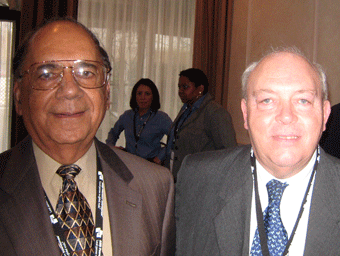
The longtime air cargo executive (in photo right)
and his colleague in America, Dave Sharma (left) both spoke of the great success
Brussels Airlines is realizing moving cargo from destinations around the world
via gateway Brussels into Africa.
“Sabena almost never turned profits but
Brussels Airlines is making money both above and below deck with our service,”
Dave Sharma added.
“Once we were hotels and catering and
all kinds of asset-driven business,” Guy Hardy recalled.
“Now we are the default champion of passenger
and air cargo service delivery to Africa with flights to Angola, Burundi,
Cameroon, D.R. Congo, Gambia, Guinea, Ivory Coast, Kenya, Liberia, Morocco,
Rwanda, Senegal, Sierra Leone, Uganda—you name it.”
Interestingly Brussels Airlines in its rebirthing
of Belgium international commercial aviation has chosen not to resume line
services into New York.
“Our code-share with American Airlines
is working for us now,” Mr. Sharma said.
“Africa and our culture for service—Sabena
to Brussels Airline—is building our future,” Guy Hardy said.
“Next will come even more aggressive development
including a low cost carrier subsidiary based in Kinshasa with service to
several new cities.”
Geoffrey
Is it feasible for low-cost
airlines to carry cargo? That is the question many Indian aviation experts
are asking. It does not really matter what the reply will be but SpiceJet,
one of India's low-cost airlines has also started looking at the cargo business.
Speaking to Air Cargo News FlyingTypers
SpiceJet executive chairman Siddhanta Sharma said: "We are aggressively
going behind cargo business. For that we are developing our own infrastructure
at various ports, our own x-ray machines and other set up."
SpiceJet planes have been carrying courier
cargo quite a while now and wants to move up the ladder with higher loads.
Sharma also said: "Our aircraft can carry about two tons of cargo and
we are operating about 120 flights per day, which means we can carry 240
tons every day. We are doing 60-70 tons of courier every day, so we can
carry about 180 tons more."
He also mentioned that SpiceJet was already
carrying cargo for the government's postal services – India Post –
along with Jet Airways. India Post has leased an Air India Boeing 737-200
to ferry letters and parcels to the less-connected stations of the North-East
from Kolkata.
Tirthankar Ghosh
|
 "Easy
flight, nice landing and a very warm welcome by you people here at the airport,"
stated Niki Lauda while he climbed out of his Challenger bizz jet to shake
hands with the welcome committee that stood in line at the apron of Luebeck
Airport in Northern Germany. Lauda had come to Luebeck because of a meeting
with local executives from Hermes Versand the logistics pillar of the world's
leading multi-channel retailer Otto Versand.
"Easy
flight, nice landing and a very warm welcome by you people here at the airport,"
stated Niki Lauda while he climbed out of his Challenger bizz jet to shake
hands with the welcome committee that stood in line at the apron of Luebeck
Airport in Northern Germany. Lauda had come to Luebeck because of a meeting
with local executives from Hermes Versand the logistics pillar of the world's
leading multi-channel retailer Otto Versand.
Prior to the event the three times Formula
1 world champion (Ferrari /
McLaren) gave Air Cargo News Flying Typers a brief
interview in the airport's cozy lounge regarding future topics on the agenda
of his 2003 established airline NIKI.
"Yes, we are shaping on plans for long
haul flights," revealed Vienna-born
Lauda. "If the outcome of our analysis is positive we will deploy Airbus
330 on routes abandoned by competitor Austrian Airlines," he added.
Without however, unwrapping details regarding neither the agenda for any
further steps nor the time frame for the maiden flight of NIKI's first intercontinental
endeavor. "Fareast and especially China could be proven to be interesting
targets", he indicated possible destinations, excluding however, any
services to Australia. There, his arch rival AUA had stepped out completely
in recent times.
According to the 59 year old, the A330 makes
sense because his NIKI airline could capitalize from the collaboration with
Air Berlin, Germany's number two airline after first ranked giant Lufthansa.
"There are a lot of synergies such as technical support, aircraft maintenance
or the flow of components," he said. A year ago Air Berlin has acquired
leisure carrier LTU, which presently operates twelve A330 out of Duesseldorf
and Munich.
Air Berlin is a minority stakeholder (24%)
in NIKI. Both airlines coordinate their schedules on short and medium haul
flights. "Between Germany and Austria we jointly offer the market about
300 flights per week, thus surpassing Lufthansa and their Star partner AUA",
Lauda lauded the mutual well doing proudly in Luebeck.
Last year his NIKI transported 1.7 million
passengers, thus posting 186 million euros revenue and a net profit of 4
million euros. In 2008 he forecasts 2.1 million guests and 220 million euros
revenue. NIKI's alliance with Air Berlin accounts for "as much as 15
percent savings since we can use their entire infrastructure, like their
IT system, which makes us a very lean enterprise," he said. In fact,
he needs only 20 office personnel in his Vienna-based headquarters to run
his airline. All in all there are 80 pilots, 160 flight attendants and 43
technicians on NIKI's payroll.
While the number of passengers grows steadily
cargo transports remain a niche product. "We do have some shipments
on board but air freight is not a big issue for us," he confirmed.
Duesseldorf-based Leisure Cargo a former subsidiary of LTU and
member of Air Berlin manages the freight business for the entire Air Berlin
group.
Heiner Siegmund
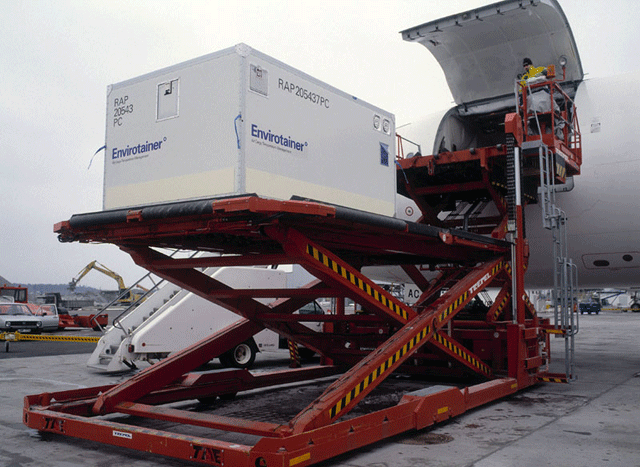
DHL said it has a new global partnership
with Envirotainer to utilize temperature controlled air cargo containers.
DHL will use Envirotainer’s specialized
equipment for temperature-sensitive shipments worldwide expanding capability
in transporting chilled and temperature-sensitive products, such as pharmaceuticals
and medical equipment, for the life science and healthcare industry.
As part of the agreement DHL has added Envirotainer
training and audit program across its network, to reach ‘Qualified Envirotainer
Provider’ (QEP) status.
First successful audits have already taken place
at several locations.
Robert Krautheim, President of Life Science
and Healthcare at DHL Global Forwarding, commented:
“This global relationship with Envirotainer
supports our initiative to establish dedicated competency centers and regional
hubs in the cold chain market which support our customers’ requirements.
Aligning our DHL programs with Envirotainer’s
‘Qualified Envirotainer Provider’ program means that we can offer
the highest levels of quality to our customers, worldwide.”










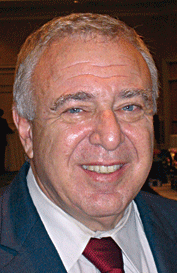 Bill
Boesch Wins Medal Of Honor
Bill
Boesch Wins Medal Of Honor  Or
if you live and love long enough you get to seem some pretty strange
things!
Or
if you live and love long enough you get to seem some pretty strange
things!