Pioneer Olga Lifts Transaero
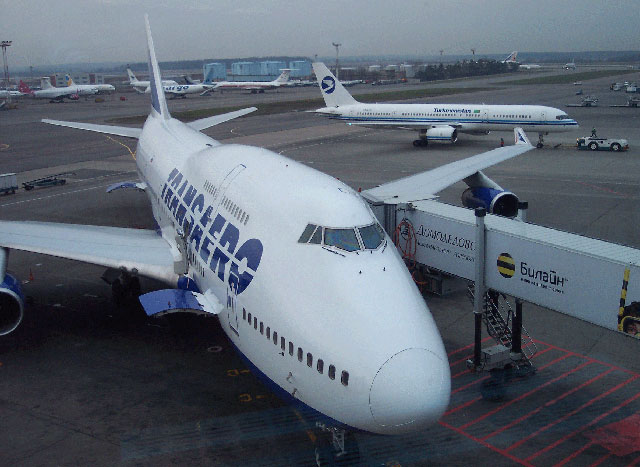
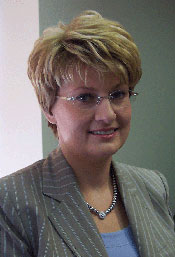 Olga
Pleshakova leaves no doubt: Olga
Pleshakova leaves no doubt:
"We are a faithful Boeing client and
we will stay a loyal partner of the U.S. manufacturer in the years to
come."
A clear commitment is hear all around by
Olga, the general director of Moscow-based Transaero Airlines.
The 42-year old energetic, determined and
straightforward talking person represents the new generation of industrial
leaders in today’s Russia.
And she’s successful, too, by becoming
the first female ever to run an airline here.
Today, privately owned Transaero ranks second
in terms of international routes and frequencies, right after state-run
Aeroflot.
Major shareholders are Mr. and Mrs. Pleshakova
(approximately 50%), local banks and investment companies.
"We serve destinations in five continents
and if there were adequate airports and traffic flows we’d also
fly to the Antarctic," she states.
To do so the airline needs adequate aircraft.
Problem is, an aspect very clearly emphasized
by Olga, that the national manufacturers between St. Petersburg and Vladivostok
cannot provide the equipment as needed by the carriers here. "There
has been a standstill for about fifteen years in this once flourishing
industry with highly negative consequences for the local carriers,"
Olga lays her fingers in a big national
wound.
Nevertheless, there could be seen some improvements
lately with manufacturers like Tupolev and Ilyushin offering new aircraft
models.
But their products obviously still keep
trailing technical and operational standards set by Boeing or Airbus.
Like the Tu-214 Transaero had ordered, a
step being taken also due to the Russian government’s pressure,
admits Olga Pleshakova.
So far only one Tu-214 out of a major order
of ten has been delivered to her airline.
Transaero is not really happy with the aircraft
since delivery commitments have not been met.
"Since we are rapidly growing we will
stick to our partner Boeing for the time to come to enlarge our intercontinental
fleet," she declares regardless of her own government’s pressure
to `buy Russian´. After all Transaero does not have a real market
alternative.
Further she criticized the special taxes
imposed by the Putin administration on all Russian-registered airlines
if they purchase foreign-built aircraft.
They consist of 20 percent of the full price
for each jetliner with less than 300 seats aboard.
"We operate in a weak currency market
but are forced to pay extra taxes in hard currency by government decision,"
she declares.
"These additional expenditures for
our fleet do not make it easier for us to successfully compete with European,
Asian or U.S. carriers that have to pay less for their planes."
Last year Transaero's number of passengers
grew to 3.2 million, plus 51.7% year-on-year.
Air freight tonnage grew by 17% to 18.000
tons.
Boxes and containers however, admits head
of cargo, Alexander Vladimirov, will not be more than a niche product
contributing between 3 to 4 percent to the total revenue of USD$727 million,
the airline posted in 2006. Current figures will be announced by the end
of April.
Then Olga will declare that the net profit
fell a bit below the USD$10 million mark Transaero made in 2006. "We
are constantly enlarging our intercontinental network and therefore our
fleet," resulting in the lower gains, she explains. Presently the
fleet consists of 33 aircraft all of them Boeings, except for the one
Tu-214.
And several B777s, 747-400s and -300s as
well as B767-300s are to come.
Next Transaero plans to introduce a first
class product because of increasing customer demand and the offering of
a new premium economy class.
Starting in the fall the airline intends
to add New York, Los Angeles and Rio de Janeiro as well as some destinations
in Southeast Asia to its network.
They will be operated out of Moscow Domodedovo,
the carrier’s intercontinental hub South of the Russian metropolis.
Heiner Siegmund
|













 If
you tell someone that Cathy Hanna is part of the heart and soul of Los
Angeles air cargo you won’t get an argument.
If
you tell someone that Cathy Hanna is part of the heart and soul of Los
Angeles air cargo you won’t get an argument. “I
was fortunate enough to work for one of the best run airlines that encouraged
women to move into the more non traditional roles.
“I
was fortunate enough to work for one of the best run airlines that encouraged
women to move into the more non traditional roles.