 |
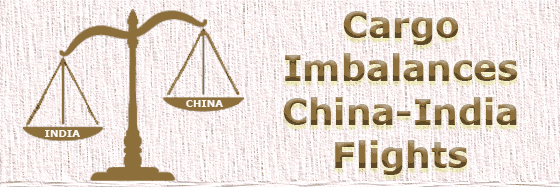
When India-China direct passenger flights resumed in October 2025 after a five-year freeze, the return of scheduled connectivity was read as a symbol that regional aviation normalization in Asia was finally back on the table. But beneath the visible reopening, the invisible asymmetry that freight carriers care about most remains firmly in place. While flying passengers between the two markets is now routine again, flying cargo is still deeply asymmetrical — because China continues to maintain one of the hardest limits in the world on foreign cargo charter access.
This is not a marginal issue. For India, one of the fastest-rising air freight markets globally, this is becoming a strategic handicap.
Since June 2024, Advisory Circular AC-129-FS-001R2 from CAAC caps foreign airlines that do not possess a CCAR-129 certificate to 10 cargo charters in any rolling 12-month period. Even carriers that hold the certificate need separate approvals every time they want to serve a new Chinese airport; until that amendment is issued — which can take months — they remain stuck under the same 10-per-year ceiling anyway.
This effectively makes scalable or seasonal catch-up capacity impossible. A sector whose economics inherently depends on pop-up, burst-season, short-cycle lift — perishables, pharma, auto parts, e-commerce replenishment — simply cannot operate with fixed micro ceilings.
India — in sharp contrast — allows foreign cargo charters unrestrictedly under CAR 158/158A and the 2024 Open Sky Policy for non-scheduled freighters. No annual numeric limits. Only safety and compliance checks.
The design philosophy is different. India regulates operational integrity while China regulates market access. This is at the core of the asymmetry. And as long as this is unresolved, the imbalance becomes a long-term structural advantage for Chinese operators. Because Chinese carriers can scale into India instantly during peak cycles. Indian carriers cannot scale into China at all.
India and China are freight giants. India is averaging 195,000 tonnes international per month in 2025 — 13% above 2019. China’s international volumes are 48% above pre-pandemic levels. And India–China trade flows are now heavily air dependent across three major city pairs: DEL–SHA, BOM–PEK, and MAA–SZX.
Yet Indian exporters often end up routing via Hong Kong, Dubai or Singapore during peak windows because Indian carriers are shut out from direct Chinese lift. Which means the margin, the network stickiness, and the pricing power shifts away from Indian airlines — and in some cases, even away from India-based logistics.
Europe doesn’t do hard caps. ASEAN doesn’t. The Gulf doesn’t. When restrictions exist, they are typically slot or congestion driven — not blanket ceilings. China’s 10-in-12 rule is an outlier among large, interconnected freight export economies.
This now has to migrate to diplomacy and there are three realistic solutions:
Time-limited, transparent Ops Spec amendment timelines in China — not discretionary open-ended approvals.
A bilateral charter reciprocity protocol under the Air Services framework — like India uses with ASEAN and EU partners.
Measured reciprocity by India — only if the first two don’t work — but this is philosophically opposite of India’s liberalisation ethic.
India is positioning itself to become a high velocity, high reliability global freight hub as part of Make-in-India and export-led industrial policy. If China ends up being the only major market where Indian carriers face structural non-scalability, then every other policy intervention — fleet expansion, conversion programmes, domestic freighter feed networks — loses leverage.
This is no longer a regulatory technicality. This is a hard competitive disadvantage. And it’s time both governments treat it like one.
Tirthankar Ghosh
|






 FlyingTypers reserves the right to edit all submissions for length and content. All
photos and written material submitted to this publication become the
property of FlyingTypers Media.
FlyingTypers reserves the right to edit all submissions for length and content. All
photos and written material submitted to this publication become the
property of FlyingTypers Media. 100%
Green
100%
Green