 |
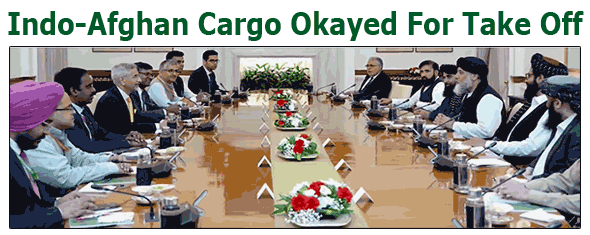
When India decided to switch on its long-dormant air cargo corridors with Afghanistan, it wasn’t merely resuming flights. It was reasserting itself in a geopolitical space that has grown more contested, more volatile, and more strategically consequential since the Taliban takeover in 2021. The revival of dedicated Kabul-Delhi and Kabul-Amritsar cargo routes signals India’s calibrated return to a trade corridor that it now aims to reclaim.
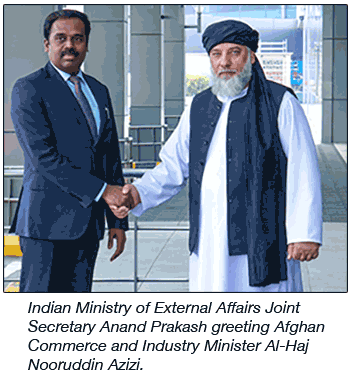 The announcement, made during Afghan Commerce and Industry Minister Al-Haj Nooruddin Azizi’s late-November visit to New Delhi, comes at a moment of renewed regional turbulence. Pakistan’s latest shutdown of land transit for Afghan trade — triggered by October 2024 border clashes — has stranded Afghan exporters, choked food and pharmaceutical imports, and once again exposed Afghanistan’s vulnerability. The announcement, made during Afghan Commerce and Industry Minister Al-Haj Nooruddin Azizi’s late-November visit to New Delhi, comes at a moment of renewed regional turbulence. Pakistan’s latest shutdown of land transit for Afghan trade — triggered by October 2024 border clashes — has stranded Afghan exporters, choked food and pharmaceutical imports, and once again exposed Afghanistan’s vulnerability.
India has moved into this vacuum with unusual speed and intent. Speaking at a PHDCCI event, Ministry of External Affairs Joint Secretary Anand Prakash confirmed that India has “reactivated” the dedicated cargo corridors and completed all procedural work. Flights can begin as soon as Kabul finishes internal paperwork. “This will significantly enhance connectivity and further strengthen our trade and commercial ties,” he said.
Afghanistan remains a steady consumer of Indian grains, pharmaceuticals, medical devices, engineering goods and textiles. With Pakistan sealing off land access, the air corridor is India’s only direct route to sustain what had been a USD 1.8 billion bilateral trade pre-2021. The figure had slipped to just over USD$ 1 billion this year — a decline India is determined to reverse.
The original India–Afghanistan Air Freight Corridor, launched in 2017 by Prime Minister Narendra Modi and President Ashraf Ghani, had quickly become a lifeline. More than 1,000 flights moved over 5,000 tonnes of perishables, carpets, dry fruits and Indian medicines between 2017 and 2020. The pandemic and political transition halted operations, but demand never evaporated. Afghan traders have repeatedly said the corridors were never a luxury — “they were survival routes.”
That survival instinct is sharper today. Afghan Deputy PM Mullah Abdul Ghani Baradar recently directed his ministries to “reduce reliance on Pakistan within three months.” Minister Azizi echoed this in Delhi: “Business should not be held hostage to politics. We want dependable access to Indian markets, and air cargo will stabilize our trade.”
India’s decision to reopen its Kabul embassy in November — upgraded from technical staff to a fuller diplomatic presence — is the biggest signal yet of a pragmatic shift. While India still does not formally recognize the Taliban administration, it has rebuilt working channels around security, humanitarian aid and trade.
No Indian airline currently flies to Kabul because Pakistan continues to deny overflight rights to Indian carriers. However, Kam Air and Ariana Afghan Airlines now operate 10–12 flights a week to Delhi — slightly higher than earlier this year — allowing limited belly cargo.
Afghan carriers have recently indicated interest in dedicated freighter operations once the corridor stabilizes, and Indian exporters have begun informal booking discussions for pharma and perishables.
The Ministry of Civil Aviation has also been evaluating whether charter-based humanitarian cargo missions could operate through Iran’s airspace if a Pakistan bypass becomes necessary — a development that officials privately say “may soon become relevant.”
The biggest strategic opportunity lies outside the air corridor. Afghanistan has renewed its push to access Iran’s Chabahar Port, jointly developed by India, as a long-term alternative to Karachi. Azizi urged Indian industry to “help operationalize the Chabahar route for Afghan exports,” noting that Afghan traders had already increased trial shipments through Iran this year.
For India, Chabahar is not just another port — it is a gateway to Central Asia and a counterweight to China-Pakistan connectivity projects. The air corridor is the quick fix; Chabahar is the structural solution.
In recent weeks, Beijing has intensified its commercial push in Afghanistan, including new investments in mining and logistics under the Belt and Road footprint. A Chinese delegation visited Kabul in November to discuss a proposed connectivity arrangement that would link Xinjiang to Afghanistan’s north.
Indian officials see this as further urgency to “re-anchor” India’s economic presence. The air cargo corridor, they privately acknowledge, is part of a broader effort to prevent Afghanistan’s trade ecosystem from tilting entirely toward China and Pakistan.
The restart of the air cargo link serves several simultaneous objectives for New Delhi:
• Maintain economic presence in a country where Indian goods enjoy high trust
• Bypass Pakistan and demonstrate an alternate connectivity model
• Re-engage diplomatically without recognizing the Taliban
• Rebuild strategic equities in a region Beijing and Islamabad seek to dominate
Indian exporters — especially pharmaceuticals, engineering goods, processed foods and perishables — are already preparing for a surge in demand. Afghan businesses, too, are positioning themselves to resume steady procurement cycles that had been disrupted for nearly three years.
India’s reactivation of the Afghanistan air corridors is not just a logistics decision. It is a geopolitical reset — a reopening of a crucial artery that carries commerce, influence and strategic leverage. As land routes remain hostage to politics and militarized borders, India has chosen the sky once again as the pathway to stability.
For both nations, this is about more than trade. It is about reopening a corridor of relevance — commercial, strategic and symbolic — at a time when the region’s balance is shifting, and routes are reshaping the map.
Tirthankar Ghosh |






 FlyingTypers reserves the right to edit all submissions for length and content. All
photos and written material submitted to this publication become the
property of FlyingTypers Media.
FlyingTypers reserves the right to edit all submissions for length and content. All
photos and written material submitted to this publication become the
property of FlyingTypers Media. 100%
Green
100%
Green