 |
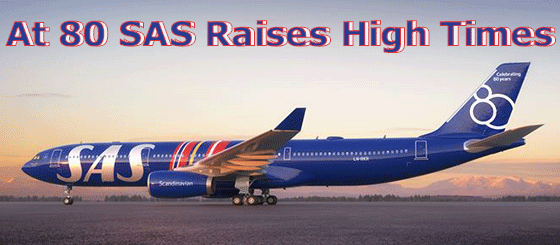
SAS Scandinavian Airlines just unveiled a refreshed livery, and it’s not just a paint job. It’s a birthday card in flight form, marking 80 years since the airline landed in USA with flights in the post–World War II era.
And when you think about SAS at its boldest, it’s hard not to picture that early leap across the Atlantic into New York—when international air travel still felt like a high-stakes expedition.
Back in September of 1946, SAS launched a pioneering Stockholm-New York service with a DC-4 called Dan Viking. That inaugural flight didn’t arrive at JFK, because JFK didn’t exist yet. Instead, it landed at LaGuardia’s Marine Air Terminal, a distinctive landmark building that still handles flights at LGA. The Marine Air Terminal, or MAT, was originally built for Pan Am’s grand flying-boat era and opened in 1940.
MAT is one of those rare aviation spaces where the architecture still feels like it remembers everything.
What’s remarkable is that MAT has had more than one close call.
It was saved once in 1980, when we as a publication made a major push that helped secure landmark status. And then, decades later, it faced another existential threat. In 2025, the Port Authority, LaGuardia’s operator—considered a renovation that would have changed the terminal so drastically that its historic identity would have been nearly erased.
The pushback this time gained serious momentum when we contacted Edward Trippe, the son of Pan Am founder Juan Trippe.
Mr. Trippe ultimately drove the issue into the public spotlight with an article in The New York Times, and the Port Authority backed off—for now—saying it had all been a misunderstanding.
However you label it, the outcome mattered: the Marine Air Terminal stayed standing as itself.
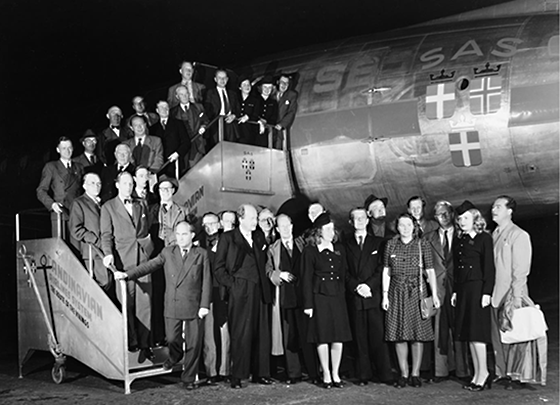 |
If you picture that 1946 SAS arrival at MAT, it’s striking how composed it all looks in hindsight—guests stepping off “Dan Viking” SAS DC-4 as if it were just another day.
But the trip was anything but casual. The journey from Bromma Airport in Stockholm took about 25 hours.
And it wasn’t a nonstop dash; it was a carefully staged crossing with stops along the way—Copenhagen’s Kastrup, Prestwick in Scotland, and Gander in Newfoundland before finally reaching New York.
And SAS didn’t treat this route like a one-time publicity stunt.
In 1946, the airline was already flying to New York twice a week from Scandinavia, including departures tied to Copenhagen and Oslo. By 1947, the route became a daily operation. It’s worth pausing on that: daily transatlantic service—before Idlewild Airport, the facility we now call JFK International, not even open until 1948.
Fast-forward through the decades and you can see how New York-area strategy evolved. SAS shifted its New York/New Jersey operations to Newark in 1989, working in partnership with Continental Airlines. Then, much later, SAS returned to JFK in 2023—and today the airline operates from both JFK and Newark, reflecting a modern approach to serving a complex metro region.
Right now in 2026, SAS connects to roughly 10 to 11 cities across North America, in both the United States and Canada. That footprint is very different from the early days, but the theme is similar: building reliable bridges between Scandinavia and the other side of the Atlantic, and doing it with consistency.
Now, since it happens to be baseball season, there’s another SAS story that fits the moment—one that has nothing to do with uniforms on the outside of an airplane, and everything to do with leadership behind the scenes.
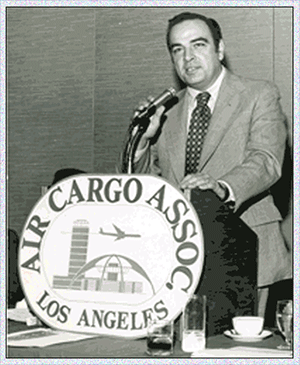 For air cargo in USA, SAS had a standout figure: Jerome “Jerry” Trimboli. He was once described as a “slugger without a bat,” which is a pretty good way to say he didn’t need spectacle to make an impact. He just delivered results—year after year. For air cargo in USA, SAS had a standout figure: Jerome “Jerry” Trimboli. He was once described as a “slugger without a bat,” which is a pretty good way to say he didn’t need spectacle to make an impact. He just delivered results—year after year.
Trimboli wasn’t simply holding a job title. He treated air cargo as a craft and a profession that could be built, improved, and shared. Guiding SAS Cargo for over more than 30 years he became a heavyweight presence—someone who pushed for better standards, stronger cooperation, and a more capable industry.
If you’re looking for a modern comparison, think of the kind of figure who’s always advocating for collaboration and professional growth across the sector, not just inside one company.
As far back as 1971, Trimboli talked about “professionalization” in a way that still sounds current. To him, the real route forward blended experience, knowledge, relationships, and reputation.
He argued that becoming truly professional wasn’t all that different for airlines and freight forwarders—and he pointed out that in many places overseas, the process started with serious internships and deliberate training rather than learning everything the hard way.
What made Jerry especially influential was his instinct to learn, then share what he learned. He helped spread stronger logistics practices broadly, raising the level of the whole community.
And he didn’t limit his contribution to SAS alone. He supported industry groups and networks—helping clubs form, backing Cargo Network Services efforts, and nudging air cargo toward a more educated, disciplined, and modern set of procedures. In other words, he didn’t just move freight; he helped shape the environment that made moving freight smarter and more reliable.
So when you look at that new SAS livery celebrating 80 years, it’s easy to focus on the visual. But the real anniversary story is bigger: a daring 1946 crossing into a Marine Air Terminal that has fought to remain itself; a long arc of New York operations from LaGuardia to Newark to JFK, and a cargo leader who helped professionalize an industry that keeps global trade alive.
That’s what eight decades really look like: not one moment, but a chain of them—each one building the next.
Geoffrey Arend |









 100%
Green
100%
Green