 |
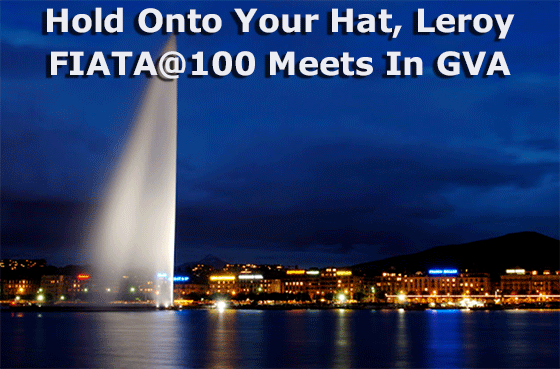
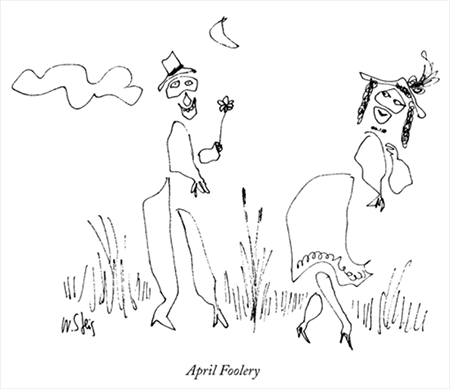
Birdies are singing with a bit of the tweet-tweet in many parts of the world. So in case the roar of the crowd and everything else going on in the world right now, including the weather has muted their sweet sound, our thoughts for you dear reader is take a deep-breath, get up and get out and under the full moon in Geneva April 1st .
No fooling . . . If one experience that puts a song in your heart is face-to-face contact with your logistics partners, well we have a doozie of a gathering in Geneva that is safe, secure and informative and a truly great place to be for a couple days this time of year.
The event is the FIATA Headquarters Meeting that is underway March 30 -April 2 2026.
What makes it special is that group celebrates its 100th Year in 2026.
To recall that history stay tuned.
For now, our Special Commentaries Editor Marco Sorgetti, who served as FIATA Director General, and at this point in his great logistics run, probably knows more about forwarders on the international level than anybody else right here opens the gates providing a stirring roadmap to a great meeting. Enjoy the ride.
 |
Logistics matters, it is essential in our life, making everything available and possible. I daresay it is the main enabler of our civilization: nothing of what we use would exist today without logistics. Looking at the FIATA HQ in Geneva this week, which is all about logistics and freight, I was wondering what else was happening in Switzerland. Well, precisely in Geneva one event surprised me because it tells us that logistics not only matters, but it can actually antimatter, too. Please forgive my gag. I could not resist: it was such a stupid joke I had to write it down… But please read the CERN Press Release and you will know more about this unusual stint in logistics: another one of my certainties goes up in the air, because I thought antimatter could only be created for a fraction of a second and die, but no more: antimatter can travel! And it all occurs in Geneva. Sometimes I wonder what will happen next.
Matter or antimatter, very few certainties remain in life: in particular in this period, many of us feel unsettled and doubtful, as many areas of the world seem to be wavering and suffering. In these moments of great insecurity, we naturally try to cling to certainties, or better to say, what we consider certainties: those steady pieces you can bank on and, without a doubt, feel you can take a breath and stop grinding your teeth. Not many places bear this kind of influence and give you the impression that you will find what you are expecting; even fewer seem to promise something positive right now, but I know at least one place, where this magic always happens: that’s FIATA!
Colleagues, FIATA friends, let us meet again! Springtime Headquarters, here we come!
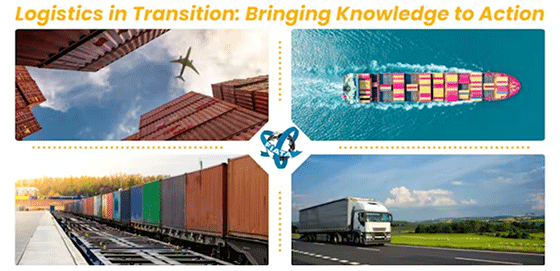
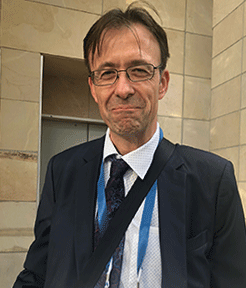 This year’s HQ has a captivating title: Logistics in Transition: Bringing Knowledge to Action. With a title like that, I want to know more . . . So just before packing my bags to travel to Geneva (by bus this time) I reached out to FIATA’s DG, the hyper-dynamic Dr. Stéphane Graber, who successfully leads the organization since 2019. I asked him for a quick overview of what is in store this time. Stéphane generously replied with a complete overview of what happens next week in Geneva. These are his exact words: “This year’s FIATA HQ Meeting carries special significance as it marks FIATA’s centenary, celebrating 100 years since its founding in Vienna in 1926 — leading up to the peak of the celebrations at the FIATA World Congress 2026 in Milan. The programme reflects this milestone with a strong focus on the future of the industry, the evolving role of freight forwarders, the challenges ahead, and the strategic value FIATA brings to its Members, while remaining true to FIATA’s mission as the global voice of freight logistics. This year’s HQ has a captivating title: Logistics in Transition: Bringing Knowledge to Action. With a title like that, I want to know more . . . So just before packing my bags to travel to Geneva (by bus this time) I reached out to FIATA’s DG, the hyper-dynamic Dr. Stéphane Graber, who successfully leads the organization since 2019. I asked him for a quick overview of what is in store this time. Stéphane generously replied with a complete overview of what happens next week in Geneva. These are his exact words: “This year’s FIATA HQ Meeting carries special significance as it marks FIATA’s centenary, celebrating 100 years since its founding in Vienna in 1926 — leading up to the peak of the celebrations at the FIATA World Congress 2026 in Milan. The programme reflects this milestone with a strong focus on the future of the industry, the evolving role of freight forwarders, the challenges ahead, and the strategic value FIATA brings to its Members, while remaining true to FIATA’s mission as the global voice of freight logistics.
One of this year’s key innovations is the diversity of session formats and topics, designed to meet the expectations of a highly global and varied audience. This rich mix ensures that every participant will gain concrete, practical value to bring back home:
Interactive Workshops addressing real operational challenges such as corridor competitiveness, air cargo risk management, illicit trade, and e‑commerce/de minimis rules. Several outputs will directly feed into FIATA tools and advocacy positions.
Plenary Expert Panels gathering industry leaders, regulators, and international organisations to discuss major issues including sustainability, decarbonisation, and emerging global digital frameworks.
Coffee & Learn Clinics, short, focused sessions providing immediate insights — including a live eFBL demonstration and a session on unlocking the strategic value of data.
Regional Committee Breakouts (RAME, RAMS, RAP, REU) enabling each region to translate FIATA’s global strategy into regional priorities and concrete next steps.
Working Group Meetings (Sea, Road, Rail) to advance sector‑specific priorities and align with FIATA’s broader agenda.
Capacity‑Building & Skills Sessions, including digital learning development, a public speaking masterclass, and the GS3 Student Competition Award Ceremony — a key moment to highlight young talent and innovation.
Networking & Social Events, including a Welcome Reception and an Italian Cultural Night, reinforcing global community ties and building momentum toward Milan 2026.
Together, these formats offer a dynamic platform for Members to exchange experiences, bring regional and operational diversity to the table, and approach shared challenges from multiple perspectives. Every participant will leave with meaningful takeaways. This includes original content such as the public speaking session for the next generation of freight forwarders, who will be celebrated during the Closing Ceremony.
We also reorganized the flow of the programme to give more time and prominence to the Members’ Roundtables, ensuring that everyone has the opportunity to share challenges, needs, and experience — for the collective benefit of the industry.
Last but not least, FIATA will introduce an important new tool to support the Regions in their work and strengthen their engagement in high‑impact regional processes and fora. The FIATA Regional Matrix, inspired by a proposal from one of our Regional Vice‑Presidents, will help assess each region’s status, needs, and KPIs to enable a comprehensive regional mapping. Implemented consistently across all Regions, it will provide a structured and harmonized framework for regional development, working in close synergy with FIATA’s global support.
Finally, I would also like to highlight the Opening Session, which will feature an interactive discussion with three renowned economists. Their insights will help us better understand current market dynamics, shifts in logistics routes, and where we may be heading in the future — another valuable piece of the puzzle that will enrich our Members’ experience and provide ample opportunities for interaction with experts.”
So we are more than grateful for the time that Stéphane devoted to us precisely when time is not abundant, considering the complex preparation the HQ session requires. His message is covering so much ground it is almost impossible to believe that all this is happening right now. Today Monday 30th, we shall have a go at the airfreight session: Mastering Risk Management in Airfreight. There will be Safety, Security, Compliance, all that forwarders need to know to “proactively understand and manage legal, operational, and compliance risks in an increasingly complex airfreight environment”. On April 1st there are many more sessions, one of which e shall not miss: the “session will explore how the UNCITRAL Negotiable Cargo Documents (NCD) Convention enables more seamless, secure, and efficient multimodal trade through a modern, opt-in legal framework for negotiable cargo documents, including the FIATA Multimodal Transport Bill of Lading (FBL) and eFBL.”
As usual, one session, one break, another session, another break . . . That’s that . . . by April 2nd all is said and done. It will be quick, but not warm: apparently there will be freezing temperatures in Geneva, precisely as the season is supposed to be heading fast into the warmer part of the year; yet we are experiencing frosty gusts coming from the North West, even past the Alps, in neighbouring Italy. The “Mistral” is hitting us here in Turin, while the Buran is hitting the eastern part of the country, reminding everyone that spring is not summer: it remains the season of meteorological indiscipline. Squeezed between East and West, that is the nature of Italy. Remember the eastern and western Roman Empires . . . ?
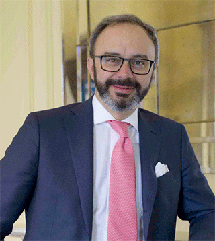 Thinking of my home country, I thought it was a good idea to speak with Alessandro Pitto, Fedespedi’s President, who is ultimately responsible for the organization of the FIATA WC in Milan in October. That is when FIATA celebrates its 100th anniversary, as we have just heard from Stéphane. President Pitto will be in Geneva with many colleagues from Italy, who will try to present the upcoming Congress during the Italian Night (to close out the programme, participants are invited to an Italian Night, a convivial evening of great food and great company. The perfect setting to reflect on three days of insight and discussions, and to raise a glass to the upcoming 2026 FIATA World Congress, source: FIATA). Thinking of my home country, I thought it was a good idea to speak with Alessandro Pitto, Fedespedi’s President, who is ultimately responsible for the organization of the FIATA WC in Milan in October. That is when FIATA celebrates its 100th anniversary, as we have just heard from Stéphane. President Pitto will be in Geneva with many colleagues from Italy, who will try to present the upcoming Congress during the Italian Night (to close out the programme, participants are invited to an Italian Night, a convivial evening of great food and great company. The perfect setting to reflect on three days of insight and discussions, and to raise a glass to the upcoming 2026 FIATA World Congress, source: FIATA).
This is what our Italian host released to the FlyingTypers: “It will be a great honour for Fedespedi to host the FIATA World Congress in Milan: ‘Empowering Global Logistics’, where we will celebrate the FIATA centenary together with delegates and industry representatives from around the world. This year is particularly meaningful for us, as it also marks the 80th anniversary of Fedespedi, which we will celebrate in Genoa on 5th of June.
These two milestones reflect the strength and continuity of our sector and its system of representation, connecting our historical legacy with the challenges and opportunities of an increasingly dynamic global environment. In a fragmented global landscape, it is essential to restore dialogue and open new channels of international cooperation. My hope is that FIATA will continue to serve as a catalyst for meaningful engagement between industry and institutions, supporting international trade and contributing to economic and social development. The FIATA World Congress will be an important moment for sharing insights, building synergies, and reflecting on the evolution of global value chains. Fedespedi is proud to contribute to this dialogue and remains committed to strengthening Italy’s role in global logistics.”
All Headquarters Session attendees, myself included, can look forward to catching up with friends and making some new ones from all corners of the world, FIATA being one the few organizations that can claim a serenely intercontinental hold on to the entire world. Personalities that are otherwise once in a lifetime’s opportunities will be present in each and every section, suffice to have a look at the programme. Amongst them, Issa Baluch, a man who needs no introduction and is also one of FIATA’s Past Presidents. Last year Issa gave us an interview during FIATA’s 2025 HQ. The interview was published a few days after the end of the HQ gathering.
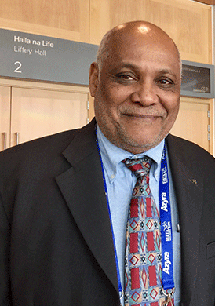 This year we had the pleasure to talk to Issa even before the meeting, which starts in Geneva on 30th of March. Our multifarious friend from Dubai talked with Geoffrey a couple of days ago and nailed down the issues the sector is facing. His words sound reassuring: “On your question about the future of our sector—multimodal logistics—I continue to emphasize the importance of true multi-modalism. We are now entering an era where algorithms increasingly determine the optimal mix of transportation modes for e-commerce flows, drawing from the full spectrum of logistics assets: air cargo, maritime, rail, road, and inland waterways. These modes can no longer be viewed in isolation. A single shipment may, for example, begin with rail or road at origin, transition to air cargo for the long haul, and then continue via road, rail, or even inland waterways at destination. The integration is dynamic, data-driven, and constantly evolving. This year we had the pleasure to talk to Issa even before the meeting, which starts in Geneva on 30th of March. Our multifarious friend from Dubai talked with Geoffrey a couple of days ago and nailed down the issues the sector is facing. His words sound reassuring: “On your question about the future of our sector—multimodal logistics—I continue to emphasize the importance of true multi-modalism. We are now entering an era where algorithms increasingly determine the optimal mix of transportation modes for e-commerce flows, drawing from the full spectrum of logistics assets: air cargo, maritime, rail, road, and inland waterways. These modes can no longer be viewed in isolation. A single shipment may, for example, begin with rail or road at origin, transition to air cargo for the long haul, and then continue via road, rail, or even inland waterways at destination. The integration is dynamic, data-driven, and constantly evolving.
This is precisely why we have been encouraging and advocating for the next generation of professionals to develop both depth and breadth—to be specialists in one mode, but also sufficiently fluent across others. In addition, a solid understanding of the various conventions and regulatory frameworks governing each of the five logistics assets is crucial. Such knowledge becomes increasingly valuable as professionals progress in their careers and navigate the complexities of global supply chains.
In this context, I, personally, hope organizations like FIATA will position themselves accordingly, embracing not only multimodal integration but also the growing role of AI in shaping logistics decisions. Historically, our sector has been among the slower adopters of new technologies, so expanding access to training and professional development will be critical as we move forward. At the same time, a long-term perspective on these developments is essential. While the industry must evolve, there remains value in drawing—at least in part—on the experience of the “old guard.” Such perspectives are increasingly rare, yet they can offer important context as new tools and approaches emerge. There are also many voices today advocating for innovative solutions to meet future challenges—these are worth listening to, often at little or no cost.”
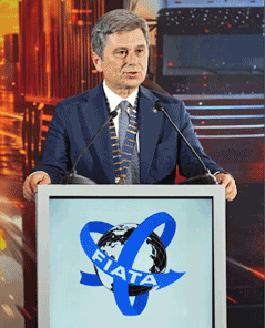 Another voice we are accustomed to associate with FIATA is Turgut Erkeskin, from the Turkish federation, who serves as Immediate Past President, after stepping down as President in 2025. This is what he was happy to share with us on this occasion: “The upcoming FIATA HQ 2026 Meeting comes at a particularly important moment for our industry. Unpredictable external shocks to supply chains and the logistics has become our reality in the last decade. As reflected in the FIATA programme, we are navigating a period shaped by geopolitical uncertainty, shifting trade patterns, and increasing regulatory and sustainability expectations. In such an environment, the role of FIATA as a global platform for dialogue, alignment, and practical guidance becomes even more critical. Another voice we are accustomed to associate with FIATA is Turgut Erkeskin, from the Turkish federation, who serves as Immediate Past President, after stepping down as President in 2025. This is what he was happy to share with us on this occasion: “The upcoming FIATA HQ 2026 Meeting comes at a particularly important moment for our industry. Unpredictable external shocks to supply chains and the logistics has become our reality in the last decade. As reflected in the FIATA programme, we are navigating a period shaped by geopolitical uncertainty, shifting trade patterns, and increasing regulatory and sustainability expectations. In such an environment, the role of FIATA as a global platform for dialogue, alignment, and practical guidance becomes even more critical.
What makes the HQ Meeting especially valuable is not only the variety of topics, from multimodal corridor development to digitalization, eFBL, and emerging technologies, but also the opportunity it creates for our community to engage openly within a structured and inclusive governance framework. It is through these exchanges that we can transform global challenges into coordinated action and ensure that the voice of freight forwarders remains relevant and influential at international level.
In addition, the HQ Meeting is where global strategy aligns with operational reality. Whether discussing risk management in airfreight, sustainability compliance, or the future of digital trade instruments, the focus is increasingly on practical implementation, equipping our members with tools, knowledge, and confidence to adapt and lead in a rapidly evolving landscape.
Last but not the least, member to member interaction in both association level and company level is extremely important. These exchanges are not only valuable for sharing best practices, but also play a critical role in strengthening cooperation and enabling tangible business development across our global community. It goes without saying that I very much look forward to the meetings with colleagues from around the world in Geneva and contributing to constructive and forward-looking discussions that will continue to shape the future of our industry.”
Time for wrapping this train of thoughts and leave you with some positive memory, in hope that this matters, or antimatters . . . ?
Music is my evergreen antidote to any possible concern, the only thing in the world that works even better than FIATA. Perhaps Sir Paul McCartney did not mean to release the song in conjunction with the FIATA HQ, but he just released, literally hours ago, a new one, worth taking good note. “Nothing can erase the days we left behind. In the skies the skylarks rise above the sounds of war”, this is what Paul tells us in 2026, just before turning 84. I wonder what John would have said listening to our everyday news. ‘Now we know how many holes it takes to fill the’ . . . Middle East? Time to wake up! ‘Woke up, fell out of bed, dragged a comb across my head’ and I started dreaming that all the anxiety and the suffering disappears.
When I am getting tired of bad news I always convert to music and listen peacefully. I guess the YouTube algorithm must have had the same approach: straight after McCartney, I got “Le Concert”. Music is always inspirational, not only for me, and even in this period, when we should be careful of what we wish for, music keeps us on track. In the case of ‘Le Concert’ music inspired a brilliant Rumanian director (Radu Mihăileanu) to produce a film showing some of the worst aspects of the Soviet Union with a healing touch: a French violinist, who is an international superstar of Russian descent, contributes to the redemption of a banished Russian orchestra director, an “enemy of the people”: the plot is intriguing and the final scene is able to make you cry. If you look at the other films this artist produced, you realize that there is always hope at the end of the tunnel, even the longest and most atrocious tunnels that humankind has been able to produce.
So in Geneva with an optimistic mind-set, we hope all our friends and colleagues will participate in good spirits. We all hope to receive good news, not only in logistics . . . We have seen other crises and this one might just reach the end by the time we get there, who knows? Keep fingers crossed and travel to Geneva, it is always worth it!
Marco L. Sorgetti
 Our thanks to Marco for this insightful and important in-depth report and in these times—news you can use—sharing these sessions with this most interesting group of people in Geneva. Our thanks to Marco for this insightful and important in-depth report and in these times—news you can use—sharing these sessions with this most interesting group of people in Geneva.
We look forward to Marco’s always excellent coverage that begins and continues ahead on our FlyingTalkers Broadcast and also on www.aircargonews.com.
A personal note:
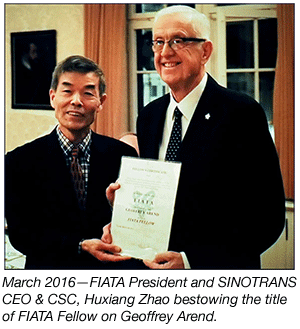
In 2015 when FIATA named me “FIATA Fellow” as the first to be honored in this manner during the Headquarters Meeting in Zurich that year . . . we recall a beautiful and heartfelt ceremony in Zurich.
Maybe even better, a great door of information was unlocked for us to share with you, as we began our coverage of FIATA.
During our “FIATA Decade”, a mere drop in the bucket when you are counting their years of service to the world, we have met many FIATA people, many of whom have become the heartbeat of our coverage in the logistics industry.
This is a great group of people with a wonderful rich history and a story that we look forward to sharing as the future unfolds.
Happy Birthday 100 years, FIATA!
|
|







 Vol. 25 No. 12
 Vol. 25 No. 13


 This is how PayCargo starts its own summary: “The trusted logistics payment platform, today outlined the next phase of its evolution, reflecting the increasingly central role payments play in global logistics and how PayCargo continues to support the industry’s operations. Originally built to streamline freight payments tied directly to cargo release, PayCargo has long helped logistics organizations reduce delays caused by manual, fragmented processes. The foundation still remains – but the challenges have become more complex. As supply chains become more global and interconnected, delays and extended dwell times are increasingly driven by fragmented financial processes that sit behind cargo movement.”
 100%
Green
100%
Green