 |
In the world of international air cargo, the most significant geopolitical and economic changes often come in surprisingly small packages. Earlier this year it came in the form of nine tonnes of high-priced Indian crabs.
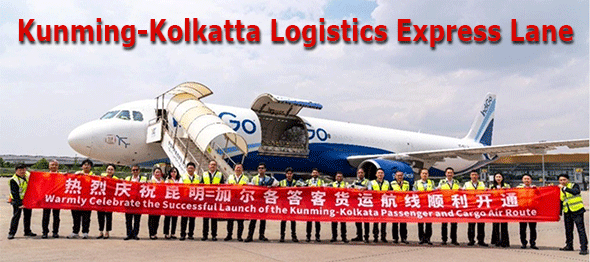
On April 20 this year when IndiGo’s Airbus A321F freighter touched down at Kunming Changshui International Airport, it didn't just deliver a delicacy to Chinese dinner tables, it heralded a massive statement of intent from India’s low-cost giant. That thrice-weekly freighter launch effectively formalized a "logistics express lane" between the industrial heart of Eastern India and China’s gateway to Southeast Asia.
The inaugural flight data told a compelling story of bilateral demand. While nine tonnes of fresh marine products flowed into China, the return leg to Kolkata was laden with over 21 tonnes of general goods, including e-commerce parcels and industrial commodities.
For Indian exporters and Importers the level of freshness becomes a major factor, changing the game. Exporters of medical supplies and seafood, who were dependent on the costly trans-shipments via Hong Kong only, now have a direct, three-hour flight to Southwest China.
Cost efficiency is also a factor. According to industry figures, direct widebody and freighter flights on India-China sectors have the potential to lower air-freight rates by 4-6%, thus giving Indian SMEs an opportunity to have a little breather in terms of margins.
As Kunming is set to be the top distribution hub, the Indian masses are likely to get their cross-border electronics and garments much quicker.
For years, IndiGo was the undisputed monarch of the Indian domestic passenger market. But the launch of the Kunming freighter marked a pivot in its evolution. It is no longer just "carrying belly cargo"; it is building a dedicated, strategic logistics network that spans from Europe to the edges of East Asia.
By choosing Kunming—a city that acts as a pivot for China’s trade with the ASEAN region—IndiGo is positioning itself as a vital middleman in the global supply chain. This isn't just about moving boxes; it’s about IndiGo proving it can operate a complex, high-frequency international freighter schedule in one of the world's most sensitive aviation markets.
While IndiGo was busy carving out new international lanes, the "new" Air India looked inward to project outward. Under the Government’s recently released Hub-and-Spoke SOP, Air India decentralized the traditional "Big City" monopoly on international travel.
In late June in a landmark move, Air India launched international connectivity from Varanasi. This hub-and-spoke model with connections through Delhi provided direct access to Air India’s extensive international network.
This move signifies a broader industry shift: For cargo, this means a farmer in Uttar Pradesh or a weaver in Varanasi could see their products cleared by customs at their local airport before being whisked away to global markets—a "multiplier effect" that Air India believes will act as a catalyst for broader national growth.
 The timing was impeccable. Alongside the Kolkata-Kunming freighter, there was also a "resurrection" of passenger routes: IndiGo’s Delhi-Guangzhou service was back, and China Eastern returned to the Kolkata-Kunming sector. The timing was impeccable. Alongside the Kolkata-Kunming freighter, there was also a "resurrection" of passenger routes: IndiGo’s Delhi-Guangzhou service was back, and China Eastern returned to the Kolkata-Kunming sector.
As Gince Kuruvilla Mattam, (right) Consul General of India in Guangzhou said, the Kunming-Kolkatta route serves as an "important bridge for economic and trade cooperation". With seat capacity between the two giants finally climbing back from its post-pandemic lows, the sight of an IndiGo A321F in the Kunming sky was more than just a business expansion — it was a sign that commerce once again was finding its wings over the Himalayas.
Tirthankar Ghosh |



 Vol. 25 No. 38
 Vol. 25 No. 39
 Vol. 25 No. 39


 100%
Green
100%
Green