 |
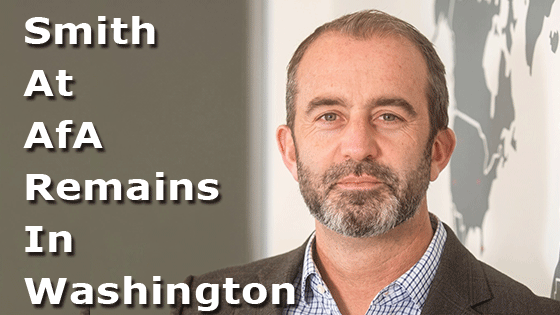
The U.S.-based Airforwarders Association, or AfA, that some like to think of with affection as the “Org. For Everyone Else” for its unabashed decades of advancing forwarders, truckers, consolidators and everyone else both in Washington, D.C. and at their annual early year gatherings in Orlando or Dallas . . . has named a new Executive Director: Steve Smith.
AfA has always been one of those organizations that’s hugely influential, but kind of operates just under the radar.
If you’re deep in logistics, you know the name.
If you’re outside the industry, you probably don’t.
But the rules AfA advocates, affect everything from how quickly shipments clear, to infrastructure funding, to how resilient supply chains act when the pressure is on.
So AfA get a new face—coming after a long era. Brandon Fried has led AfA for 21+ years.
That’s not just a tenure, that’s two entire generations of air cargo policy work.
When someone leads an association that long, they don’t just manage the day-to-day. They define the tone, the relationships, the strategy—especially in a city like Washington, D.C. where the ability to pick up the phone and have your call returned is basically its own form of capital.
So, who is Steve Smith, and why AfA sees him as not just a logical pick, but a strategic one as well?
Well, in the first place Steve brings more than 25 years of leadership across aviation, logistics, and crisis response.
Most notably, Mr. Smith spent 13 years as President and CEO of Airlink.
Airlink is fascinating because it sits at the intersection of aviation and humanitarian response.
It’s not just heft it’s also about heart; it’s about moving aid, fast, when lives depend on it.
Smith took Airlink from essentially a one-person startup idea into a sizable nonprofit operation—nearly USD$20 million dollars in revenue—and built a network with more than 50 airlines and logistics companies, plus around 250 humanitarian organizations, operating across about 100 countries.
Also Airlink (like AfA, is based in Washington, D.C. btw), numbers on impact are huge.
Airlink, under Mr. Smith supported responses to more than 200 disasters and crises, helping more than 80 million people.
Even if you take a step back and say, what does that have to do with being Executive Director of a trade association in Washington?
I think the answer is: everything. Because the future of air freight leadership is about resilience, coordination, and how fast an industry can mobilize when the unexpected happens.
In 2026, Mr. Smith’s background is basically a résumé built on the unexpected.
At Airlink, he helped build operational frameworks that didn’t really exist before—systems that connect airlines, logistics providers, and aid organizations so they can function together during disasters instead of scrambling as separate silos.
He also led through some of the biggest disruptions we’ve seen: COVID-19, the Russia-Ukraine war, the Ebola outbreak, and the 2023 Türkiye earthquake.
In terms of being able to deliver a message, Mr. Smith has also done spokesperson work with NATO and has been positioned as a subject matter expert on crisis response across both public and private sectors.
AfA might have landed an Executive Director who can talk to policymakers with credibility, and talk to industry with practicality, just like Brandon.
More power to them.
Right now Mr. Smith sits on the board of InterAction, which is a major alliance of international NGOs in the U.S.
He’s also a Board Trustee at the Aero Club of Washington and advises a crisis management company called GoCrisis.
Those positions suggest he’s comfortable across government-adjacent circles, industry circles, and the humanitarian ecosystem.
Backing up just a bit, Brandon Fried who apparently has finally reached the point where he can exhale deeply, backed Smith, saying he brings aviation and logistics experience, understands air cargo, and has established relationships across the industry.
Coming from Fried, who without flinching held the role for two decades, that endorsement carries weight—especially with members who might be wondering, “Will the new leader keep our priorities front and center?”
So what might change under Steve Smith?
We can’t predict the exact agenda, but we can talk about the signals.
One signal is that AfA is emphasizing the moment we’re in: trade policy shifts, geopolitical disruption, aging infrastructure.
That reads like a selection designed for volatility, not calm waters.
Another signal is the focus on predictability and infrastructure investment. If forwarders are asking for something right now, it’s fewer bottlenecks and clearer pathways—whether that’s at airports, in security programs, at customs, or in the regulatory environment that governs how freight moves.
As a Jim Foster award winner I have deep affection for AfA and its people and the job they do. AfA has historically been influential, but not always loud.
It’s had a reputation for being effective in the policy space without necessarily being flashy about it.
With someone like Steve Smith—who has represented organizations in high-stakes global contexts—you wonder if we’ll see AfA become more visibly assertive, or perhaps broaden the narrative around what forwarders contribute.
Because forwarders often do the invisible work. When things go well, nobody notices. When things go wrong, they’re the first call. It’s like being an air traffic controller for cargo, except the “aircraft” includes paperwork, warehouses, screening requirements, capacity constraints, and last-minute changes from five different stakeholders.
And that’s why advocacy matters.
A rule written in Washington can add hours, days, or costs to a shipment. Multiply that by billions of dollars of trade, and the downstream effect is enormous.
AfA’s value is that it turns the forwarder’s reality into policy language lawmakers can act on.
In Miami this week, both Smith and Fried are available for interviews at TIACA ACF.
That’s one of those natural moments where the industry can hear directly from both leaders—what stays the same, what evolves, and what the next chapter looks like.
We note Steve Smith’s comments about knowing Fried for many years and appreciating what he built—those are small lines, but they matter. They signal continuity and respect, which helps the association move forward without splitting into “old era” and “new era” camps.
Steve Smith’s track record suggests he’s comfortable when the situation is complex and the stakes are high.
We’ll keep watching how this leadership transition unfolds and what priorities rise to the top. For now, that’s the headline: Steve Smith is stepping in as Executive Director of the Airforwarders Association, with Brandon Fried supporting the handoff, and the mission clear—making sure forwarders have an effective voice in Washington, and by extension, in the global system that depends on air cargo every day.
Geoffrey Arend |




 Vol. 25 No. 45
 Vol. 25 No. 46
 Vol. 25 No. 47


 100%
Green