ATC Aviation Ad
EMO Trans ad
FlyingTypers Logo
#INTHEAIREVERYWHERE
Feed The Children Ad
   Vol. 24  No. 52                                         

Wednesday December 10, 2025

linespacer
linkedin
facebook
Instagram

Kale Info Solutions Ad

India Afghanistan Trade Meet

     When India decided to switch on its long-dormant air cargo corridors with Afghanistan, it wasn’t merely resuming flights. It was reasserting itself in a geopolitical space that has grown more contested, more volatile, and more strategically consequential since the Taliban takeover in 2021. The revival of dedicated Kabul-Delhi and Kabul-Amritsar cargo routes signals India’s calibrated return to a trade corridor that it now aims to reclaim.
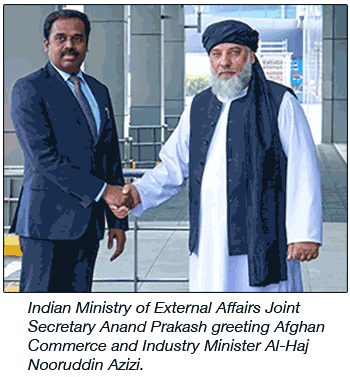
Anand Prakash and Al-Haj Nooruddin Azizi      The announcement, made during Afghan Commerce and Industry Minister Al-Haj Nooruddin Azizi’s late-November visit to New Delhi, comes at a moment of renewed regional turbulence. Pakistan’s latest shutdown of land transit for Afghan trade — triggered by October 2024 border clashes — has stranded Afghan exporters, choked food and pharmaceutical imports, and once again exposed Afghanistan’s vulnerability.
     India has moved into this vacuum with unusual speed and intent. Speaking at a PHDCCI event, Ministry of External Affairs Joint Secretary Anand Prakash confirmed that India has “reactivated” the dedicated cargo corridors and completed all procedural work. Flights can begin as soon as Kabul finishes internal paperwork.      “This will significantly enhance connectivity and further strengthen our trade and commercial ties,” he said.
     Afghanistan remains a steady consumer of Indian grains, pharmaceuticals, medical devices, engineering goods and textiles. With Pakistan sealing off land access, the air corridor is India’s only direct route to sustain what had been a USD 1.8 billion bilateral trade pre-2021. The figure had slipped to just over USD$ 1 billion this year — a decline India is determined to reverse.
     The original India–Afghanistan Air Freight Corridor, launched in 2017 by Prime Minister Narendra Modi and President Ashraf Ghani, had quickly become a lifeline. More than 1,000 flights moved over 5,000 tonnes of perishables, carpets, dry fruits and Indian medicines between 2017 and 2020. The pandemic and political transition halted operations, but demand never evaporated. Afghan traders have repeatedly said the corridors were never a luxury — “they were survival routes.”
     That survival instinct is sharper today. Afghan Deputy PM Mullah Abdul Ghani Baradar recently directed his ministries to “reduce reliance on Pakistan within three months.” Minister Azizi echoed this in Delhi: “Business should not be held hostage to politics. We want dependable access to Indian markets, and air cargo will stabilize our trade.”
     India’s decision to reopen its Kabul embassy in November — upgraded from technical staff to a fuller diplomatic presence — is the biggest signal yet of a pragmatic shift. While India still does not formally recognize the Taliban administration, it has rebuilt working channels around security, humanitarian aid and trade.
     No Indian airline currently flies to Kabul because Pakistan continues to deny overflight rights to Indian carriers. However, Kam Air and Ariana Afghan Airlines now operate 10–12 flights a week to Delhi — slightly higher than earlier this year — allowing limited belly cargo.
     Afghan carriers have recently indicated interest in dedicated freighter operations once the corridor stabilizes, and Indian exporters have begun informal booking discussions for pharma and perishables.
     The Ministry of Civil Aviation has also been evaluating whether charter-based humanitarian cargo missions could operate through Iran’s airspace if a Pakistan bypass becomes necessary — a development that officials privately say “may soon become relevant.”
     The biggest strategic opportunity lies outside the air corridor. Afghanistan has renewed its push to access Iran’s Chabahar Port, jointly developed by India, as a long-term alternative to Karachi. Azizi urged Indian industry to “help operationalize the Chabahar route for Afghan exports,” noting that Afghan traders had already increased trial shipments through Iran this year.
     For India, Chabahar is not just another port — it is a gateway to Central Asia and a counterweight to China-Pakistan connectivity projects. The air corridor is the quick fix; Chabahar is the structural solution.
     In recent weeks, Beijing has intensified its commercial push in Afghanistan, including new investments in mining and logistics under the Belt and Road footprint. A Chinese delegation visited Kabul in November to discuss a proposed connectivity arrangement that would link Xinjiang to Afghanistan’s north.
     Indian officials see this as further urgency to “re-anchor” India’s economic presence. The air cargo corridor, they privately acknowledge, is part of a broader effort to prevent Afghanistan’s trade ecosystem from tilting entirely toward China and Pakistan.
     The restart of the air cargo link serves several simultaneous objectives for New Delhi:
        Maintain economic presence in a country where Indian goods enjoy high trust
        Bypass Pakistan and demonstrate an alternate connectivity model
        Re-engage diplomatically without recognizing the Taliban
        Rebuild strategic equities in a region Beijing and Islamabad seek to dominate
     Indian exporters — especially pharmaceuticals, engineering goods, processed foods and perishables — are already preparing for a surge in demand. Afghan businesses, too, are positioning themselves to resume steady procurement cycles that had been disrupted for nearly three years.
India’s reactivation of the Afghanistan air corridors is not just a logistics decision. It is a geopolitical reset — a reopening of a crucial artery that carries commerce, influence and strategic leverage. As land routes remain hostage to politics and militarized borders, India has chosen the sky once again as the pathway to stability.
     For both nations, this is about more than trade. It is about reopening a corridor of relevance — commercial, strategic and symbolic — at a time when the region’s balance is shifting, and routes are reshaping the map.
Tirthankar Ghosh


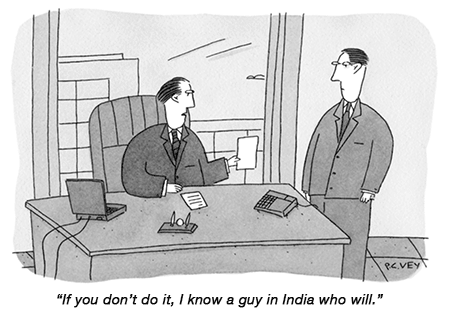
Chuckles for December 10, 2025

hina India Cargo Impalance


     When India-China direct passenger flights resumed in October 2025 after a five-year freeze, the return of scheduled connectivity was read as a symbol that regional aviation normalization in Asia was finally back on the table. But beneath the visible reopening, the invisible asymmetry that freight carriers care about most remains firmly in place. While flying passengers between the two markets is now routine again, flying cargo is still deeply asymmetrical — because China continues to maintain one of the hardest limits in the world on foreign cargo charter access.
     This is not a marginal issue. For India, one of the fastest-rising air freight markets globally, this is becoming a strategic handicap.
     Since June 2024, Advisory Circular AC-129-FS-001R2 from CAAC caps foreign airlines that do not possess a CCAR-129 certificate to 10 cargo charters in any rolling 12-month period. Even carriers that hold the certificate need separate approvals every time they want to serve a new Chinese airport; until that amendment is issued — which can take months — they remain stuck under the same 10-per-year ceiling anyway.
     This effectively makes scalable or seasonal catch-up capacity impossible. A sector whose economics inherently depends on pop-up, burst-season, short-cycle lift — perishables, pharma, auto parts, e-commerce replenishment — simply cannot operate with fixed micro ceilings. 
     India — in sharp contrast — allows foreign cargo charters unrestrictedly under CAR 158/158A and the 2024 Open Sky Policy for non-scheduled freighters. No annual numeric limits. Only safety and compliance checks.
     The design philosophy is different. India regulates operational integrity while China regulates market access. This is at the core of the asymmetry. And as long as this is unresolved, the imbalance becomes a long-term structural advantage for Chinese operators. Because Chinese carriers can scale into India instantly during peak cycles. Indian carriers cannot scale into China at all.
     India and China are freight giants. India is averaging 195,000 tonnes international per month in 2025 — 13% above 2019. China’s international volumes are 48% above pre-pandemic levels. And India–China trade flows are now heavily air dependent across three major city pairs: DEL–SHA, BOM–PEK, and MAA–SZX.
     Yet Indian exporters often end up routing via Hong Kong, Dubai or Singapore during peak windows because Indian carriers are shut out from direct Chinese lift. Which means the margin, the network stickiness, and the pricing power shifts away from Indian airlines — and in some cases, even away from India-based logistics.
     Europe doesn’t do hard caps. ASEAN doesn’t. The Gulf doesn’t. When restrictions exist, they are typically slot or congestion driven — not blanket ceilings. China’s 10-in-12 rule is an outlier among large, interconnected freight export economies.
     This now has to migrate to diplomacy and there are three realistic solutions:
     •  Time-limited, transparent Ops Spec amendment timelines in China — not discretionary open-ended approvals.
     •  A bilateral charter reciprocity protocol under the Air Services framework — like India uses with ASEAN and EU partners.
     •  Measured reciprocity by India — only if the first two don’t work — but this is philosophically opposite of India’s liberalisation ethic.
     
     India is positioning itself to become a high velocity, high reliability global freight hub as part of Make-in-India and export-led industrial policy. If China ends up being the only major market where Indian carriers face structural non-scalability, then every other policy intervention — fleet expansion, conversion programmes, domestic freighter feed networks — loses leverage.
     This is no longer a regulatory technicality. This is a hard competitive disadvantage. And it’s time both governments treat it like one.
Tirthankar Ghosh


PayCargo Ad

Kendra Tanner

     The upcoming AirCargo Conference 2026 set February 15-18, 2026 at The Omni ChampionsGate in Orlando promises to be an inspiring event with Kendra Tanner as the Keynote Speaker.
     Kendra, President & CEO of Allstates WorldCargo Cargo, is a prominent woman in logistics and a local hero.
     Reflecting on her journey, Kendra shares:
     “My dad was a truck driver, and he was the one who first opened the door to this industry for me. I joined him at Consolidated Freightways 37 years ago, and his example of grit, perseverance, and pride in his work has shaped me every day since.”
     Powerful words with shared inspiration when this leading lady in logistics, takes the stage in Orlando.
     Brandon Fried of The Airforwarders Association, a driving force behind The AirCargo Conference, expressed excitement about Kendra's participation:
     “We are beyond thrilled to have Kendra Tanner keynote our gathering," he declared.
     "Our Associations link us to powerful thought leaders so we can bring the most progressive insights to our attendees.”
     The AirCargo Conference is backed by three of the most reputable and influential groups in air cargo, freight forwarding, airlines and airports: AEMCA (Air and Expedited Motor Carriers Association), ACI World - Airports Council International-NA, and Airforwarders Association.
     "Allstates WorldCargo, established in 1961, has built a national and international reputation for excellence in customer service," Kendra emphasizes.
     “Our knowledgeable and dedicated team members continually strive to maintain our philosophy of providing the best service value for our customers’ needs.”
     "Step into Logistics 2026 by joining us in Orlando for a gathering filled with insights and inspiration from leaders in the future of logistics," Brandon Fried remarked.
     Looks like planning ahead in December to 2026, is a good bet that the best is yet to come.

GDA/SSA


FlyingTalkers podcastFlyingTalkers


LaGuardia Marine Air Terminal Rescued Again


John Ryan and family

Is There Life After Air Cargo?
     Yep! Life goes for John and Gloria Ryan pictured at home sumptuously situate on Long Island, New York this December 2025.
     John served Virgin Cargo Americas at start-up as key player of the team fielded by Angelo Pusateri, which went on to build the brand in the USA and put air cargo on the map for the airline.
     John has been retired for some years now, so it’s really great to see this couple all-smiles awaiting some hoof beats on the rooftop, whilst sharing the Christmas season for everyone with their spirited group of grandchildren.


FTM2025

If You Missed Any Of The Previous 3 Issues Of FlyingTypers
Access complete issue by clicking on issue icon or
Access specific articles by clicking on article title
FT111825
Vol. 24 No. 49
Southwest Cargo Straight Talk
Chuckles for November 18
EMO Trans On The Beach
Kale Logistics Celebrates 15

FT112625
Vol, 24 No. 50
The Marine Air Terminal In Danger

FT120125
Vol. 24 No. 51
Glyn And Ram On Air Cargo Tomorrow
Wang Fuk Rises From The Ashes

Publisher-Geoffrey Arend • Managing Editor-Flossie Arend • Editor Emeritus-Richard Malkin
Senior Contributing Editor/Special Commentaries-Marco Sorgetti • Special Commentaries Editor-Bob Rogers
Special Assignments-Sabiha Arend, Emily Arend
• Film Editor-Ralph Arend

Send comments and news to geoffrey@aircargonews.co
Opinions and comments expressed herein do not necessarily reflect the views of the publisher but remain solely those of the author(s).
FlyingTypers reserves the right to edit all submissions for length and content. All photos and written material submitted to this publication become the property of FlyingTypers Media.
Copyright ©2025 FTMedia, Inc. All Rights Reserved.
More@ www.aircargonews.com

recycle100% Green