 Michelle DeFronzo is both Founder and President of ImEx Cargo, a leading logistics service provider that manages to proudly write on its front website page: “At the heart of ImEx Cargo is a simple promise: to make logistics simple, reliable, and stress-free. Our customer-first approach means tailored solutions, proactive communication, and a commitment to excellence — every step of the way.” Michelle DeFronzo is both Founder and President of ImEx Cargo, a leading logistics service provider that manages to proudly write on its front website page: “At the heart of ImEx Cargo is a simple promise: to make logistics simple, reliable, and stress-free. Our customer-first approach means tailored solutions, proactive communication, and a commitment to excellence — every step of the way.”
‘Music to my ears’ I could say, thinking of the many years I spent organizing logistics in the earlier part of my life. Making logistics simple, reliable and stress free requires a magic touch and after speaking with Michelle I have developed this conviction: she does have a magic touch, and much more: a malicious pneumonia almost killed me, and in all that I even felt guilty, because I had promised Michelle to prepare the article about her work and activity, but I could not lift a finger... So I told Michelle she would have to wait. She showed her sympathy and consideration in a way I shall never forget. She kept corresponding with me and encouraging me with admirable empathy. After much trouble, here we are eventually. I am now able to deliver my conversation with this extraordinary woman about her business and her achievements.
Based in Peabody, Massachusetts ImEx Cargo is a certified woman-owned logistics company, Airline GSA, Domestic Freight Broker and government contractor with +30 years of experience in international and domestic freight. Michelle and her team provide end-to-end cargo solutions for air freight, trucking, and government transportation, backed by strategic tech and deep operational experience.
I asked Michelle to tell us what she considers important and distinctive in the way she conducts business as ImEx Cargo. Her reply was simple and completely “back to basics”: “We are certified as a WBE, WOSB, EDWOSB, DBE, ACDBE, and serve clients ranging from global airlines to U.S. government agencies and freight forwarders. We’ve shipped millions of kilos for airline partners, handled complex government logistics, and recently launched our own freight technology ecosystem.”
In a period when even the most reluctant operators are embracing digital technology as an essential part of their offer ImEx Cargo appears to be well placed to take stock of their investments: a totally new digital portal serves a number of functions in their daily routine and we are proud we have the opportunity to explain why it is so special.
I asked Michelle about her successful adventure and this is how she described her journey to the top: “After nearly a decade of failed vendor systems, false starts, and millions of kilos managed manually, we finally built the ImEx Cargo Portal — a freight-tech solution created by real cargo professionals who lived the pain of disconnected tools and inefficiencies. We were handling 200–300 emails per day, multiple carrier reports, AWB inventory, custom billing models, and sales intelligence — all while supporting several airlines simultaneously.” Clearly Michelle’s experience shaped the reliability and depth of the system she proposes. “Decades of running freight desks, booking with over 20 major airlines, and manually managing millions of kilos gave us a very different lens compared to the Silicon Valley startups. This portal wasn't imagined; it was earned through operational pain, late nights, crisis management, and rebuilding during COVID. Everything inside the platform exists because we lived without it, felt the impact, and designed a better way.”
 |
Having worked in the associations for many years, we tried to contribute to the laudable work carried forward at UNCEFACT, WCO, WTO and others in the quest of total logistics connectivity. It was a mystery to me that we seemed to be engaged in an eternal hopping Echternach’s sprangprëssessioun. There was much progress and hope but sooner or later we seemed to be back to square one. The reasons why the process is so slow could take a book to write and perhaps I am not even the right candidate. So I was not surprised to hear that Michelle was frustrated with the difficulties to find the right solution for the issues she was experiencing in her daily work and I was curious about how she matured the idea of launching this vast program change; how could she find the courage to try and accomplish where many others had failed.
Michelle was adamant: “COVID magnified every bottleneck. During that time, I was hospitalized with COVID for 8 days, on oxygen, but never stopped working. I couldn’t let our customers or team down. That’s when I knew: we had to build something that could scale sustainably, protect our independence, and serve the industry.” As it happens, quite often the best ideas come from exceptional hardship. This is a case in point in my view. There is more… “We were weeks away from launching this system with AirBridge Cargo when Russia’s invasion of Ukraine shut their U.S. operations down. Overnight, we lost 50%+ of our revenue. I made a decision: we would no longer depend on anyone else’s system, contract, or circumstance. We would build our future. And now we are in a position to decide our own future, respectful of all our connections and alliances, but happily independent. That is how it all started.”
I interrupted Michelle’s train of thoughts with a pointed question: “The air cargo industry has invested billions in digitalization. In this crowded landscape, Plug-In Freight Ops™ fits where exactly?” She patiently conducted me to understanding the point: “Plug-In Freight Ops™ is not trying to replace the CargoMarts, WebCargo, CargoAI, or legacy airline systems that companies have spent years implementing. We designed our ecosystem to sit between all of these platforms, acting as the connective operational layer that simplifies quoting, booking, trucking, tracking, reporting, and customer communication. Most digital tools address one slice of the workflow. None brings the whole freight desk into a single, unified screen. That's the gap we close. We complete the ecosystem, not compete with it.”
I was curious to understand the dimensions of the market opportunity for a system like Plug-In Freight Ops™ and my curiosity was immediately met with facts and figures: “The combined digital air cargo and multimodal freight technology market is estimated to reach $25–35 billion globally by 2030. Specific segments aligned with Plug-In Freight Ops™ include: Airline GSA/GSSA industry, $4B+; Global freight forwarding technology: $12B+; Government logistics digital contracting: $150B+ annually (U.S. only); Domestic trucking TMS/API integration market: $10B+. Because our platform spans many segments, the total reachable market is much larger than tools that only do bookings or only do trucking.”
My understanding was that there is no way diminish the value of this combined, unique offer. In order to understand the advantages in greater detail I listened to more and more particulars that were all quite revealing from the observer’s point of view.
 |
“Plug-In Freight Ops™ help reduce costs and increase revenues for airlines and forwarders, e.g. Airlines and GSAs reduce costs by reducing manual quotes by 60-80%, thus reducing mis-billings and AWB errors. Automation of sales reporting and forecasting affords eliminating system switching. In all this Forwarders enhance revenue by comparing airline, GSA and interline options instantly, improving speed-to-quote and providing real-time visibility to customers without extra overhead. The result is that the same staff can double their throughput without burnout.”
I observed that this is a result not many could claim in the same area of business. Michelle told me that it all comes down to eliminating adoption barriers to unlock potential: “there is no need to rip out existing systems, no need for an IT department, with multi-month integration cycles. No rigid structure is required, on the contrary Plug-In Freight Ops™ is flexible for GSAs, airlines, forwarders, BCOs, and government primes, also avoiding disruption to legacy workflows. This is why our positioning as the friendliest platform for adoption actually resonates across the ecosystem.”
 |
In terms of interline strategies and network expansion the online portal enables forwarders to instantly compare mainline and interline pairings side by side, an invaluable facility when capacity fluctuates, as is almost routine in recent times. Airlines, particularly niche and long-haul carriers, can widen their market reach without increasing staff, offices, or sales teams. For GSAs representing multiple airlines, the Plug-In Freight Ops™ becomes a centralized sales intelligence engine.
There is another aspect of the portal that Michelle was ready to explain: government contracting and federal modernization efforts are crucial today. “Government agencies and prime contractors are under pressure to modernize logistics and increase WOSB/DBE participation. Plug-In Freight Ops™ provides: a digital quotation/bookings/tracking layer for government freight, audit-ready documentation, shipment-level transparency and milestone compliance, as well as automated reporting for government oversight,” i.e. all that even the most exacting professional could require. “We're positioning ourselves as the future of digital GovCon freight, a space where most traditional tools don't operate.”
 |
“The strongest interest has come from airlines without U.S. representation and forwarders needing a more unified customer-facing digital layer.” I thought: sitting on this sizeable treasure, can we understand what is in store and what steps will be taken in future?
Michelle then explained to me what happens next: “The ImEx Cargo Portal officially launched in September 2025 to coincide with Supply Chain Month and Women in Logistics Month. We have clarified that it is a highly integrated system that allows you to achieve results that were not available before this step was taken:
• Real-time quoting, booking, and cargo tracking
• Interline and airline GSA rate access
• Domestic trucking integration (50,000+ carriers)
• Predictive milestone updates with document access
• Analytics dashboards for AWB usage, airline sales, performance, and reports
• White-label licensing options for airlines, GSAs, forwarders, and government primes
“We’re now in Phase 2 with government freight tracking tools, ULD booking, and forecasting modules on the roadmap.”
Michelle was indeed persuasive, but we do know that there are areas of inefficiency that still exist within the industry, so I asked her what were the biggest inefficiencies still holding air cargo back.
That is when I really appreciate talking to an expert: “Three persistent gaps remain across the global cargo chain: a) Fragmented data across airline portals, GSA tools, Excel sheets, trucking systems, and emails; b) Slow communication loops, still averaging 20–30 emails per shipment; c) Forwarders, airlines, and shippers all lack predictive visibility.
Every large digital platform claims to be ‘the future’, but freight people live in today's reality. The ImEx Cargo Portal was built to bridge real operational gaps we've experienced for decades.”
So the invisible “Chinese whispers” gap that has been hindering communications along the supply chain for many years exists, but the gap is being bridged by Michelle’s organizational efforts and everyone seems to be able to enjoy the results. I then asked Michelle what made the difference and how could she get round to solving a problem that had been a riddle for many other competitors. She answered in a relatively simplified manner: “We built this tech in-house, after working with over 20 major airlines, managing 2–5 million kilos per year for some clients. We know what forwarders, GSAs and airlines need, because we are one. This is not just a booking system. It’s a business intelligence tool, plus quoting engine, plus freight desk, plus tracking layer, plus scalable SaaS.” In other words, she had just described what is a dream for many other operators and she described it with the confidence of the person who is used to cutting diamonds every other day of the week, so no surprise the facets are perfect!
“Our model is built to support SaaS, FaaS (Forwarding-as-a-Service), and white-label licensing for cargo partners worldwide” she proudly concluded.
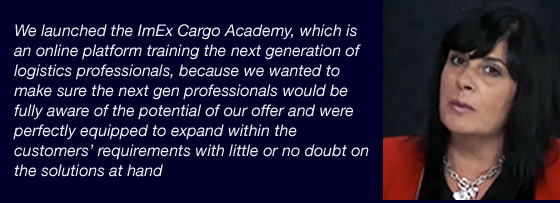
So we did get the idea that Ms. DeFronzo is not a person to sit idly contemplating her success. She just achieved a not-so-small industrial miracle and she is already planning another endeavor: “introducing the Imex cargo academy to complement our tech and expand our industry impact. We launched the ImEx Cargo Academy, which is an online platform training the next generation of logistics professionals, because we wanted to make sure the next gen professionals would be fully aware of the potential of our offer and were perfectly equipped to expand within the customers’ requirements with little or no doubt on the solutions at hand.
The academy offers:
• Self-paced courses in air cargo, government contracting, domestic trucking, supply chain fundamentals
• Corporate team training for freight forwarders, primes, and subcontractors
• Workforce development aligned with DEI, WOSB, and federal supplier diversity initiatives.
WHAT’S NEXT in Michelle’s store . . .
• Global rollout of SaaS and white-label portal offerings
• Expansion of Plug-In Freight Ops™ Partner Portal (launching Q4 2025)
• Licensing to airlines, GSAs, forwarders, and prime contractors
• Continued focus on diversity, innovation, and industry leadership
• Workforce development partnerships through the Academy
Before ending my conversation with Michelle DeFronzo by giving her the floor for the last time, I wanted to cite some comments that were registered by third parties and customers acquainted with the system, in a way to seal off the positive impression that this entire conversation has left in my mind. Here you are: “It finally feels built by cargo people.” “We don’t have to abandon the systems we already rely on.” "It makes our teams faster without changing our internal processes.” We could continue . . .
 |
Michelle concluded her conversation with us by making a statement of self-confidence: “We envision a freight ecosystem where every airline can sell its capacity digitally, each forwarder can independently automate bookings, every shipment is trackable without 15 different log-ins, government agencies have full visibility, GSAs can scale without adding headcount, training and workforce development are directly coupled with technology. Ultimately: one ecosystem, one infrastructure, multiple partners successful together. We’re not just moving freight. We’re building the next generation of professionals to lead this industry forward. I didn’t come this far just to come this far. We’re here to lead — with technology, transparency, and tools built by the people who know the cargo business best.”
Now is the right time to thank you, Michelle, for your caring and wise approach, even for your display of consideration for your interviewer’s problems, but especially for your successful endeavors and for making the world a better place in so many ways.
Marco Sorgetti |







 Vol. 25 No. 11
 Vol. 25 No. 12
 Vol. 25 No. 13


 One of the voices helping lead this effort is Peter Jaeger, the Branch Manager at EMO Trans Global Logistics and a DACA founding member.
 100%
Green
100%
Green