
|
 |
 #INTHEAIREVERYWHERE |
 |
| Vol. 25 No. 11 | Monday March 9, 2026 |
 |
|
|
 |
Here at FlyingTypers we wanted to reflect on what is happening to our world of services and logistics in this period. So let us start by noting that in January 2026 the word ‘peace’ has been named Oxford Children’s word of the year 2025. As we know this happened while bombs were falling in many places and more bombs were about to fall in other places where so many children were about to be killed. One could argue this is not a smart way of starting an article, probably others could argue that this start is just the understatement of an uglier truth. A number of Europeans, and I am told, Americans have surely not been enjoying peaceful evenings in the last few days. An American friend told me that “there is a general malaise and people are down about everything. The uncertainty of everything and the illogical way in which things are happening is putting a pall on life.” I thought this could also apply to many of us in Europe and the feeling is similar, if not identical. One could contend that thousands of other people in the world, unlike these two groups among others, have been obliged to deal with direct bombardments and/or other kinds of warfare, with casualties. We all know what we are talking about: war has erupted in the Middle East in a period when peace was the word, very frequently heard in public. This is what AI tells us if you ask to compare its usage in year 2025 as compared to year 2024: “In 2025, the word peace has seen a significant increase in public and cultural prominence compared to 2024, shifting from a general aspiration to an urgent global call.” You can even argue that peace has quickly become just a dream for many people, perhaps in contrast with the public promises we continuously receive. Indeed, we live in a complicated and troubled period: what does this mean to us in transport? International trade and logistics at its service thrive when peace exists, not when it is hastily and vaguely promised. I did some cherry-picking about this issue on the web and, needless to say, I got involved with a jumble of issues regarding infrastructure, threats, shortages, blockades, embargoes, damages, etc.  In Long Beach, at TPM26, Jeremy Nixon presented himself “with the awareness of someone who is about to close a chapter. A manager who has lived through mergers, crises, and ‘black swan’ events, he now finds himself commenting on another systemic shock: the closure of the Strait of Hormuz. 'We are on the third day of a major regional conflict involving ten countries; there are 750 ships blocked, unable to pass through the Strait of Hormuz: 350 within the Gulf and 350 arriving, of which about 100 are container ships. This means that approximately 10% of the global container fleet is affected.’ He said." That is quite a statement! In Long Beach, at TPM26, Jeremy Nixon presented himself “with the awareness of someone who is about to close a chapter. A manager who has lived through mergers, crises, and ‘black swan’ events, he now finds himself commenting on another systemic shock: the closure of the Strait of Hormuz. 'We are on the third day of a major regional conflict involving ten countries; there are 750 ships blocked, unable to pass through the Strait of Hormuz: 350 within the Gulf and 350 arriving, of which about 100 are container ships. This means that approximately 10% of the global container fleet is affected.’ He said." That is quite a statement!These numbers give a measure of the magnitude of the event, even though they could even sound insufficient, as they are more than a couple days’ old. The statement suggested that we are "in the worst-case scenario. We were thinking of a few quick strikes and that was it, but instead we're in the middle of a regional conflict." Whether this is an early statement or a foretelling intuition, we shall find out as we get further along in this difficult year of the Fire Horse. In Italy we have seen fuel prices and gas prices increase by some 20% in a couple of days. I am now writing from Switzerland and, as usual, everything here takes a more prudent approach; the prices are high, but not much higher than a couple of months ago… which makes me think that unrest nourishes speculation and speculation boosts inflation, in particular in markets that are more inclined to dramatizing. Inflation in Switzerland is relatively small compared to other areas of the world. Sticking to transportation, many carriers, if not all, had to halt all bookings to the Middle East. The airport of Dubai is now closed. This is not like closing the airport of my hometown, Turin… The impact of Dubai in international aviation is huge. The impact on freight rates and on the fluidity of trade is inevitable. We read that “today, the global fleet is worth 33 million TEUs, and almost 10% is stuck waiting for docking. Fifteen years ago, docking upon arrival was the norm, with 1-2% attrition. Today, we're at 10%.” In this chaotic situation repercussions and action-reaction disruptions will be inevitable, supposing the public will continue fuelling international trade, despite the gloomy picture. If all of a sudden customers decide to sit and watch instead of buying, we are in for a real nightmare in international trade.  If we use the internet in AI mode, this is what we get: “As of March 2026, the escalation of conflict in the Middle East has triggered a profound and immediate crisis in international logistics, characterised by the near-total suspension of major maritime and aviation corridors. If we use the internet in AI mode, this is what we get: “As of March 2026, the escalation of conflict in the Middle East has triggered a profound and immediate crisis in international logistics, characterised by the near-total suspension of major maritime and aviation corridors. Maritime Logistics, closure of global chokepoints . . . The conflict has effectively shut down the two most critical waterways for East-West trade:
We read on FreightWaves.com that, “as of March 2026, MSC Mediterranean Shipping Company has announced an $800 USD per container surcharge (End of Voyage Fee) for all cargo destined for the Gulf region.” This is a very recent update (March 4, 2026) in ‘response to security risks in the region’, was the given reason for the decision.
The World Economic Forum published a lot of material on this particular issue; our expert readers are best placed to judge whether this is contributing to cast light, or rather a shadow on the landscape we are contemplating: “As of March 2026, the Middle East security situation has escalated, significantly impacting the global economy, primarily through energy markets and shipping routes. The escalation, driven by US-Israel actions against Iran, has resulted in immediate disruptions that the World Economic Forum (WEF) and other analysts highlight as key global risks.” Current Spot Rate Comparison (March 2026)
Key Pricing Drivers
AI then asked me whether I “would like to analyse how these rate hikes are specifically impacting just-in-time manufacturing sectors in Europe?” I decided to leave it at that. My mind went back to those days in 1973 when all of a sudden we suffered the first (to my memory) restrictions in using private cars, because of the penury of fuel caused by the war in the Middle East: the then famous, at least in Italy and in Europe, “domeniche a piedi” i.e. Sundays on foot. That is over fifty year ago. I remember I was thinking how could the whole world get itself tangled in such a situation, inevitably tied to the destiny of petroleum, without thinking of alternatives. It was clear to me that alternatives would come at a price, but why not if they could preserve our freedom and independence. My train of thoughts did not travel very far. Over fifty years later, it seems to me we have not moved much from that point. |
In Mumbai, during the last week of February, the air cargo industry gathered at the air cargo india conference with the optimistic hope for a great 2026 business year propelled by its dozens of awards and recognitions and corporate projections of boom times at India’s doorstep. |
March 8 marked International Women’s Day 2026 (IWD 2026), under the theme, “Rights. Justice. Action. For ALL Women and Girls”, calls for action to dismantle all barriers to equal justice: discriminatory laws, weak legal protections, and harmful practices and social norms that erode the rights of women and girls. |
 |
 |
If
You Missed Any Of The Previous 3 Issues Of FlyingTypers Access complete issue by clicking on issue icon or Access specific articles by clicking on article title |
||
 Vol. 25 No. 8 Women's Panel Lights Up MCO Happy Lunar New Year National B777F Takes Wing Team Targets No Regrets Music & Mories On Fat Tuesday |
 Vol. 25 No. 9 Everybody Comes To Ingo's Kale Accents Flying High In Mumbai Why Pharma Will Dominate India Air Cargo Story Geoffrey Arend Paradise Season 2 |
 Vol. 25 No. 10 Vol. 25 No. 10Tej Mayur Contractor In FIATA Future Chuckles for March 2, 2026 BLR FRA Ink Pact At BOM The Man Who Changed Color On The Bridge |
Publisher-Geoffrey Arend • Managing
Editor-Flossie Arend • Editor Emeritus-Richard Malkin |
Send comments and news to geoffrey@aircargonews.co
|


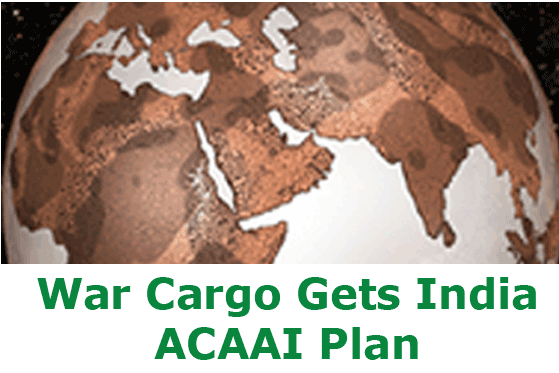
 The President of ACAAI Samir J. Shah says that exporters and air cargo companies should not be penalized for problems they cannot control because of the Iran-U.S. war.
 100%
Green
100%
Green