 That’s Michael Webber That’s Michael Webber
Everybody or mostly thereof in air cargo USA knows Michael Webber.
Most often he is engaged in airport projects but he also can be found wrapping his great talent for common sense into advising solutions around any number of challenges in air cargo.
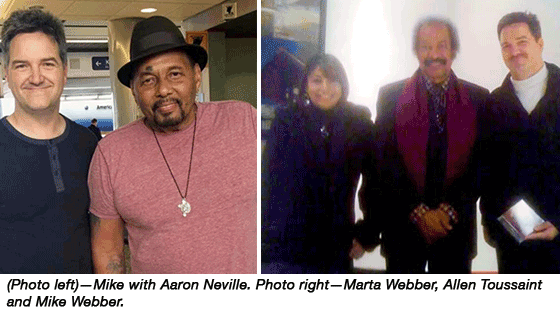
But here is another side of Michael and that’s his love for New Orleans and a life he once lived there where he fell in love with The Big Easy (as the place is called), its great cultural gift to all Americans’ and people worldwide of jazz music and fabulous cajun cuisine and let’s not forget, his lovely wife, Marta.
Very grateful here as Mike celebrates all of it including some wonderful music as we celebrate Mardi Gras 2026.
Since medieval times, Mardi Gras – literally Fat Tuesday in French – marked the final day of feasting before the Lenten Fast began on Ash Wednesday. By practice during those pre-refrigeration days, it was an occasion to exhaust provisions of fat, dairy and eggs.
Although the terms are often used interchangeably, Mardi Gras is a specific day, while Carnival spans an entire season that begins with Epiphany (around January 6) and culminates on Mardi Gras in February.
Literal translations are interesting, but the origin story scantly troubles common perceptions about Mardi Gras’ most recognizable U.S. manifestation down in New Orleans where I completed my MBA at Tulane University in the 1980s and started my international cargo career in the early 1990s.
 |
Having lived in a variety of locales (currently Austin, TX) and worked in dozens more, I endorse the characterization of New Orleans as the U.S. city least like any other U.S. city, which is a far softer description than Tennessee Williams: “America has only three cities: New York, San Francisco and New Orleans. Everywhere else is Cleveland.”
There is even a substantial disconnect between how locals and visiting tourists relate to Mardi Gras. New Orleans is a majority-Black (an estimated 54-58% of the population) city and Orleans Parish’s Catholic population (around 38%) roughly doubles the U.S. share.
New Orleans also has a lengthy, complex history with Latin America (specifically Central America) dating to the often-lamentable practices of United Fruit Company and Standard Fruit Company which enriched New Orleans (with my alma mater, Tulane, being an obvious beneficiary) but basically coined the term “banana republic” for their ruthless exploitation of native populations in Central America. In stark contrast to Texas where I live now, when my Mexican-born wife and I lived in New Orleans, exponentially more Hispanic citizens cited Central American and Cuban roots than Mexican. However, the Mexican population grew as immigrant laborers rebuilt the Gulf Coast after Hurricane Katrina.
Like a great gumbo, New Orleans’ ingredients are relatively distinguishable from one another, but the real magic happens collectively. For those who embrace the sound of a variety of accents and languages, New Orleans is a unique treasure year-round. By Ash Wednesday, the barely organized chaos of the Mardi Gras season has just about exhausted the locals who are ready to put the subject to rest for a few months. By comparison, New Orleans Jazz & Heritage Festival – always the last weekend in April and first weekend in May which diabolically mirrored final exams for Tulane’s Spring semester – feels tame with only localized traffic issues and a manageable bump in restaurant wait times.
Here Is A Mardi Gras playlist:
1. The Meters — Mardi Gras Mambo
Commonly proclaimed as “the funkiest band in the land”, The Meters recorded THE classic Mardi Gras morning song. I hired a couple of former Meters to play a party thrown by the Tulane Business School. I’m fine with that claim going on my headstone some day in the distant future, preferably.
2. The Dixie Cups & The Neville Brothers (and guests) — “Brother John/Iko Iko”
“Iko Iko” is a New Orleans classic most famously recorded by The Dixie Cups. When The Neville Brothers (including former Meters Art and Cyril Neville) revisited that classic in the 1980s, they prefaced it in medley form with “Brother John”. This specific performance – with Herbie Hancock and actor Dennis Quaid in tow – was filmed during a private performance filmed by Cinemax in what used to be Storyville. Although the all-star show was filmed before a select audience of a couple hundred in a small club (with half the floor space occupied by filming equipment), I managed to talk my way in. Of course I did.
3. Allen Toussaint — Mardi Gras in New Orleans
Allen Toussaint was the most elegant man I ever met and I’ve never used that adjective about another man. It was in his dapper attire, in his cultured but unassuming demeanor and as you can hear, it resonated in his artistry. This particular performance is a bit more delicate than one would typically associate with Mardi Gras but maybe enjoy a moment’s grace before the debauchery begins anew.
4. Professor Longhair & The Meters – Tipitina
Professor Longhair (“Fess”) recorded so many seminal sides. His influence on subsequent generations of musicians would typically hold bragging rights, if not having happened in a city that also produced Louis Armstrong. The appearance of The Meters here underscores the organic nature of New Orleans’ music scene. One of the thrills of going to hear live music in NOLA was always the anticipation that half a dozen musicians not on the bill were liable to show up and play.
I could go on for another few hundred titles but better get back to my paying work as an air cargo consultant. Laissez les bon temps rouler.
Michael Webber |









 FlyingTypers reserves the right to edit all submissions for length and content. All
photos and written material submitted to this publication become the property
of FlyingTypers Media.
FlyingTypers reserves the right to edit all submissions for length and content. All
photos and written material submitted to this publication become the property
of FlyingTypers Media. 100%
Green
100%
Green