 |
If 2025 taught Indian air cargo one lesson, it was this: growth alone is no longer a guarantee of comfort. Volumes moved, exports held up, and India retained its position as one of the world’s fastest-growing air freight markets—but the second half of the year exposed just how thin the margin for error has become. Geopolitical shocks, capacity disruptions, regulatory friction and the IndiGo crisis combined to test the system in ways not seen since the pandemic years.
Yet, as the year drew to a close, the dominant story was not collapse, but continuity.
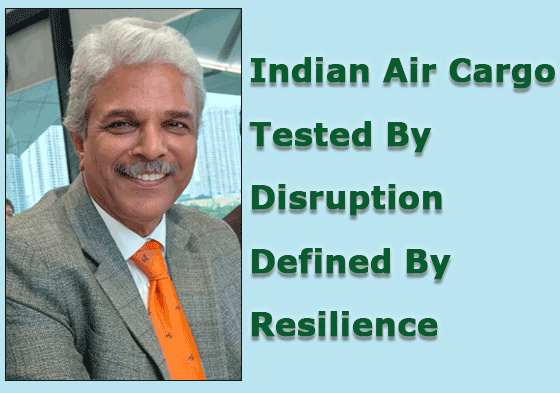
“India is known to be resilient. Our ability to overcome challenges and find good alternates is well established in all fields,” said Samir J. Shah, President of the Air Cargo Agents Association of India (ACAAI). His words were indicative of the experience of freight forwarders in 2025, who were compelled to invent solutions on a daily basis, change the routes of shipments at night, and bear the blows so that exporters could continue to operate.
The defining disruptions of 2025 were largely external. “The major challenges have been geopolitical and the IndiGo crisis,” Shah noted bluntly. For an industry that depends on predictability, global conflicts and airspace constraints left little room for strategic planning.
“There is little we can, as a sector, do in the case of a geopolitical crisis except find immediate alternates and enable our clients to continue their EXIM movements with the same speed and minimal cost burden,” he said. That improvisational ability—finding capacity via new routings, alternate hubs and temporary solutions—became the sector’s primary defence.
But resilience, Shah cautioned, cannot rest on jugaad (Hindi word meaning 'a flexible approach to problem-solving that uses limited resources in an innovative way') alone.
“As long as all stakeholders realize that compliance is the key to sustainability and continuity, there will be no problem.” In 2025, compliance was no longer a back-office issue; it became a survival skill.
 |
One of the quieter shifts in 2025 was a change in tone from regulators. “In the recent past, regulators have shown a willingness for dialogue and pre-intimation of any major changes. Industry must take advantage of the same,” Shah observed.
That dialogue matters as India rapidly expands its airport network and logistics infrastructure. New international and domestic airports, combined with government initiatives through MSMEs, MOHR and other agencies, are steadily strengthening the backbone of air cargo. “All of this will work towards making the air cargo industry more robust and healthier,” Shah said.
Yet 2025 also revealed a persistent gap between intent and execution—one that continues to frustrate operators on the ground.
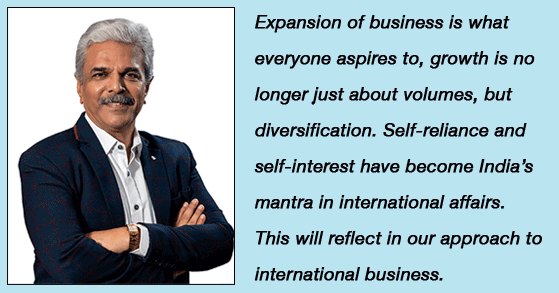
Despite the turbulence, Indian exporters did not retreat inward. Instead, many looked outward—to new products, services and markets. “Expansion of business is what everyone aspires to,” Shah said, pointing out that growth was no longer just about volumes, but diversification.
“Self-reliance and self-interest have become India’s mantra in international affairs. This will reflect in our approach to international business,” he added. That shift was visible in the growing appetite among Indian freight forwarders to take calculated risks.
“The average Indian freight forwarder has an appetite to take risks and explore new markets, new networks and new agents. A similar trait has been shown by exporters,” Shah said. The government’s push to finalize FTAs with non-traditional partners reinforces this trend. The result, he believes, will be “a wider and bigger market for Indian exporters in the future.”
Perhaps the most uncomfortable introspection of 2025 concerns sustainability—not environmental alone, but commercial. Shah was unequivocal: “In my opinion, we are not in a buy-sell industry, but one where domain knowledge, coupled with an understanding of political and international affairs, is critical.”
For too long, he argued, freight forwarders have subsidized trade by financing exporters instead of pricing expertise. “It is essential that the industry makes a studied move from financing the EXIM trade to being a true service provider, asking for its due credit.”
This transition will not be easy in a market conditioned to razor-thin margins. But Shah believes collaboration—not cut-throat competition—will define survival. “Good working principles and an effort to ensure that all actions are for the common good is essential.”
Cargo volumes, he is confident, will continue to rise. “Cargo movement will increase, as will international business. The industry will survive,” he said, “provided stakeholders remain “agile, adaptable, stay in touch with changes, and are not caught by surprise.”
“If 2025 was about capacity shocks, 2026 may be about paperwork. Shah issued a clear warning: “Non-tariff barriers will increase along with more FTAs and more cargo movement.”
In his view, complexity will become universal. “I see a possibility of every cargo facing a non-tariff barrier, both when going out of India and when entering another country.” For regulated sectors like pharmaceuticals, electronics and perishables, this could mean higher costs, longer dwell times and greater exposure to regulatory risk.
Asked what more can the government and regulators do, Shah’s answer was direct and unsentimental. “The present need is more ease of doing business, and lesser intervention in both spirit and practice.”
He called for “simpler, achievable, unambiguous and not expensive regulations” and clearer statutory language that leaves little room for interpretation. “There is a gap between the intention of the government and regulators and the practice on the ground,” he said.
But responsibility, he insisted, does not rest with the state alone. “Not only the government, but every stakeholder will have to participate in India’s growth as a global player, putting the nation above personal needs.”
Indian air cargo exited 2025 tougher, wiser and under no illusion. Growth will continue—but without reform, discipline and collaboration, it will remain stressful rather than sustainable. As Samir Shah’s reflections make clear, the next phase is less about flying more cargo and more about flying smarter.
If resilience defined 2025, credibility may define 2026.
Tirthankar Ghosh
|







 FlyingTypers reserves the right to edit all submissions for length and content. All
photos and written material submitted to this publication become the property
of FlyingTypers Media.
FlyingTypers reserves the right to edit all submissions for length and content. All
photos and written material submitted to this publication become the property
of FlyingTypers Media. 100%
Green
100%
Green