 |
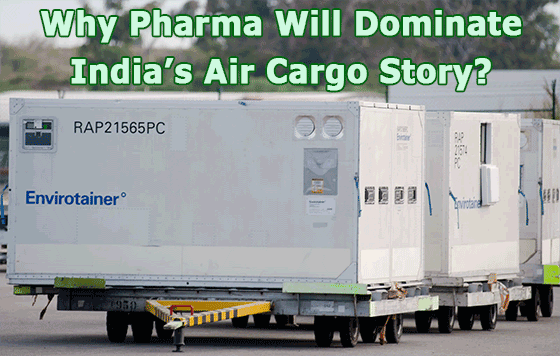
By 2026, India’s air cargo map will look less like a generic export grid and more like a specialized pharmaceutical circulatory system—fast, temperature-controlled, data-rich, and deeply integrated with global healthcare supply chains. The turning point is not just market demand; it is policy design. Union Budget 2026 has effectively made pharma the organizing principle of India’s next logistics era.
At the centre of this shift is Bio-Pharma Shakti, a ₹10,000 crore, five-year national initiative aimed at transforming India from a low-cost generic drug producer into a high-end biologics and advanced-therapeutics hub. Unlike traditional incentives that target manufacturing alone, Bio-Pharma Shakti weaves together research, clinical trials, skills, regulation and logistics — the very ingredients that make air cargo indispensable.
The program will create three new National Institutes of Pharmaceutical Education and Research (NIPERs), upgrade seven existing ones, and build a national network of 1,000 accredited clinical trial sites. It also strengthens the Central Drugs Standard Control Organization (CDSCO), fast-tracking approvals while raising scientific standards. In practical terms, this means more biologics, cell therapies, vaccines and precision medicines—all of which are high-value, time-sensitive, and temperature-critical cargo that almost always flies.
As one global forwarder put it privately, “If India moves up the pharma value chain, air cargo stops being optional—it becomes the backbone.”
Global logistics players entering India in 2026 are no longer obsessed with growth alone; they want predictability. The DP World Global Trade Observatory shows that 94% of executives expect trade growth in 2026, yet more than half also expect heightened policy uncertainty. Customs delays remain the single largest bottleneck, cited by 60% of respondents.
India’s response—Customs 2.0, SWIFT, Turant Customs and e-Sanchit—is slowly smoothing the system, but the impact is uneven across airports. For pharma, unevenness is unacceptable: a single temperature excursion can wipe out an entire shipment.
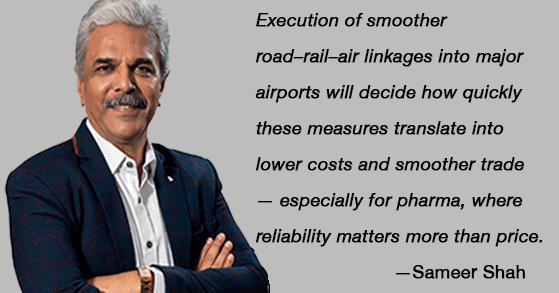 |
This is where leadership voices matter. Samir J. Shah, President of the Air Cargo Agents Association of India (ACAAI), sees Budget 2026 as a structural pivot rather than a patchwork of incentives: The focus has clearly shifted from incremental incentives to fixing core inefficiencies that keep India’s logistics costs above global benchmarks. The new Dankuni–Surat Dedicated Freight Corridor, 20 operational National Waterways, the Coastal Cargo Promotion Scheme and the ₹10,000 crore container manufacturing program will improve schedule reliability, reduce road dependence and stabilize freight costs—all critical for pharma supply chains.”
He adds that single-window customs, operator-centric warehousing and expanded AEO benefits “directly cut transaction time and hidden logistics costs for forwarders moving high-value, time-sensitive shipments.”
India’s pharma exports are already among the country’s strongest trade pillars. But the future is less about tablets in drums and more about biologics in cryogenic containers. These products need:
• Cold-chain integrity from factory to patient
• Time-definite delivery
• End-to-end digital visibility
• Trusted customs clearance
• Resilient multimodal links to airports
Here, air cargo becomes decisive. India’s air cargo volumes have risen steadily—from 2.53 million tonnes in FY15 to 3.72 million tonnes in FY25—but the mix is changing in favor of high-value goods like pharmaceuticals, medical devices and biologics.
Yet infrastructure still lags demand. Bengaluru and Hyderabad are capacity-constrained; freighter parking is tight; and outside major metros, cold storage depth remains patchy. UDAN Cargo’s night operations have helped, but apron and ground-handling upgrades haven’t kept pace.
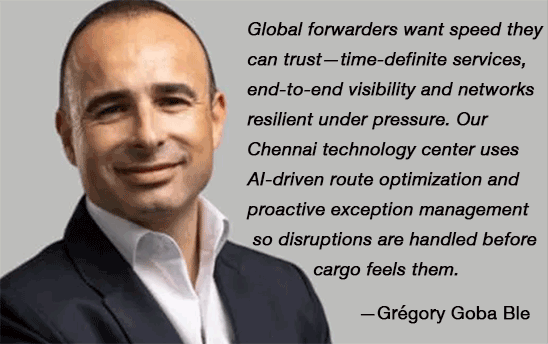
For global integrators, technology is the great leveller. Grégory Goba Ble, Head of UPS India & Director of MOVIN Express, frames the challenge bluntly: “Global forwarders want speed they can trust—time-definite services, end-to-end visibility and networks resilient under pressure. Our Chennai technology center uses AI-driven route optimization and proactive exception management so disruptions are handled before cargo feels them.”
He argues that digital integration is now “table stakes, not a differentiator,” particularly for pharma, where compliance, traceability and data integrity are non-negotiable.
 |
Goba Ble also links Budget 2026 to a larger story: India’s logistics costs must move closer to 8% of GDP through smarter models, better multimodality and deeper digitalization—a transformation that disproportionately benefits pharma shippers.
Budget 2026’s ₹5.98 lakh crore transport outlay signals that air cargo will no longer operate in isolation. The Dankuni–Surat DFC, expanded waterways, and a domestic container manufacturing push will create smoother road–rail–air linkages into major airports.
As Samir Shah notes, “Execution will decide how quickly these measures translate into lower costs and smoother trade — especially for pharma, where reliability matters more than price.”
Three shifts make Bio-Pharma Shakti a game-changer for air cargo:
• More advanced products = more air shipments
Biologics, gene therapies and clinical trial samples travel almost exclusively by air.
• Stronger regulation = fewer shipment failures
A reinforced CDSCO reduces compliance risk, making India a more trusted origin.
• Research clusters = logistics clusters
New NIPERs and clinical sites will pull investment in specialized cold-chain hubs near airports.
Additionally, Budget 2026’s full customs exemption on 17 life-saving drugs and new exemptions for seven rare diseases will further increase inbound and outbound pharma flows.
India’s 5.7 crore MSMEs (micro small medium enterprises) are increasingly part of the pharma ecosystem — packaging, devices, diagnostics, reagents, clinical kits. Budget measures on credit guarantees, customised cards and green logistics help smaller players plug into global supply chains, often via express air networks. As Goba Ble puts it, “Empowered MSMEs make the entire pharma export machine more resilient.”
However, gaps remain in cold-chain depth outside metro airports. Foremost among them is inconsistent e-AWB adoption at smaller gateways, limited integrated national cargo community system, and urban last-mile congestion in tier-II/III cities. Fixing these will determine how fast pharma’s dominance materializes.
By 2030, India aims to handle 10 million tons of air cargo annually. Reaching that figure will not be driven by bulk commodities; it will be pulled by high-value sectors—above all, pharmaceuticals.
Bio-Pharma Shakti, combined with multimodal infrastructure, customs digitization and integrator-led technology, is quietly reshaping the market so that Indian air cargo looks less like a volume business and more like a precision healthcare network in the sky.
As a senior forwarder told FT: “In India’s next decade, if you want to understand air cargo, follow pharma.” That is not a prediction. It is already happening.
Tirthankar Ghosh
|









 FlyingTypers reserves the right to edit all submissions for length and content. All
photos and written material submitted to this publication become the property
of FlyingTypers Media.
FlyingTypers reserves the right to edit all submissions for length and content. All
photos and written material submitted to this publication become the property
of FlyingTypers Media. 100%
Green
100%
Green