

ATC Aviation Services AG
EMO Trans ad
FlyingTypers Logo
#INTHEAIREVERYWHERE
Feed The Children Ad
   Vol. 25  No. 5                                      

Thursday February 12, 2025

linespacer
linkedin
facebook
Instagram

PayCargo Advert

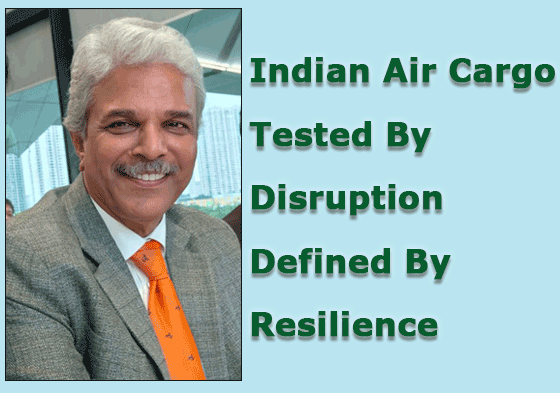
Sameer Shah

     If 2025 taught Indian air cargo one lesson, it was this: growth alone is no longer a guarantee of comfort. Volumes moved, exports held up, and India retained its position as one of the world’s fastest-growing air freight markets—but the second half of the year exposed just how thin the margin for error has become. Geopolitical shocks, capacity disruptions, regulatory friction and the IndiGo crisis combined to test the system in ways not seen since the pandemic years.
     Yet, as the year drew to a close, the dominant story was not collapse, but continuity.
     “India is known to be resilient. Our ability to overcome challenges and find good alternates is well established in all fields,” said Sameer Shah, President of the Air Cargo Agents Association of India (ACAAI). His words were indicative of the experience of freight forwarders in 2025, who were compelled to invent solutions on a daily basis, change the routes of shipments at night, and bear the blows so that exporters could continue to operate.
     The defining disruptions of 2025 were largely external. “The major challenges have been geopolitical and the IndiGo crisis,” Shah noted bluntly. For an industry that depends on predictability, global conflicts and airspace constraints left little room for strategic planning.
     “There is little we can, as a sector, do in the case of a geopolitical crisis except find immediate alternates and enable our clients to continue their EXIM movements with the same speed and minimal cost burden,” he said. That improvisational ability—finding capacity via new routings, alternate hubs and temporary solutions—became the sector’s primary defence.
     But resilience, Shah cautioned, cannot rest on jugaad (Hindi word meaning 'a flexible approach to problem-solving that uses limited resources in an innovative way') alone.
     “As long as all stakeholders realize that compliance is the key to sustainability and continuity, there will be no problem.” In 2025, compliance was no longer a back-office issue; it became a survival skill.

Sameer Shah

     One of the quieter shifts in 2025 was a change in tone from regulators. “In the recent past, regulators have shown a willingness for dialogue and pre-intimation of any major changes. Industry must take advantage of the same,” Shah observed.
     That dialogue matters as India rapidly expands its airport network and logistics infrastructure. New international and domestic airports, combined with government initiatives through MSMEs, MOHR and other agencies, are steadily strengthening the backbone of air cargo. “All of this will work towards making the air cargo industry more robust and healthier,” Shah said.
     Yet 2025 also revealed a persistent gap between intent and execution—one that continues to frustrate operators on the ground.
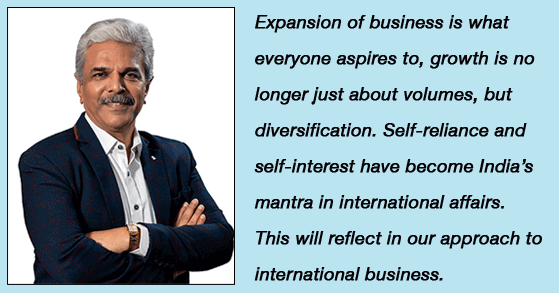
Despite the turbulence, Indian exporters did not retreat inward. Instead, many looked outward—to new products, services and markets. “Expansion of business is what everyone aspires to,” Shah said, pointing out that growth was no longer just about volumes, but diversification.
     “Self-reliance and self-interest have become India’s mantra in international affairs. This will reflect in our approach to international business,” he added. That shift was visible in the growing appetite among Indian freight forwarders to take calculated risks.
     “The average Indian freight forwarder has an appetite to take risks and explore new markets, new networks and new agents. A similar trait has been shown by exporters,” Shah said. The government’s push to finalize FTAs with non-traditional partners reinforces this trend. The result, he believes, will be “a wider and bigger market for Indian exporters in the future.”
     Perhaps the most uncomfortable introspection of 2025 concerns sustainability—not environmental alone, but commercial. Shah was unequivocal: “In my opinion, we are not in a buy-sell industry, but one where domain knowledge, coupled with an understanding of political and international affairs, is critical.”
     For too long, he argued, freight forwarders have subsidized trade by financing exporters instead of pricing expertise. “It is essential that the industry makes a studied move from financing the EXIM trade to being a true service provider, asking for its due credit.”
     This transition will not be easy in a market conditioned to razor-thin margins. But Shah believes collaboration—not cut-throat competition—will define survival. “Good working principles and an effort to ensure that all actions are for the common good is essential.”
     Cargo volumes, he is confident, will continue to rise. “Cargo movement will increase, as will international business. The industry will survive,” he said, “provided stakeholders remain “agile, adaptable, stay in touch with changes, and are not caught by surprise.”
     “If 2025 was about capacity shocks, 2026 may be about paperwork. Shah issued a clear warning: “Non-tariff barriers will increase along with more FTAs and more cargo movement.”
     In his view, complexity will become universal. “I see a possibility of every cargo facing a non-tariff barrier, both when going out of India and when entering another country.” For regulated sectors like pharmaceuticals, electronics and perishables, this could mean higher costs, longer dwell times and greater exposure to regulatory risk.
     Asked what more can the government and regulators do, Shah’s answer was direct and unsentimental. “The present need is more ease of doing business, and lesser intervention in both spirit and practice.”
     He called for “simpler, achievable, unambiguous and not expensive regulations” and clearer statutory language that leaves little room for interpretation. “There is a gap between the intention of the government and regulators and the practice on the ground,” he said.
     But responsibility, he insisted, does not rest with the state alone. “Not only the government, but every stakeholder will have to participate in India’s growth as a global player, putting the nation above personal needs.”
     Indian air cargo exited 2025 tougher, wiser and under no illusion. Growth will continue—but without reform, discipline and collaboration, it will remain stressful rather than sustainable. As Sameer Shah’s reflections make clear, the next phase is less about flying more cargo and more about flying smarter.
     If resilience defined 2025, credibility may define 2026.
Tirthankar Ghosh


Vicki Jaramillo, Brandon Fried, Kevin Thibault,Tim Weisheyer, Kendra Tanner, Tod Willman

     Listen to the “Why Orlando Air Cargo?” FlyingTalkers Broadcast and meet the team that worked at bringing the global air cargo industry to Orlando for The Air Cargo Conference beginning next Monday February 15, at the Omni Orlando Resort.
  Here creating a historic move in bringing air cargo centerstage at MCO included are executives from Greater Orlando Aviation Authority: Orlando International (MCO) and Executive (ORL) Airports from left, Vicki Jaramillo, GOAA–Executive Vice President & Chief Development Officer; Brandon Fried, Executive Director, The Airforwarders Association; Tim Weisheyer, GOAA Chairman of the Board; Kendra Tanner, MBA-AfA Board Director and CEO of Allstates WorldCargo; Tod Willman, GOAA Assistant VP of Cargo Development and Kevin Thibault, GOAA Chief Executive Officer.
  The host associations of the Air Cargo Conference next week include:
AEMCA (Air and Expedited Motor Carriers Association), ACI-NA (Airports Council International - North America) and The Airforwarders Association
  These associations are involved in a conference, unique and vital “for everybody else" in logistics including truckers, airports, freight forwarders, airlines and more to meet, greet and learn, bringing together all the actors in the air cargo supply chain to discuss industry dynamics and opportunities.

Hong Kong Forklift and Pallet Competition

     If anyone cares to claim that driving a forklift or building up cargo pallets isn’t fun they clearly have never attended the annual Forklift Driving and Pallet Building Competition, hosted by Hong Kong Air Cargo Terminals Ltd aka Hactl.
     This event has been run in various formats for decades, even back to Kai Tak days, but more recently takes place adjacent to the huge Hactl terminal, this year under cloudless blue skies.
     44 competitors from 10 teams from Air Canada, Cargolux, China Southern Airlines, Emirates SkyCargo, EVA Air, Finnair, IAG Cargo, Japan Airlines plus a Hactl team competed to breakdown a loaded pallet, transfer the contents using a forklift and reload as much as possible into a smaller contour load. A further 80+ supporters provided loads of encouragement.
     All this against the clock with a cut off time of 60 minutes with points for the best use of available volume and under the watchful eye of the judges handing out penalties.
     This year long-time participant Japan Airlines swept all the top honours, claiming Overall Champion and winning the Forklift Competition, Forklift Driving Safety Award, and Pallet Building Competition, but it was a fiercely fought race.
     And of course, when it comes to safety everyone was a winner.|
     While the judges were tearing down the loads looking for errors such as incorrect contours, poor DG spacing and unstable loading, the fun really ramped up with the singing and dancing competition, with the various teams putting on some very polished performances!
     As the largest cargo terminal in the world’s busiest air cargo airport, Hactl puts a huge effort into making this event an annual event, and particularly this year as it is Hactl’s 50th anniversary, we even had the catering by Hong Kong’s iconic Peninsula Hotel—hard to beat.
     This wonderful traditional event in Hong Kong gets a big thanks to everyone who made it possible including officials, judges, and the staff and management of Hactl.
     Thanks to the great spirit of our community. Folks departed this day feeling good all over.
Bob Rogers


Indian Air Cargo

     India will remain one of the very few large air freight markets still growing with consistency. Shipments will rise, routes will realign, and air cargo will continue to play a strategically vital role in India’s export economy. But growth will offer little comfort. Expansion will slow, margins will be thin, and the deep-rooted stresses exposed in 2025—many of them policy-induced—will remain unresolved.
     The defining question for 2026 is no longer whether India’s air cargo sector will grow—it will—but whether it can do so without locking itself into a permanent state of financial stress.
     After two years of unusually strong expansion, the market is normalizing. ICRA expects India’s air cargo volumes to grow by 4–6% in FY2026, down from around 10% in FY2025. Domestic cargo is forecast to grow faster at 5–7%, while international cargo growth is expected to moderate to 2–4%, weighed down by a high base and persistent global trade friction.
     This deceleration is not a sign of fragility. It reflects the gradual unwinding of tariff-driven, front-loading, post-pandemic supply chain reconfiguration, and aggressive capacity redeployments. What it signals instead is a more exacting operating environment, where growth will be shaped less by external tailwinds and more by execution, cost discipline and policy coherence.
     Despite a tougher base, three forces will continue to anchor the Indian market. High-value, time-critical exports remain structurally aligned with air freight. Pharmaceuticals -- vaccines, biologics, and temperature-sensitive formulations --depend on speed and reliability. Electronics, particularly smartphones, have today become core to the Indian export profile, with tight production cycles and global launch timelines that favor air over sea transport. 
     E-commerce and express cargo are no longer cyclical add-ons. Domestic express, cross-border parcels and Asia-origin cargo feeding global consumption markets provide a stable demand floor. This is why domestic air cargo is expected to continue outperforming international volumes through 2026.
     Trade diversification is cushioning shocks. As U.S. tariffs and geopolitical uncertainty reshape flows, Indian exporters are redirecting shipments toward Southeast Asia, the Middle East, Africa, Australia and parts of Latin America. As one freight forwarder put it during the tariff shock of late 2025, “cargo has not vanished—it has simply been rerouted.”
     The global backdrop, however, will be far less forgiving. The International Air Transport Association expects global merchandise trade growth to remain below 1% in 2026, as protectionism hardens into policy and the one-off effects of tariff front-loading fade. IATA Director General Willie Walsh has repeatedly noted that air cargo is “adapting to trade shocks rather than buckling under them,” but adaptation does not automatically translate into profitability.

Dinesh Kumar Krishnan, Afzal Malbarwala, Rajen Bhatia

     The disruption witnessed in late 2025 on the India-U.S. corridor showed what could happen. Higher duties rendered air freight uneconomical for many labour-intensive exports, forcing abrupt shifts in routing and mode choice. Rajen Bhatia, Managing Director of Tulsidas Khimji Pvt Ltd, observed that the impact was no longer anecdotal. “Weekly air cargo volumes from India to the U.S. dropped by around 8–12% week-on-week, and overall volumes ran well below recent averages,” he said.
     Others saw the fallout spread across categories. “Handicrafts, gems and jewellery, textiles, engineering tools—even seafood—were hit,” noted Afzal Malbarwala of Galaxy Freight. “Exporters cut order sizes and began actively scouting alternative markets.” Dinesh Krishnan, another freight forwarder, was blunter: “Once duties crossed 50%, air freight simply stopped making sense for most discretionary cargo.”
     This places a heavier burden on India’s own competitiveness. Without global tailwinds, inefficiencies at home matter far more.
     On paper, ambition is not lacking. More than $12 billion has been earmarked for airport expansion through greenfield projects and brownfield upgrades. In practice, cargo remains an afterthought to passengers.
Capacity creation is still passenger-led, with cargo accommodated rather than planned. During airport rebuilds, continuity of cargo supply is seldom protected. Dedicated freighter infrastructure continues to be treated as optional. The result is congestion at existing hubs, uncertainty around transitions to new airports, and rising handling costs that directly erode export competitiveness.
     These weaknesses are compounded by aircraft availability constraints and limited MRO capacity—problems rooted in years of under-investment and regulatory inertia. They will not be solved in a single budget cycle and will remain visible well beyond 2026 unless explicitly addressed.
     Costs are moving in the wrong direction. While fuel prices may soften marginally, non-fuel costs—labor, maintenance, leasing and airport charges—continue to climb. Passenger airlines can absorb these pressures because cargo is cross-subsidized by ticket revenue. Dedicated freighter operators cannot.
     The financial divergence is already stark. Express operators with time-definite, contract-backed models—most notably Blue Dart Aviation—remain profitable. Independent freighter airlines are squeezed from all sides by suppressed yields, royalty-driven airport charges and surplus belly capacity.
India is moving more freight by air than ever before. According to Airports Authority of India data, cargo throughput exceeded 1.2 million tonnes between April and July 2025 alone, with steady growth continuing into FY2026. Yet most of the companies carrying this cargo struggle to earn sustainable returns.
 C.K. Govil     One quiet achievement of 2025 was the system’s ability to absorb shocks. Tariff disruptions, route volatility and even domestic airline disruptions did not trigger a national cargo breakdown. Freight was rerouted, integrators leaned on proprietary networks, and airports prioritized clearance. Veteran industry observer C K Govil described this as evidence that “the ecosystem has matured enough to bend without breaking.” That resilience will carry into 2026.

     But resilience without profitability is not a strategy.
     Unless India addresses royalty-heavy airport charging models, adopts cargo-first planning during infrastructure upgrades, and levels the playing field between belly cargo and freighters, the paradox will persist: volumes will rise, relevance will grow—and financial stress will deepen.
     India’s air cargo market will grow in 2026.

     The harder test is whether it can finally grow up.
Tirthankar Ghosh


If You Missed Any Of The Previous 3 Issues Of FlyingTypers
Access complete issue by clicking on issue icon or
Access specific articles by clicking on article title
FT012026
Vol. 25 No. 2
2025 Snapshot
Photo Of The Day
Love At Work At ATC
India Between Pressure & Progress
Chuckles for January 20, 2026

FT020226
Vol. 25 No. 3
FIATA Passage To India
My Luncheon With Wilson
Chuckles for February 2, 2026
Amar Goes Brokers At JFK
Pied Piper Hails MACA Return

FT020526
Vol. 25 No. 4
Fruit Logistica Freshens February
Olympics Logistics Delivers
Chuckles for February 5, 2026
Love Stems From Delta Cargo
All Dogs Go To Heaven

Publisher-Geoffrey Arend • Managing Editor-Flossie Arend • Editor Emeritus-Richard Malkin
Senior Contributing Editor/Special Commentaries-Marco Sorgetti • Special Commentaries Editor-Bob Rogers
Special Assignments-Sabiha Arend, Emily Arend
• Film Editor-Ralph Arend

Send comments and news to geoffrey@aircargonews.co
Opinions and comments expressed herein do not necessarily reflect the views of the publisher but remain solely those of the author(s).
FlyingTypers reserves the right to edit all submissions for length and content. All photos and written material submitted to this publication become the property of FlyingTypers Media.
Copyright ©2026 FTMedia, Inc. All Rights Reserved.
More@ www.aircargonews.com

recycle100% Green