 |
When Geoffrey asked me to look into the idea of writing an article about the logistics of the upcoming Olympic Games in Milano-Cortina I was left with a question that would not go away: what is going on, what’s up? Remember the 4-Non Blondes’ song? That is precisely how I felt, hopeful, but slightly estranged. The information publicly available was not abundant, and that is an understatement. Nobody seems to talk about the ‘O’ games in Italy, about their preparation even less. If you listen to the Italian radio and TV, the time allotted to this once-in-a-lifetime experience is quite small indeed. I get much more information from our neighbours in Switzerland. Well, that’s life, so we must live with it.
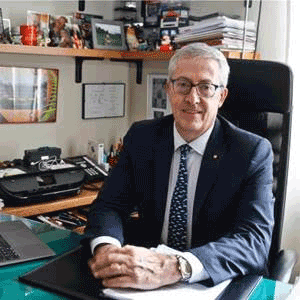 With no luck at all, I tried to contact the Milano-Cortina Foundation to get information. As the cited song suggests, I stepped outside, took a deep breath and… From that “outside”, an idea came to mind. In 2002 I had unsuccessfully tried to apply as director for transport and logistics of 2006 Olympic Games in Turin, my home town. This happened just a few months before starting my ten years in Brussels at CLECAT: no regrets. But there was the connection: the person then in charge of the preparation, Paolo Balistreri, who is Secretary General of Confindustria Piemonte today, had been a friend for many years and . . . At that time Paolo had become Coordinator of Transport, Logistics, Accommodation, Protocol, Accreditation and International Client Services (2003-2006) and Director for Transport and Logistics in the Organizing Committee of the 2006 Olympic Games in Turin (TOROC) between 2002 and 2006. With no luck at all, I tried to contact the Milano-Cortina Foundation to get information. As the cited song suggests, I stepped outside, took a deep breath and… From that “outside”, an idea came to mind. In 2002 I had unsuccessfully tried to apply as director for transport and logistics of 2006 Olympic Games in Turin, my home town. This happened just a few months before starting my ten years in Brussels at CLECAT: no regrets. But there was the connection: the person then in charge of the preparation, Paolo Balistreri, who is Secretary General of Confindustria Piemonte today, had been a friend for many years and . . . At that time Paolo had become Coordinator of Transport, Logistics, Accommodation, Protocol, Accreditation and International Client Services (2003-2006) and Director for Transport and Logistics in the Organizing Committee of the 2006 Olympic Games in Turin (TOROC) between 2002 and 2006.
Paolo and I have been working in parallel in many areas, the airport of Turin in particular was a common interest for a long period. Nobody has worked harder on regional infrastructure and industrial logistics than Paolo Balistreri, who spent more than twenty years promoting our region’s logistics and actually getting things done. I asked him whether he was available to share his experience, in particular with regard to the upcoming Olympic Games starting on Feb 6th, as compared to the job he had completed in Turin. So here we go, we have an Olympic experience compared with another for the benefit of our readers. Again, this is not the first experience for Cortina. In his recently published book Andrea Goldstein wrote: “The first Games after the Second World War hosted by an Axis country, the first in winter, and the second overall, after Athens 1896, south of the Alps, the first in which a reunified German team competed, the first with international television coverage, the first in which the participants' oath was recited by an athlete, the first in which the Olympic anthem was performed.”
I tried to kick my ball with Paolo from that remote time, “aside from ‘our’ memories of 2006 in Turin, I'd like to begin with other memories, many years earlier, as quoted on the 'Post', an interesting opinion maker in Italy: “On January 26th, 1956 the Winter Olympics began in Cortina d'Ampezzo. They lasted eleven days and certainly did not change the world, but they were an important piece of Olympic history and of the [so called] Italian economic boom. They were also crucial for the future of Cortina, a mountain town of just a few thousand inhabitants, where nearly a thousand athletes from 32 countries arrived, along with tens of thousands of fans and tourists. They probably went partly for the sport and partly to cruise around and be seen; in some cases, even just to be part of the social scene, of which Cortina became a centre. The 1956 Cortina Winter Olympics were the first with a Soviet team and the first for Italy (abridged) between the Cold War and the Dolce Vita.”
 |
FT: We are exactly 70 years past Cortina 1956, the Olympics that set several records: where are we in 2026? Will we set more positive records? Paolo, what's your gut feeling about the atmosphere in Italy right now?
PB: It is . . . shall I say more detached? Twenty years ago we were part of a big working group, there was a sort of institutional enthusiasm. There hadn't been anything comparable in these committees, since 2002: the municipality, the regional chamber of commerce, associations . . . a sort of collective emotion was created. Today it is different. I have colleagues from Confindustria who have tried to interact, but it seems to me there's a kind of disinterest, and the choice of playing the Games in distant territories hasn't allowed us to build a real team like we had in Turin. We met every two weeks then, even to merely discuss supplies and services. For Cortina, they didn't ask me or any of my colleagues to participate in the preparations. Perhaps we could have offered some advice . . .
FT: Indeed, there seems to be little enthusiasm; even the media and the press are dry in their communication about this.
PB: Perhaps it's more difficult to organize the Games in such a vast area. We were in Turin, but today we are talking of well more than half of Northern Italy.
FT: From the Corriere della Sera (January 26th), we read this headline: "Milan-Cortina, the train stations put to test by the Olympics: 40 million investments, yet barriers and painters still at work." Just a few days before the inauguration, isn’t it an almost alarming headline? Yesterday (Jan 25th), walking through the streets of Milan, the impression I got was modest, as though there was nothing special, save a few billboards and signs celebrating the upcoming Olympics. In Turin in 2006, things were very different, weren’t they? What does Paolo Balistreri – a well-informed and representative personality of the industrial world, who "created" the logistics for Turin 2006 – think about this? What is the current state of the essential infrastructure . . . your assessment?
PB: I don't have the details, but from my relationship with our local colleagues, within the local community, right before the ribbon-cutting ceremony, it seems to me that there are still delays that could create problems: in Turin, everything was ready a year earlier . . . The Agency Torino 2006, then called TOROC, was really working as a big team. Today I know some delays exist, and perhaps not everything will be ready, especially in terms of infrastructure. Not just the Olympics infrastructure, but also simply the upgrading of the transport infrastructure . . . I really hope this is not the case and these rumours are not well-founded.
FT: What were the most difficult challenges faced in the infrastructural and logistical organization of Turin 2006? What are the differences between Turin and Milan-Cortina, exactly twenty years later, in your opinion?
PB: A rigorous work plan that worked across all users, in order to develop a logistics plan: that was our asset. The service customer base is highly diversified in the Games. The Olympic environment is extremely complicated. Flow schedules must not add up, the preparation of contents and schedules is tight. A year earlier, we were ready . . . This allowed us to address the unexpected, with a pragmatic approach and cross-functional work within TOROC. Something unexpected always happens, you can address it only if the rest functions as clockwork. The Savoy (1) method and Savoy culture came into play at that point and the result was good enough. Leaving Turin Airport outside of our programmes, as some nicknamed Caselle: “Mikey Mouse Airport” was not a good idea. I had seen what hadn't worked in Salt Lake City and didn't want to repeat the error by working at Malpensa, which was too far away from the Olympic sites. The airport of Turin functioned flawlessly and our choices were confirmed.
I contended that such institutional coordination contributed to the revitalization of Caselle Airport then, but now there are some nuts and bolts that need some fixing . . . Perhaps it deserves a bit of updating? Then I continued with my questions. Paolo, as a true professional in organizing large logistics projects, I'd be happy to gather your comments on the logistics support system set up by the Milano Cortina Foundation, drawing, if possible, parallels with 2006. The following information about this year’s Olympic logistics system can be gathered from the internet by AI. Saying it’s just essential is probably an understatement and I do not think the problem comes from using AI to do it . . .
The logistics of the 2026 Winter Olympic Games (Milano Cortina 2026) are primarily managed by the Milano Cortina 2026 Foundation (Fondazione Milano Cortina 2026), the official Organizing Committee. Within this framework, several key figures and organizations oversee specific logistical operations:
Key Leadership
- Andrea Varnier (CEO, Milano Cortina 2026 Foundation): As CEO, Varnier leads the operational phase of the Games, including the management of functional areas such as transport and logistics.
- Giovanni Malagò (President, Milano Cortina 2026 Foundation): Provides overall leadership and high-level coordination with national and international bodies.
The Organizing Committee relies on specialized strategic partners to handle large-scale physical logistics: Poste Italiane is the designated Premium Logistics Partner for the Milano Cortina 2026 Olympic and Paralympic Winter Games. The company will manage the end-to-end transport, logistics, and supply chain for all goods, equipment, and materials required for the event across the various Olympic venues.
- Poste Italiane (Premium Logistics Partner): Tasked with managing the transport, customs formalities, and logistics of all goods, equipment, and materials necessary for the event.
- FS Italiane (Ferrovie dello Stato Italiane): As a Premium Partner, its logistics and transport units are responsible for rail and road infrastructure, ensuring the flow of athletes, delegations, and spectators between venues.
- Terna: Responsible for the logistics of energy supply, ensuring the stability and resilience of the electricity grid at all competition and logistics sites.
Key details regarding 2026 Games logistics:
- Operational Scope: Managing logistics for over 3,600 athletes and equipment across a wide, "diffused" territory of 22,000 square kilometers.
- Infrastructure Support: FS Italiane (Ferrovie dello Stato) is also a premium partner managing transport infrastructure, specifically enhancing rail and road connections.
- Organizing Body: The Fondazione Milano Cortina 2026 (Milano Cortina 2026 Foundation), led by President Giovanni Malagò and CEO Andrea Varnier, oversees the overall planning and execution of the Games.
- Logistics Team: Over 1,200 professionals will be involved in the logistical operations.”
|
FT: I'll tell you how I see it . . . looks like a structure suffering from cronyism. What do you think about my perception, especially regarding the decision to choose Poste Italiane as principal logistics provider?
PB: Entrusting everything to the Post Office seems to be a daring choice. In Turin, we selected among the ten top operators worldwide; TNT (in Italian) won the bid in the end based on international criteria only. When I saw it is the Post Office this time, I suggested that the operator should receive very clear instructions from the Committee on what needs to be done. It was a different approach then. We were looking for the experience of an international operator, knowing that Schenker was the logistics service provider for the IOC, all the way down to the arrival airports. From there it was our job, TNT was taking over each and every piece. It had been a tough negotiation, TNT won: no regrets. As can be seen from the post-Olympic report it was a good choice.
FT: Is the Post Office more equipped for a parcel logistics system? Or have logistics changed in these 20 years so much that this is what is now required?
PB: Olympic logistics isn't just package logistics . . . The territory to be covered is very large, and the needs are very complex and diverse. Special attention is needed for different needs, certainly not just the last mile. Today's postal services are not what they were twenty years ago, but the offerings cannot be limited to just an extended last mile option.
FT: Assuming the available information is correct, what do these numbers and this facility suggest to you? Do they compare with those of Turin 2006?
PB: The decision was TNT's—we were discussing what to do with them and they took full ownership of certain responsibilities. I hadn't gone into much detail about TNT's numbers; it was certainly more important to relate to the various agencies and companies, and TNT did its planned job quite well. TNT was one of the major operators at the time, though not the only one.
FT: The media, aside from some advertising space, has covered relatively little of the 2026 Olympics, at least so far, both in Italy and abroad. It's true that we live in a time when the news seems to be focused on extremely serious geopolitical events, yet we read very little about the Olympic preparations. The knock-on effect is missing . . . It looks as though we only cared to attract prominent politicians . . . Attracting them is important, and then? That’s not all . . . Should we start being alarmed? What's really going on?
PB: In Turin it was different. We've worked to accommodate quite a large number of people: we've worked in the city, in the mountains, with carriers and services providers, in order to accommodate very big numbers. We've also worked extensively with the railway as a tool for transporting different types of passengers. The train was essential, but Trenitalia hadn't understood the opportunity and adequately promoted the service. We've also tried to reorganize attendants’ requests so they could become compatible with the local capacity, because Olympics largely taking place in the Alps suffers from capacity limitations dictated by nature that must be taken into account. For example, we've instituted a one-way system on the two existing connections between Cesana and Sestriere, which was proven to be a solution that significantly eased traffic congestion. In the case of Milan-Cortina, perhaps due to the distances involved, it seems to me that their approach hasn't been as thorough so far. However, for us in Turin there was never any doubt that it wasn't just securing the Games, holding the Olympics, but we had to do it well . . . I sincerely hope the same goes for Cortina.
FT: My impression was that organizing the Olympics wasn't just a political undertaking, but the expression of the efforts of an entire community.
PB: In fact, I completely agree, but as much as I was satisfied with the cooperation in creating the Olympics, I was disappointed by the post-Olympic arrangements, because once the Olympics was over, we weren't able to seize this opportunity to further promote the area. For example, when I go to Barcelona, I see that the city has been changed for the better by the Olympic experience and this is still a legend today.
FT: Has Confindustria set up a body to monitor the progress of the preparations and, if necessary, intervene to support the efforts?
PB: There isn't a body like the one we had in Turin (TOROC). The Chamber of Commerce is a reference point, but as industrial associations, we weren't invited, not even our local colleagues.
FT: It seems like a missed opportunity to me, because the association you represent brings unparalleled organizational expertise and knowledge . . . After all, you had a recent experience that was close by, and we could draw experience from it. Your views?
PB: In any case, without being intrusive we sent some of our material to them and we hope that it was taken into account.
FT: Turin will be the place where the ice-skating at the 2030 French Olympics takes place. Has the organizational machinery already started? Will you be involved in the preparations?
PB: Right now, nothing has been done yet. The organizational machinery needs to get going, but a preliminary thought never hurts . . . as soon as the 2026 Olympics is over, we should start thinking . . . In any case, even just the ice skating events will require some sizeable organization.
FT: Moving on to another level: Italy seems torn and full of doubts about its future. With the death of the great ‘captains’ of our industrial past, things seem to have come at a standstill, especially in logistics, yet Mr. Aponte, who is Italian, is in charge of the largest fleet in the world and does more than just sailing ships, we see expansion on the railway and airborne transport, all this from Switzerland though . . . Are we doing something wrong?
PB: Believe me, as Confindustria, we're on the ball; there's strong coordination with the neighbouring regions, particularly on the issue of inland ports. I've superimposed the hinterland of Rotterdam port on the map of Piedmont, and that reaches from Genoa to Novara and beyond, just to give you an idea of what we're talking about . . . The inland port, combined with the Alessandria inland port, isn't enough. Confindustria will organize events at the macro-area plane, with all the regions. At industrial and trade level, I've just received more than decent figures with an increase in exports; we've just organized an event on internationalization. The number of countries to which we are exporting is also increasing: India, China, and many others are listed. The signals are positive: we published a report on this development. Questions regarding the United States’ trade exist though, because companies need certainties that are currently lacking in that area. Attracting investments, streamlining bureaucracy and providing structured information must become a mantra. We're preparing a catalogue, evaluating nearly 600 areas where new businesses can be opened, and we're trying to evaluate the 100 areas to focus on, with the collaboration of the Piedmont region, in order to attract competitive new entrants.
A final statement regarding the Games, there's very little left to go, and I hope we can repeat Turin's success. Let's hope that we shall not have to say: Turin had done it better . . . The IOC was careful to monitor our efforts then — I hope the same was done with Milan-Cortina in this connection. The relationship with the IOC was an added value for us. Transportation, logistics and accommodation must be able to work together . . .
Time was up. Paolo had to return to his business. I was very grateful he granted so much time to us. I was left with a bunch of other questions, but our readers may have to guess the answers . . . Perhaps we can open a debate on this?
The difference in the world of communication between 2006 and 2026 is extraordinary. In 2006, no one could cheat, because photographic truth nailed everyone to a single reality. Today, this is no longer the case: even reality is a concept that can be manipulated. How much does this factor influence the stress of the organizers? Do we really believe there are organizational shortcomings, or should we think this is just unreliable, detrimental information?
Well, the truth is not far away in future . . . On Feb 6th it all starts, right? The Olympic Games is too big a thing for faking it. Keeping fingers crossed, in hope that everything runs as perfectly as we have imagined it, let’s go Olympic!
Marco L. Sorgetti
(1) The “Spirit of Savoy” refers to the enduring cultural, humanitarian and historical legacy of the House of Savoy, one of the world’s oldest royal dynasties that ruled parts of the Alps and Italy for nearly a millennium.
|








 FlyingTypers reserves the right to edit all submissions for length and content. All
photos and written material submitted to this publication become the property
of FlyingTypers Media.
FlyingTypers reserves the right to edit all submissions for length and content. All
photos and written material submitted to this publication become the property
of FlyingTypers Media. 100%
Green
100%
Green