PayCargo Advert

EMO Trans ad
FlyingTypers Logo
#INTHEAIREVERYWHERE
Feed The Children Ad
   Vol. 25  No. 44                                                                       

Wednesday October 21, 2026

linespacer
linkedin
facebook
Instagram

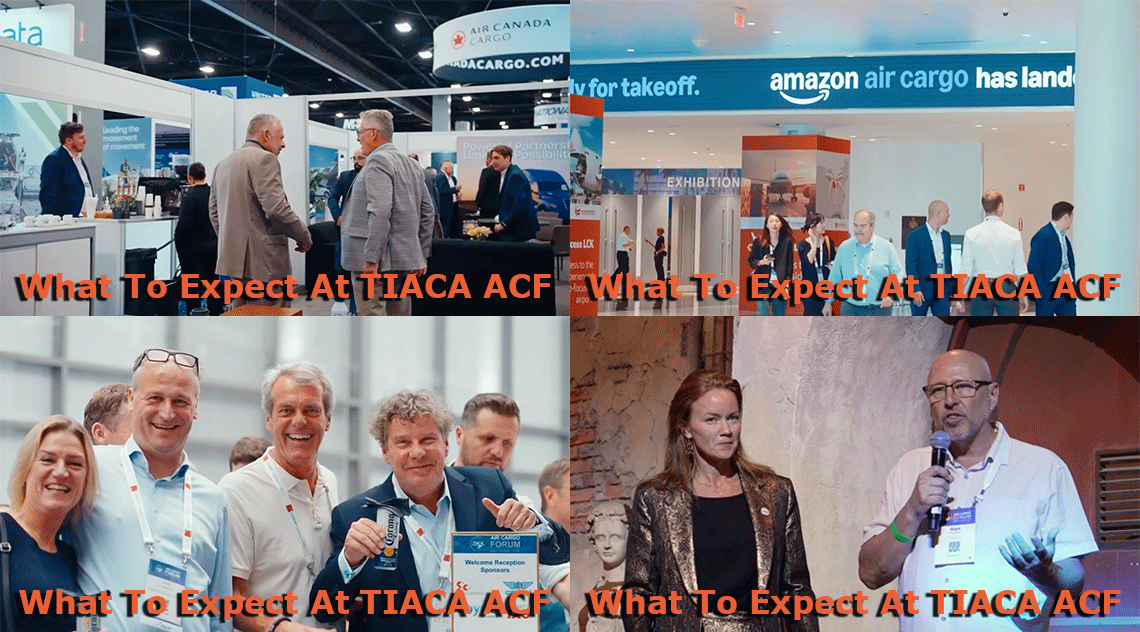
TIACA ACF Collage

     Here is a brief look ahead. Just for you.
     Today we’re jumping in with hands, hearts and heads first into content and thoughts before the show starts next week in Miami, Florida, setting our table where the Miami Beach Convention Center is about to turn into a crossroads for the global air cargo world.
     The TIACA Air Cargo Forum runs October 26th through the 29th, and this year it feels like more than just another trade event.
     It’s a moment where the industry gets to look forward and, at the same time, take stock of the people and decisions that shaped the last few years.
     It feels with so much driving change on so many levels, this event could host and also be the start of something big.
     Next week in Miami are recognizable names in U.S. air cargo—Jan Krems, Brandon Fried, and Glyn Hughes—all could be in the same place at the same time, possibly even showing up alongside the people who now have stepped into their roles.
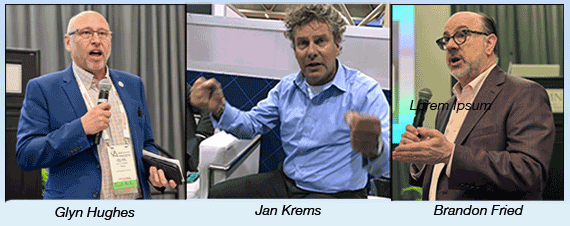
Glyn Hughes, Jan Krems, Brandon Fried

      Jan Krems (retired) led United Airlines Cargo for more than 12 years, and during that time United Cargo didn’t just grow—it separated itself from the pack. The way people talk about it, he helped turn United’s cargo arm into a top-tier global competitor, and the revenue performance climbed to about double what the nearest U.S. competitor was doing.
     Krems’ legacy is going to stay in the conversation for a long time. During the pandemic, United got aggressive and creative with cargo-only flights using passenger aircraft. That sounds obvious now, but in the moment, it required fast decisions, operational flexibility, and the willingness to reimagine what the network could do.
     United operated more than 17,000 of these cargo-only flights. Think about what that means: while people were grounded, supply chains still needed to breathe. PPE, pharma, e-commerce, industrial parts—everything that couldn’t wait. Those flights helped keep goods moving and also brought in critical revenue at a time when traditional passenger income was under severe pressure.
     So when people talk about resilience in aviation logistics, the name Krems and United Cargo is forever linked to those case studies.
     Now, where over 90% of airline cargo business resides, we go shifting from airline leadership to the forwarder side—Brandon Fried.
     Different lane, but massive influence.
     Brandon Fried became the face of the Airforwarders Association in Washington, D.C. and his timeline there tells you something. He started serving on the board in 2001 and then took on the executive director role in 2005. He held that leadership position for 21 years. That kind of continuity is rare, especially in an industry where regulations, security rules, trade policy, and technology all keep shifting.
     Brandon stepped up after Jim Foster, the AfA founder passed away and for forwarders—who often sit in the middle of shippers, airlines, handlers, regulators—advocacy isn’t a side project.
     Brandon’s job for two decades plus representing that community, shaping policy conversations, and keeping members aligned was huge and complex and in retrospect almost unreal.
     Frankly speaking, the way he kept the AfA together and tracking positive given the challenges of that task—all in all could make someone else cry.
     Now let’s go global.
     Glyn Hughes is a name many people connect with IATA first, and then TIACA.
Glyn’s air cargo resume spans decades. He joined IATA back in 1991, and later he became IATA’s Global Head of Cargo from mid-2014 through January 2021.
     Then, in February 2021, Glyn picked up his sword and took on a new kind of challenge as the first Director General of TIACA.
     At TIACA, DG Glyn defined that job.
     Building expectations, shaping how the organization shows up in the industry, and translating a broad membership into actionable priorities Worth noting is, that Glyn did all of this coming out of the most disruptive period in modern aviation while the industry is still trying to normalize. That’s not an easy runway.      So at this upcoming Air Cargo Forum in Miami next week, we may have these three leaders—airline cargo, forwarder advocacy, and international association leadership—all in the same orbit. Which makes me wonder: what will the big themes be? What are people going to be debating in hallways between sessions?
TIACA Air Cargo Forum isn’t just about exhibits. It’s where the industry argues politely about capacity, rates, digitalization, sustainability targets, security requirements, and the next disruption no one wants but everyone expects.
     This year, I think there’s an added layer: what kind of leadership does the next era demand?
A publishing note: interviews coming here next week are going to be offering up close and personal views directly from the new leaders—Chris Busch, (United) Steve Smith, (AfA) and Mammen Tharakan—(TIACA) about what they’re walking into and what they want to change.

We Like Mike

     Meantime as we look ahead, Mike White joins us to share some thoughts of air cargo.
     Mike, who served as President of Cargo Network Services (CNS)-reputation in air cargo comes from bridging worlds: airlines and forwarders, strategy and operations, the present-day grind and the future that’s arriving fast.
     Pleased to report with Mike scheduled at TIACA ACF in Miami next week, it’s a good reminder that the industry moves forward through people who can connect ideas to execution.
     Here Mike shares some further thought:
     “The global air cargo industry is entering what I believe will be one of the most consequential periods of transformation in its history.
     “As we recognize the contributions of respected industry leaders such as Jan Krems, Brandon Fried, and Glyn Hughes, we should also recognize that the industry they helped shape is changing rapidly.
     “Their experience, leadership, and commitment have contributed significantly to the progress we have made.
     “But the next chapter will demand a new level of adaptability, innovation, collaboration, and strategic thinking.
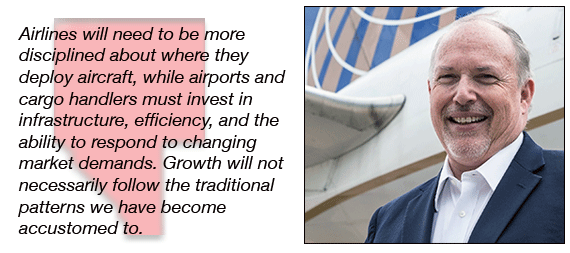
Michael R. White

Reshaping Our World
     “Government regulations, tariffs, shifting trade policies, geopolitical uncertainty, and changing economic conditions are reshaping global supply chains. Traditional trade lanes are being challenged, new manufacturing centers are emerging, and airlines and freight forwarders are reassessing capacity deployment, network strategies, and long-term investments. Some markets are experiencing declining volumes, while others are generating new opportunities. The challenge is no longer simply moving freight from one point to another. It is anticipating where global commerce is headed and positioning our industry to support it.”

What's Next?
     “Over the next three to five years, I believe we will see a significant realignment of global air cargo networks. Southeast Asia, India, and other developing manufacturing and distribution centers will play increasingly important roles. E-commerce will continue to evolve, while pharmaceuticals, semiconductors, high-value technology, aerospace, and other time-sensitive commodities will create opportunities for specialized services.
     “At the same time, capacity management will become increasingly critical.
     “Airlines will need to be more disciplined about where they deploy aircraft, while airports and cargo handlers must invest in infrastructure, efficiency, and the ability to respond to changing market demands. Growth will not necessarily follow the traditional patterns we have become accustomed to.

It's Not Fake, It's Artificial
     “Artificial intelligence and technology will be among the most powerful forces shaping this transformation. AI, predictive analytics, automation, digital documentation, and real-time shipment visibility will change how we forecast demand, manage capacity, clear customs, handle cargo, and serve customers. But I would caution our industry against believing that technology alone is the answer. Technology should strengthen our ability to make decisions, improve service, and create efficiencies. It should never replace the relationships, trust, experience, and personal accountability that have always been the foundation of this business. The companies that successfully combine advanced technology with knowledgeable, experienced people will have a distinct competitive advantage.

Firming Up Proactive Relationships
     “I also believe we must become more proactive in our relationships with governments and regulatory authorities. Too often, our industry finds itself reacting to regulations rather than helping shape the conversations that lead to them. Air cargo is a critical component of global commerce, economic development, national competitiveness, and supply chain resilience. We need stronger industry advocacy, greater collaboration among airlines, forwarders, airports, handlers, and government agencies, and a unified commitment to making international trade more efficient and predictable. Our voice must be heard before decisions are made, not simply after their consequences are felt.”

Next Generation Will Tell Our Story
     Perhaps the greatest opportunity ahead, however, is developing the next generation of industry leadership. We have benefited tremendously from individuals who dedicated their careers to building organizations, strengthening industry associations, improving standards, and bringing people together. As experienced leaders move into new chapters of their lives, we have a responsibility to mentor emerging professionals, attract new talent, and create an environment where fresh ideas are encouraged. The future of air cargo will require leaders who understand both the operational realities of this business and the rapidly changing technological and economic environment in which it operates.

Action Optimism
     “I remain extremely optimistic about the future of air cargo, but optimism must be accompanied by action. We cannot continue to operate with yesterday’s thinking while expecting to succeed in tomorrow’s marketplace. We must be willing to challenge established practices, embrace meaningful innovation, invest in our people, and recognize that the industry’s greatest growth opportunities may come from places and technologies we are only beginning to understand.
     “My prediction is that the next five years will create a clear distinction between organizations that simply respond to change and those that anticipate it. The winners will be those who are agile, technologically capable, customer-focused, and willing to collaborate across traditional industry boundaries.
     “We should never underestimate the contributions of those who helped build this industry. But honoring their legacy means preparing the next generation of leaders to take air cargo further than any of us imagined possible.
     “The future of air cargo will not be defined by how well we preserve the past, that we should always respect and pay attention to, but by how boldly we prepare for what comes next,” Mike White concluded.”
     Thanks, Mike. This gentleman is one of our most important thought leaders in air cargo.
Geoffrey Arend
To listen to the broadcast click here.


chuckles for October 21, 2026

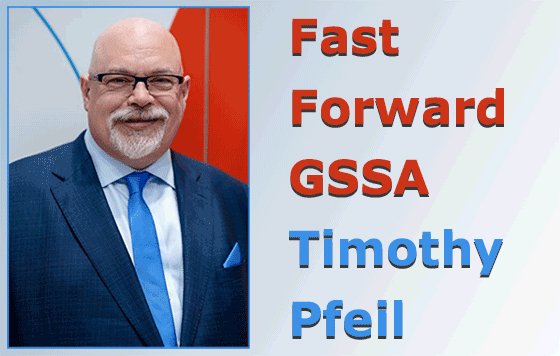
Timothy Pfeil

     Today we’re sitting down with Timothy Pfeil, a longtime air cargo GSSA pro who serves as President and Managing Director U.S.A. / Head of Group Global Compliance at ATC Aviation Services AG.
     Timothy has spent a whole lot of his life on the road, in fact more than 30 years of leadership in multimodal international transportation, of which 20 have been in airline cargo management.
     A total professional, he still shows he can get right down on the ground saying with a smile: "I ain’t ever met a problem that I can’t outrun."
     A cross-cultural specialist who thrives on customer engagement and negotiation; International sales and Operations Management within the 3&4PL, Ocean Carrier and Airline Cargo industry with postings in the U.S., Europe and Middle East in terminals, in airline offices, and in the middle of real-world shipping decisions, Timothy brings a wealth of knowledge coupled with the ability to listen and conquer just about any challenge in this business.
     Getting down to business we ask Timothy, when you think about that crowd in the Miami Convention Center at the TIACA Air Cargo Forum, what are the moments you’re most excited for? What are the high points you want people to feel when they hear what ATC is bringing to the table?
ATC Booth 543 TIACA ACF      “Miami is always a crossroads, and that’s what makes it valuable. You’re not just shaking hands, you’re comparing notes. For ATC, the high points are pretty simple: we’re there to listen, to show what’s working, and to be clear about where the market is headed. People want practical answers. They want to know what capacity looks like, what demand is doing, and who can actually help them perform week after week.”

     So if someone bumps into you in a hallway and says, "Give me the one-minute version," what do you want them to know about the ATC 2026 offering in the Americas?
     “That it’s built for reality, not slides.  The Americas are diverse, and the trading patterns shift fast. What I want people to know is we’re focused on consistency, smart coverage, and real partnership. Not just selling space, but supporting decisions with market intelligence and strong local relationships so shipments don’t fall apart when things get tight.”
     Let’s zoom out for a second for listeners who hear the term GSSA and think, "I kind of know what that is." In 2026, how would you explain ATC and the GSSA business, and what are the high points you’d underline?
     “A GSSA as the drill goes, is essentially the airline’s commercial reach in markets where they need sales, service, and strategy executed locally. And in 2026, it’s not just about booking. It’s about performance: yield quality, customer mix, lane development, and service reliability. The high points are when a GSSA can actually bring clarity to chaos, connect airline goals with forwarder realities, and create stable growth instead of quick wins that disappear next quarter.”
     This year’s been . . . let’s say, full of surprises for a lot of cargo folks. What’s surprised you most about the business climate, and how have you handled the tough parts without losing your footing?
     “The speed of change. One month a lane looks strong, the next month it cools off, and then you’ve got disruptions you can’t ignore. I’ve handled it by staying close to the market and even closer to the customer. When things get complicated, you don’t hide behind email. You show up, you talk through options, and you make sure partners know you’re not guessing.”
     That “show up” piece is your reputation. Be honest with us—how many weeks a year are you on the road? And when you walk into a customer’s country, what’s the reaction when they see you there in person, ready to take things in hand?
     “It’s a lot of weeks. Enough that you learn airports better than restaurants. But there’s a reason. When you’re physically there, it signals commitment. People react differently when you’ve crossed time zones to sit at their table. You hear what’s really happening, you catch problems early, and you build trust that doesn’t come from dashboards.”
     Let’s talk about those dashboards, though. You’re dealing with data, market signals, customer pressure, airline expectations. How do you turn knowledge into actual shipping decisions? And what’s the most valuable impact you can have with partners as a GSSA?
     “Data is only useful if it turns into a decision someone can act on. I look for patterns—where demand is real, where capacity is tightening, where rates are unstable, where service risk is rising. Then I translate it into clear recommendations: this routing, this timing, this kind of freight mix, this customer priority. The most valuable impact is being the person who prevents mistakes and protects relationships—helping the airline and the forwarder win together, not trade blame when something goes sideways.”
     There are giant players and smaller ones in the GSSA world, but ATC keeps growing and doing well year after year. Why? What do you think actually explains that, and what’s in store as you look toward 2027?
     “Growth comes from doing the basics exceptionally well: disciplined sales, strong customer care, and market coverage that doesn’t disappear when the cycle turns. If you’re consistent, airlines lean on you more, and customers trust you more. 
     “Looking to 2027, I think the winners will be the teams who can adapt quickly, communicate clearly, and keep service quality high even when the market is choppy.”
     Now I want to go personal for a minute. If a family member or a close friend asked you, "Should I build a career in air cargo?" what would you say? And when you think back, who helped shape your path—who pulled you forward or left a lasting mark?
     “I’d recommend it, but with honesty. It’s not a nine-to-five, and it’s not always glamorous. But it’s a real global business and you can build something meaningful if you like solving problems. As far as mentors and influences, there have been leaders who taught me discipline, colleagues who taught me humility, and customers who taught me what service actually means because they live with the consequences of our decisions.”
     Back to travel—because it’s a huge part of your life. What’s your favorite city to visit, and what’s your favorite city to work in? And when you’re not talking cargo, what do you do to stay sharp out in the field? Also, do you worry about other GSSAs, or do you welcome the competition?
     “Favorite city to visit and favorite city to work can be two different things. Some cities are great for energy, some are great for getting things done.
     “What keeps me sharp is staying curious—asking questions, comparing notes, learning what’s changing in each market. And competition? I welcome it. If you’re doing the job right, competition forces you to improve, stay disciplined, and keep earning the business instead of assuming you deserve it.”
     How long have you been in air cargo now? And for the record, when you think of the people who impacted your career—positively, even sometimes by challenging you—who comes to mind?
     “It’s been 30 years, long enough that I’ve seen cycles repeat, but never in exactly the same way. The people who impacted me most are the ones who expected more than average: managers who held a high standard, partners who demanded transparency, and teams in the field who proved that execution beats theory every day.”
     We have to talk about AI. What do you really think—threat, helper, or the future of some roles? Have you felt the impact yet, and how has ATC approached it?
     “AI is an aid if you use it correctly. It can speed up analysis, improve forecasting, and help teams respond faster. But it doesn’t replace relationships, judgment, and accountability. In our world, one wrong assumption can create a service failure. So I see AI as a tool that makes good people stronger, not as a magic solution that removes the need for experience.”
     Looking ahead, what’s the future role of the GSSA? What do relationships look like between airlines, forwarders, and partners as the next few years unfold?
     “The role becomes more strategic. Airlines will want partners who bring intelligence, stability, and real market access. Forwarders will want reliability and communication. ATC GSSA sits smack dab in the middle! We are the GSSA that wins and will be the one who can align everyone’s expectations early and keep performance measurable, not just promised.”
     If you could change one or two things—something realistic—that would make everybody’s job easier and more successful, from airlines to forwarders to shippers, what would you pick?
     “First, clearer communication standards, especially when conditions change. Bad news is manageable when it’s early and honest. Second, better alignment on service expectations—what’s actually possible, what’s a priority, and what the contingency plan is when disruption hits. Those two things alone reduce stress and protect long-term partnerships.”
     Last one, and it’s the big one. If you could do it all over again, would you choose this life—this road, this business, air cargo and all the pressure that comes with it?
     “Yes. It’s demanding, but it’s real. You get to be part of moving the world’s goods, solving problems that matter, and building relationships across cultures and time zones. I wouldn’t pretend it’s easy, but I would say it’s worth it—especially if you care about doing the work the right way.”
     Timothy Pfeil, thanks for sharing the road stories, the reality behind the role, and what you see ahead. And to everyone either reading all of this or listening, if you see Timothy in Miami, don’t just ask how business is. 
Ask what he’s seeing that you’re not.
GDA/SSA

TIACA ACF Ad
FIATA Salutes FlyingTypers

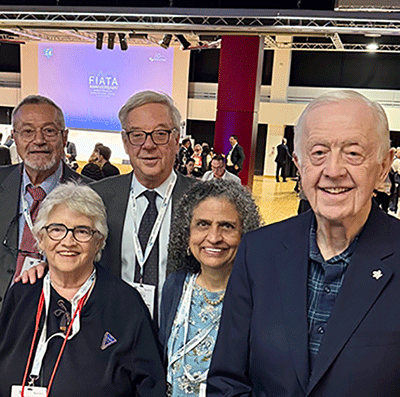
Marco Sorgetti, Francesco Parisi, Marina Grimani, Sabiha Arend, Geoffrey Arend     Attending The FIATA World Congress during their 100th Anniversary week in Milan Italy, we were unexpectedly surprised, delighted and slightly overwhelmed to receive some unsolicited individual recorded moments of accolades and thanks from FIATA's current Director General (DG) Stèphane Graber, past DG Marco Leonardo Sorgetti and Past Presidents Turgut Erkeskin (Turkey) and Huxiang Zhao (China) for our work as FIATA Fellow during the past decade.
     Ten years ago in 2016 we were invested as first FIATA Fellow in the 90-year history of the largest non-governmental organization representing the freight forwarding and logistics industry in the world.
     Emotion washed over the packed meeting room where during an unforgettable moment, an unusal heartfelt standing ovation erupted from a usually staid business audience as mother of our four children, my partner and brain trust, Sabiha and I accepted an honorarium from FIATA President Thomas Sim and Director General Stèphane Graber.
     But in fairness and reality, your reporter as a messenger can think of scores of FIATA people who deserve attention for what they do in life and business.
Today as my mind centers on Italy, it doesn’t go first to postcards or landmarks. It goes to a person.
     I picture Francesco Parisi of Francesco Parisi Casa di Spedizioni S.p.A. in Trieste, in his offices, doing what he has been at for his entire life: carrying forward a business with extraordinary roots.
     This is a company that traces back to its founder, Francesco Parisi, who lived from 1778 to 1813 and established the enterprise in 1807.
     Put that in perspective for a second. In that same era, the United States was still a brand-new country, only a few years into its existence.
     In Europe, in 1807 Napoleon was in Venice where he famously took in the gondola regattas on the Grand Canal from the balcony of Palazzo Balbi.
     So when I think of Francesco Parisi, both the current and former, I see Francesco today, leading the company in 2026, in front of a wall of faces, generations of ancestors, 220 years of history, are looking down on the action in the home office every day.
     Imagine what that feels like: not as pressure, exactly, but as responsibility, as continuity. It tells me what you do today can transcend time and place.
     In the picture (back row left) are Marco Sorgetti with Francesco Parisi.
With us (left) is Signora Marina Grimani Parisi during our evening filled with wonderful Italian hospitality and fun Wednesday October 7 at the beautiful and exciting Alfa Romeo Museum.
Geoffrey Arend


FlyingTypers Ad
If You Missed Any Of The Previous 3 Issues Of FlyingTypers
Access complete issue by clicking on issue icon or
Access specific articles by clicking on article title
FT100526Vol. 25 No. 41
FIATA Curtains Up In Milan
Lufthansa Lugs Cargo Into Space
Kunming-Kolkatta Logistics Express Lane
FT100726Vol. 25 No. 42
Pictures At An Exhibition Voice Of The People
FT101626Vol. 25 No. 43
FIATA Theme For An Imaginary Centennial
FIATA 100—Pictures At An Exhibition

Publisher-Geoffrey Arend • Managing Editor-Flossie Arend • Editor Emeritus-Richard Malkin
Senior Contributing Editor/Special Commentaries-Marco Sorgetti • Special Commentaries Editor-Bob Rogers
Special Assignments-Sabiha Arend, Emily Arend
• Film Editor-Ralph Arend • Photo Editor-Anthony Atamanuik

Send comments and news to geoffrey@aircargonews.co
Opinions and comments expressed herein do not necessarily reflect the views of the publisher but remain solely those of the author(s).
FlyingTypers reserves the right to edit all submissions for length and content. All photos and written material submitted to this publication become the property of FlyingTypers Media.
Copyright ©2026 FTMedia, Inc. All Rights Reserved.
More@ www.aircargonews.com

recycle100% Green