 |
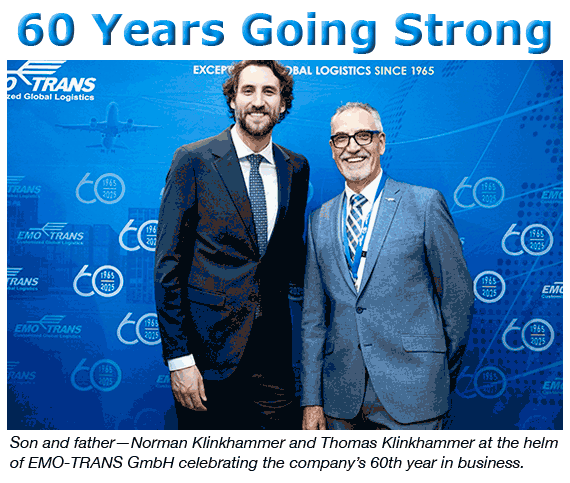
A couple of months ago Thomas and Norman Klinkhammer of EMO-TRANS GmbH were surely very busy. They were about to celebrate a historic milestone for their company’s 60 years in business and, quite at the same time, they were ready to announce a new arrangement within the Board that was meant to show the way into the future. Not a good period to intrude into their lives, but that was precisely the time when I knocked on their door and proposed to arrange an interview for the FlyingTypers. They kindly opened the door with a smile and here we are today!
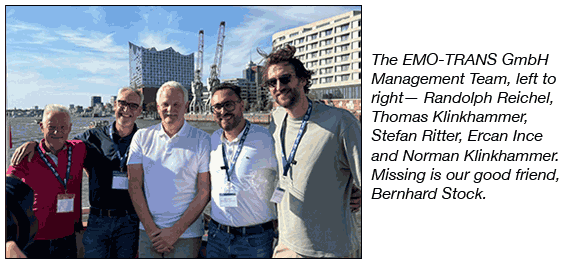
Thomas Klinkhammer is MD at EMO-TRANS GmbH, Germany, a company that in 60 years rose from a local freight forwarding business to a multinational, active in several continents, including the Americas, where our late friend Joe Frigger so largely contributed to its success. Norman is Thomas’s son and entered the EMO-TRANS Board in 2024, in a successful transition that follows EMO’s undisturbed tradition of success.
Thanks to their perfect combination of efforts, interviewing father and son at the same time was easier than I had originally anticipated and produced what I consider an interesting, civilized and encouraging conversation, where we talked business, generations and handovers, staff, regions, international trade, and the ever changing freight forwarding and logistics services. With a tone that suggest a long lasting confidence in your own resources, both gentlemen opened their hearts without restraint. What follows is the essence of a long conversation that we cannot reproduce entirely. We hope our readers will appreciate this encounter, which is as precious and unusual as it may be.
FT: Thomas, you have been in EMO-TRANS now for over 25 years, which is remarkable. These are the years that changed trade through globalization, while now it seems to start going backwards on its trail? How comfortable was it then to work alongside this huge development and now, how do you see your son’s future in this rapidly evolving pattern, in Germany and globally?
Thomas: Naturally, the ongoing globalization has been very important for our development, and it still is. Covid certainly highlighted boundaries and prompted a rethink in parts, but global trade will continue to evolve in the coming years—perhaps not as strongly in the familiar regions, yet there are still many other regions that are not developed, and there too live many young people who want to consume. So I believe our industry will continue to play an important role in the future, and thus Norman's future is secured.
 |
FT: Norman, how do you expect your next 25 years in EMO-TRANS to be? In which direction you expect EMO Trans and freight forwarding to evolve? Do you feel the challenge or you expect your position will ensure that results are coming through no matter what? What is your priority list in addressing the major issues in multimodal transport logistics?
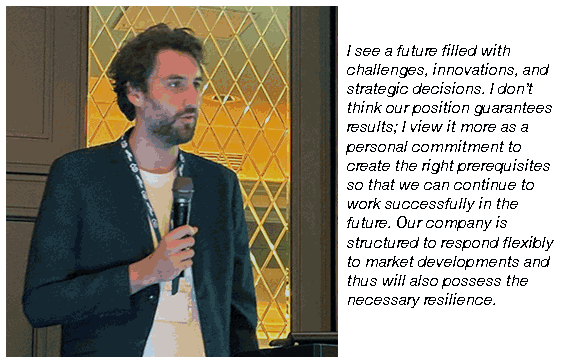
Norman: I see a future filled with challenges, innovations, and strategic decisions. I don’t think our position guarantees results; I view it more as a personal commitment to create the right prerequisites so that we can continue to work successfully in the future. Our company is structured to respond flexibly to market developments and thus will also possess the necessary resilience. Regarding multimodal logistics, I see digital integration, growth-oriented expansion, and sustainability as key drivers. At the same time, I believe the human element remains the crucial factor in an increasingly technology-driven industry. Our culture is based on service, trust, responsibility and development, and this will continue to be demanded by our customers in the future.
 |
FT: Norman, innovation in logistics is meant to benefit first and foremost the “originators of the trade”, who happen to be freight forwarders’ customers. In your perception, are shippers showing visible interest in fostering innovation in their service requirements? Can forwarders lead the way?
Norman: I believe that much of the innovation, especially in our industry, has been caused or will be adopted by customers. Globalization has shown this element: without proper logistics, transports from all over the world could not be carried out safely, on time, and cost-effectively. Our customer being the ultimate judge in this, I think it’s a collaboration between our customers and us with a view to achieving the expected goal. The customer tells us where their problems lie, and we try to find the solution to their issue and implement it with their help and approval. If there appears a novel solution or a new product, other customers will also include it in their portfolios and modus operandi.
FT: Norman, Artificial intelligence (AI) seems to be promising to improve efficiency, visibility and optimisation in logistics. It is important to explain how this could be achieved, as nobody really seems to have a clear picture yet. Have you considered this evolution in your company and how do you see your future steps with this change going forward? In your expectation, can AI independently analyze suppliers’ data, social and environmental performance indicators, to identify partners able to produce a more sustainable supply chain? Who will make this kind of choices in your perception?
Norman: We are intensely focused on the topic of artificial intelligence, as it offers great potential in logistics, for example, for more efficient processes, greater transparency, and more sustainable supply chains. AI can analyze large amounts of data and provide well-founded recommendations. It can be a crucial enabler of improvement, but what matters is that the human factor remains at the center: we make the decisions ourselves, review them critically, and coordinate them closely with our customers. Customer orientation has the highest priority at EMO TRANS—every change or optimization should deliver real value for our clients. Our company’s size will probably never make us a pioneer in the industry, but we want to actively participate and shape things. Therefore, we rely on ongoing engagement with AI, for example through pilot projects, workshops, and systematic evaluation of new technologies. This enables us to use innovations strategically while ensuring that decisions stay responsible, transparent, and customer-centric.
 |
FT: Let us move to another area now: the succession process you are mentioning in your video is one of the elements that contributes to EMO’s success. Clearly this is part of a winning strategy and seems to be working in your family. Is there a flip side for this success, or is it just working well from all points of view for both of you?
Thomas: I have also heard many times that a succession process didn’t work out as hoped . . . But I believe it can only go as well as both sides allow. Of course, as the person who will eventually step down, you also have to step back once the succession process has started, otherwise there will sooner or later be great tensions that employees and customers will feel. I think we have managed this very well, for our part.
Norman: Letting go and granting trust is indeed an art – and I am very grateful that this has worked so well during our transition. Of course, the beginning was a major challenge that required a lot of close and open coordination. It was important that the handover of the company was communicated clearly and transparently to all stakeholders and employees. That significantly contributed to a smooth transition. From years of collaboration with my father there were of course friction points at the start – that is normal when two generations with different experiences and viewpoints come together. But we have found a fantastic way to work with each other, characterized by mutual respect and trust. Experience cannot simply be learned – it is built over many years as lived in practice. Exactly this shared time was a great help for me. My father’s necessary advice was and is always available, and the awareness that I can always rely on his experience gives me a lot of security. The same goes for the entire senior-management circle, whose experience and loyalty have made a substantial contribution to a successful transition. And yes, sometimes we find it hard to maintain the necessary distance from EMO Trans. Our wives have to gently rein us in during a joint dinner when we start talking again about projects or strategies. But that also shows how much passion we both bring to it . . .
FT: Thomas, your company just celebrated 60 years in business as EMO-TRANS. What a feat! In your post you mentioned: “a strong and trusted logistics network across the world” and “dedication, innovation, and the people who make it all possible”. Your video in quite engaging, congratulations! Is there a secret recipe in your success all over the world that you wish to disclose to our readers?
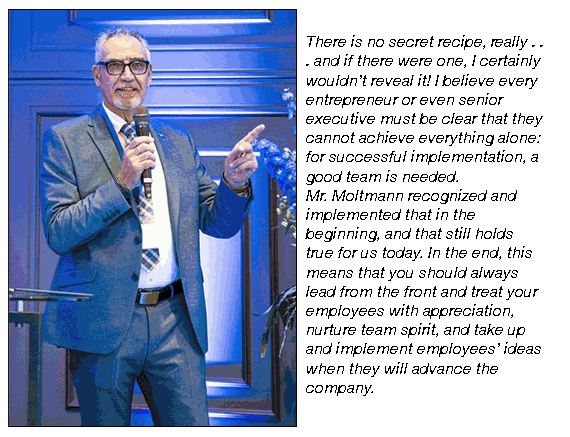
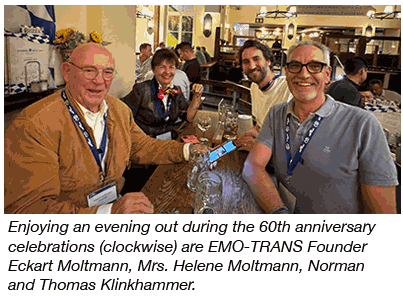 Thomas: There is no secret recipe, really . . . and if there were one, I certainly wouldn’t reveal it! I believe every entrepreneur or even senior executive must be clear that they cannot achieve everything alone: for successful implementation, a good team is needed. Mr. Moltmann recognized and implemented that in the beginning, and that still holds true for us today. In the end, this means that you should always lead from the front and treat your employees with appreciation, nurture team spirit, and take up and implement employees’ ideas when they will advance the company. Thomas: There is no secret recipe, really . . . and if there were one, I certainly wouldn’t reveal it! I believe every entrepreneur or even senior executive must be clear that they cannot achieve everything alone: for successful implementation, a good team is needed. Mr. Moltmann recognized and implemented that in the beginning, and that still holds true for us today. In the end, this means that you should always lead from the front and treat your employees with appreciation, nurture team spirit, and take up and implement employees’ ideas when they will advance the company.
FT: Let us look ahead a little . . . How do you see EMO-TRANS evolving in areas such as environmental performance, risk management, new trade rules coming into force? “We are very well positioned in that regard, have invested, and are well prepared” was the reassuring and uncompromising answer! EMO-TRANS has interests globally and will surely be able to weather the changes in international trade created by the recent developments; which are the markets you expect to afford the best opportunities for you?
Norman: I am sure about that, because we still have a size that gives us the necessary flexibility to master such challenges. In addition to the USA and China, the major markets will certainly include India; South America and Africa will also develop strongly in the coming years due to their demography and average age.
FT: EMO-TRANS seems to have created a serious regionalized enterprise, multiplying its initiatives at regional level. Is this just a sign of focussing on local areas of business or is it also a sign that in today’s day and age logistics is becoming more and more regional? Is this connected with the expectation that higher tariffs will accelerate reshoring and near-shoring? Any other breakthrough to be expected?
Norman: No, of course it is also very important for our customers to have someone on-site who knows the local challenges and can offer solutions for them. Of course, higher tariffs can have an impact on reshoring and nearshoring, provided that these products can be manufactured in the importing country with the same quality, and only then.
FT: In recent times there has been uncertainty regarding the de minimis rule: If the de minimis is strongly limited, probably the millions of consignments entries, which fuelled the exponential development of ecommerce, will be less and less. Do you think that this will generate a more traditional approach in trade, where forwarders will prevail over the express operators and ecommerce specialized carriers?
Norman: The custom’s job is to protect its own economy. De minimis rules were designed to allow goods up to a certain value to clear customs quickly and with little effort. For example, the fact that the U.S. has tightened the de minimis rule may also be due to some bigger importers systematically trying to classify all their products under the de minimis threshold and have clearly been caught misapplying the rule.
FT: Thomas, I had a quick overview of your profile on LinkedIn and saw you started your career by learning your skills in 1976-1979 at Gebr. Weichelt. How important is learning on the job in your opinion? Do you apply the same criterion with your own son?
Thomas: I fundamentally believe it is very important to pursue an apprenticeship, and today I would certainly prefer a dual study program, with a healthy mix of theory and practice. Unfortunately, at my time it wasn’t yet an option. My son completed his dual studies successfully at one of our competitors’ and then worked there for quite a while. I am very grateful to the training company that they gave Norman the opportunity to do this, even though it was to be expected that he would switch to us at a later point.
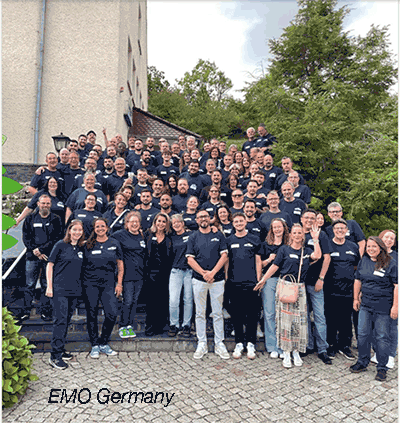 FT: Thomas, do you have a secret wish that you would like to see coming true before you take your retirement? We have a series of articles with the same title “is there life after air cargo?” and these are showing great personalities of air cargo in their retirement period. Can we ask you the same question: is there life after EMO-TRANS? What are your plans? FT: Thomas, do you have a secret wish that you would like to see coming true before you take your retirement? We have a series of articles with the same title “is there life after air cargo?” and these are showing great personalities of air cargo in their retirement period. Can we ask you the same question: is there life after EMO-TRANS? What are your plans?
Thomas: I am perfectly happy with no secret wishes and yes, there is life after air cargo for me as well, although I will certainly remain connected to my association’s activities through air cargo. I can easily imagine spending more time in the mountains and on the golf courses of this world during my retirement.
With the image of Thomas Klinkhammer evenly dividing his newly acquired free time between the mountains and the golf course ‘of this world’, we must come to the end of this pleasant chat.
This was the epitome of the gentlemen’s conversation, where you can talk about some of the most complex and, at times, difficult passages in one’s life with the levity and grace that Thomas Klinkhammer and his son Norman have granted us. Thomas at one point said: I have also heard many times that a succession process didn’t work out as hoped . . .We all know he is completely right and in many other situations things may become complicated to handle. This is not the case here: Thomas and Norman Klinkhammer represent in flesh and bones the successful process we have reported; we are just too happy to contribute celebrating their 60 years of achievements with EMO-TRANS, if belatedly on our side . . . In fact, on this point I have another small gratitude to pay. Thomas and Norman have been so kind to wait until I had recovered from a rather serious health problem and supported me all along the way in the process, with considerable understanding and discretion.
Thank you, Thomas, thank you, Norman for your totally reassuring approach and your insightful comments. Many happy returns of the day to EMO-TRANS GmbH, with our best wishes from the FlyingTypers!
Marco Sorgetti/SSA |




 FlyingTypers reserves the right to edit all submissions for length and content. All
photos and written material submitted to this publication become the
property of FlyingTypers Media.
FlyingTypers reserves the right to edit all submissions for length and content. All
photos and written material submitted to this publication become the
property of FlyingTypers Media. 100%
Green
100%
Green