 |
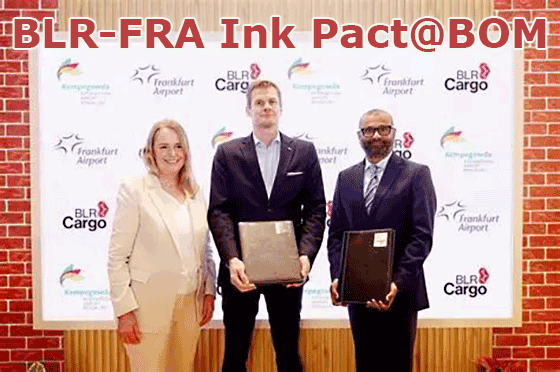
At the recent Air Cargo India show in Mumbai (BOM), a significant partnership has been formed between Frankfurt Airport AG (FRA) and Kempegowda Airport (BLR) in Bengaluru. Simone Schwab and Alexander Laukenmann from FRA, along with Girish Nair, Chief Operating Officer of BLR, announced the signing of a Memorandum of Understanding (MoU).
Bengaluru’s Kempegowda International Airport (BLR) and Frankfurt Airport have taken a significant step toward strengthening air cargo links between South India and Europe. The strategic Memorandum of Understanding (MoU) is a collaboration to develop the next generation of smart, fast and especially predictable cargo movement along one of the fastest, growing long, haul trade routes.
This joint effort places Bengaluru, which is rapidly becoming a manufacturing and export center in the Indian economy, in an ideal position. The partnership with Frankfurt, a leading freight hub in Europe, will undoubtedly strengthen the air cargo segment that is growing very fast in India. Therefore, this initiative has come at the perfect moment.
During the fiscal year 2024-25, Indian airports handled around 3. 7 million tons of cargo, where international shipments constituted 62% of the total. This trend is likely to keep going. Analysts project India's air cargo volume to grow to somewhere between 5 and 5.8 million tons by 2029, largely driven by the booming sectors of e-commerce, engineering goods, pharmaceutical products, perishables, and electronics.
Against that backdrop, the Bengaluru–Frankfurt collaboration aims to build a high-performance trade lane designed for today’s global supply chain expectations — speed, transparency and reliability.
What the partnership focuses on. The MoU outlines four key areas of cooperation:
Trade-lane analytics: By sharing data and forecasting insights, the airports hope to improve carrier planning, slot usage and capacity forecasts — vital as demand grows and new routes come online.
Digital corridor development: Coordinated digital tools will give exporters better shipment visibility and help reduce delays, especially for sensitive, high-value cargo.
Pharma and Cold-Chain Standards: Because India exports a lot of medicine, standardizing our handling and temperature-control will make both more reliable.
Sharing Knowledge on Operations and Rules: Both airports want to share what they do best. This includes everything from customs to how fast things get done on the ground. This helps keep up with changes in trade.
Frankfurt sees this partnership as part of its broader CargoHub Masterplan, while BLR is positioning it as a step toward building integrated, data-driven cargo corridors with major global hubs.
Why Bengaluru Matters
Kempegowda Airport, India’s third busiest, processed more than 500,000 tonnes of cargo in FY 2024–25. Unlike Mumbai or Delhi, which have long acted as national gateways, Bengaluru is uniquely tied to the fast growing manufacturing clusters of South India — especially electronics, IT hardware, pharma and perishables. For these sectors, cutting transit times and boosting reliability for Europe bound shipments is a long standing priority.
Working with Frankfurt gives Bengaluru better access to Europe, meaning:
Faster transit
Easier transfers
Dependable schedules for urgent shipments
Consistent space — important for on-time production
This makes BLR a main point for India–Europe trade, not just a South Indian cargo hub. This deal fits with larger trade changes.
The MoU also arrives as India and the EU's relationship is changing. In early 2026, they agreed to a big Free Trade Agreement covering almost all tariff lines. Once approved, the FTA should increase trade between them, which will call for even better, stronger air-cargo routes.
Air freight already accounts for less than 1 percent of India’s trade by volume but more than 30 percent by value, underscoring its importance for high value and time sensitive sectors. With several Indian airports — including Hyderabad, Chennai, Kochi and Ahmedabad — expanding cargo infrastructure, the BLR–Frankfurt pact highlights a broader shift: India is moving from reactive logistics toward strategic integration with global freight networks.
Ultimately, the Bengaluru–Frankfurt MoU is more than an operational arrangement; it’s a trade enabler. By collaborating on data, digital systems and handling standards, both airports are preparing for the next wave of India–Europe commerce.
This cements Bengaluru's spot as a key cargo center. It also shows how smart global teamwork can turn potential into real trade advantages for Indian exporters, no matter where they are or what they sell.
Tirthankar Ghosh |








 FlyingTypers reserves the right to edit all submissions for length and content. All
photos and written material submitted to this publication become the property
of FlyingTypers Media.
FlyingTypers reserves the right to edit all submissions for length and content. All
photos and written material submitted to this publication become the property
of FlyingTypers Media. 100%
Green
100%
Green