 |
India’s air cargo sector could be on the cusp of one of its biggest transformations in decades after Union Civil Aviation Minister Kinjarapu Rammohan Naidu unveiled a sweeping reform agenda aimed at boosting cargo volumes, reducing dwell times and lowering logistics costs.
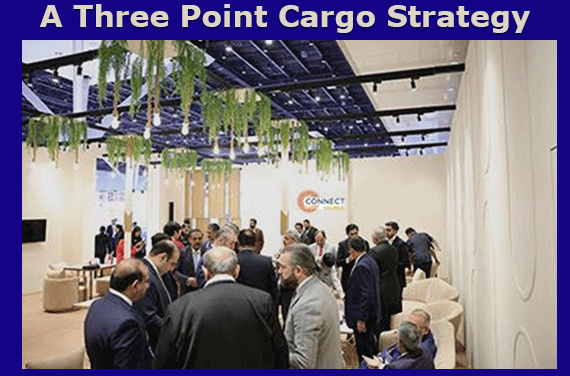
 Speaking at the India International Cargo Show (IICS) 2026 in early June at Delhi, Naidu delivered what industry executives described as one of the strongest policy endorsements the air cargo sector has received from the government in recent years. The reforms come at a time when India’s exports are showing resilience despite geopolitical disruptions, while the proposed India-European Union Free Trade Agreement (FTA) is expected to significantly increase high-value freight flows between India and Europe. Speaking at the India International Cargo Show (IICS) 2026 in early June at Delhi, Naidu delivered what industry executives described as one of the strongest policy endorsements the air cargo sector has received from the government in recent years. The reforms come at a time when India’s exports are showing resilience despite geopolitical disruptions, while the proposed India-European Union Free Trade Agreement (FTA) is expected to significantly increase high-value freight flows between India and Europe.
The timing may be critical. India’s airports handled 3.48 lakh tonnes of freight in April 2026, up 10 per cent year-on-year from 3.15 lakh tonnes in April 2025, according to Airports Authority of India (AAI) data. International cargo volumes alone surged by nearly 40 percent during the period, underlining the growing importance of air freight to India’s export economy.
Naidu outlined a three-point strategy focused on increasing cargo volumes, cutting transit delays and reducing costs for exporters and logistics players. “Increasing the air cargo volumes in the country will be the number one priority for us,” the minister said. “The whole point of sending a product through air cargo is the advantage of time. So, cutting down the dwell time is going to be another priority for us.”
He added that lowering logistics costs would be equally important to widen participation in the sector, particularly for smaller exporters and MSMEs. “The third priority is to cut down the costs that are associated with that. There is an opportunity for us to reduce the cost even more, make it more viable for the smaller players to also come into this network and proudly utilize the air cargo ecosystem,” Naidu said.
The minister also announced impending reforms to India’s Air Freight Station (AFS) policy after admitting that the existing framework had failed to deliver expected results. According to Naidu, stakeholder consultations are now underway to redesign the system by studying global models and adapting them to Indian conditions.
India’s strategic location between Europe, the Middle East and East Asia also gives it the potential to emerge as a major global transshipment hub — an ambition the government now appears keen to pursue more aggressively. “Because of the geographical location, we can create a system of transshipment where we not only cater for our domestic consumption but also international air cargo,” Naidu said.
The government’s renewed push comes amid strong export performance from several Indian gateways, particularly Chennai. Chennai airport emerged as the fastest-growing cargo airport among India’s top five hubs between January and April 2026, recording growth of 16.4 per cent. Industry executives attribute the rise partly to Production-Linked Incentive (PLI) schemes, especially in electronics and telecom manufacturing, which are increasing demand for rapid freight movement.
Exports of electronics, pharmaceuticals, perishables, engineering goods and automotive components have all contributed to cargo growth. Cross-border e-commerce has also become a powerful driver, especially for express and time-sensitive shipments.
The India-EU FTA being discussed may well boost the pace of this development even more. India and the European Union Much increased their trade over the last ten years, and the value of their trade in goods was up to 118 billion in 2025. According to some industry experts, the trade deal has the potential of massively increasing the export of pharma goods, the growth of specialized manufacturing and strengthening of automotive supply chains.
The pharmaceutical sector in particular may benefit from lower tariffs, simplified customs procedures and stronger cold-chain logistics demand. Industry executives believe temperature-controlled air cargo could see especially sharp growth if exports of biologics, APIs and specialty medicines rise.
 Yet despite the optimism, significant structural challenges remain. The most immediate concern is India’s continued failure to establish itself as a major transshipment hub, despite its geographic advantage. Samir Shah, President of the Air Cargo Agents Association of India (ACAAI), warned that procedural bottlenecks and fragmented regulation are preventing India from capturing cargo flows currently routed through Middle Eastern hubs such as Dubai and Doha. Yet despite the optimism, significant structural challenges remain. The most immediate concern is India’s continued failure to establish itself as a major transshipment hub, despite its geographic advantage. Samir Shah, President of the Air Cargo Agents Association of India (ACAAI), warned that procedural bottlenecks and fragmented regulation are preventing India from capturing cargo flows currently routed through Middle Eastern hubs such as Dubai and Doha.
“We have missed one very big opportunity,” Shah said at IICS 2026. “The U.S.-Iran war gave us a great opportunity to position ourselves as a very good transshipment hub.” According to Shah, multimodal cargo operations involving sea-to-air or air-to-sea transfers remain cumbersome because operators must often deal with multiple customs districts and overlapping clearances.
“Legally, I can do sea to air and air to sea, but the systems are not in place,” he said. “If we have a single window process, we can do sea to air and air to sea easily.”
Industry stakeholders also point to inadequate cargo infrastructure, limited customs-enabled cargo stations, high airport handling charges and inconsistent digitization across airports as continuing bottlenecks. While major airports such as Delhi, Hyderabad and Bengaluru have modern cargo terminals, several Tier-II cities still lack efficient cold-chain infrastructure and dedicated cargo handling facilities.
Another challenge will be the geopolitical risks. While air freight has flourished from disruptions in maritime shipping due to tensions in West Asia and the Red Sea, the sector is still exposed to threats like increasing fuel prices, longer flight routes and shortage of capacities. Executives have, in fact, cited very steep increase in air freight charges as a consequence of rerouting to avoid conflict zones.
Besides, it is feared that some cargo that for the time being is transported by air may revert to sea freight after the maritime routes have been stabilized considering that air transport still costs five to seven times more than ocean shipping.
Yet, the overall image is quite optimistic. Manufacturing in India, the rising exports and growing e-commerce ecosystem are continuously driving up the strategic importance of air cargo. In case the government is able to simplify regulations, integrate multimodal logistics and enhance infrastructure, India could even start to pose a challenge to the long-standing regional cargo hubs. As Naidu put it, “The road to becoming a global manufacturing hub passes through becoming a global logistics hub.”
Tirthankar Ghosh |








 100%
Green
100%
Green