As America creeps up on its 250th birthday, I keep circling one question: what does this country sound like when it talks about itself? Not in speeches, not in textbooks: in the stories it sings. That’s a big question.
So where do you even start? Maybe with a detour, a musical timeout, because sometimes two songs can tell you more about a nation than a shelf of history books. And today, I want to put two tracks side by side, like two riders moving through two totally different landscapes.
One is pure American folklore turned into a hit: the song "Ghost Riders in the Sky," and I’m thinking specifically of Vaughn Monroe’s 1949 recording. The other is a late-night Los Angeles storm you can practically see through the windshield: the Doors’ "Riders on the Storm," from 1971. The two songs are connected by mood and more.
In fact, the first song drove the creation of the second by motion and by that feeling of something chasing you, or maybe something you can’t outrun because it’s inside you.
Let’s start out home on the range in America, under those huge skies. Monroe’s "Ghost Riders" doesn’t feel like a pop song so much as a campfire warning that somehow got upgraded into a widescreen movie.
The moment it begins, there’s a kind of authority to it. His voice isn’t begging you to listen, it’s telling you to. That’s narrator energy, like he’s seen something and he’s not thrilled about it, creeps into the rhythm. The song paints the land so clearly you can feel the dust and distance. Then it tilts into the supernatural: ghostly cowboys tearing across the sky, hooves pounding somewhere above your head. It’s awe mixed with fear, the way folklore often is. The story is basically a moral warning, but at eight years of age, when I first heard it at home in Toledo, Ohio glued to the Magnavox radio I missed most of that and was just plain thrilled as the western “yarn unwound.” That’s how a cowboy would describe it and Monroe’s arrangement sold it. The music sounds like a horizon that won’t stop widening. Little instrumental details suggest wind, space, and that approaching rush, like the riders are getting closer whether you’re ready or not.
And then you get that unforgettable cowboy syllable-sprint. That "Yippee-ki-yay" line.
You can’t fake that kind of American shorthand. For a lot of people way back then, the heroes were radio cowboys, the larger-than-life good guys: Gene Autry, Roy Rogers and Hopalong Cassidy. For at least one kid in Toledo, Ohio hearing Ghost Riders on the radio wasn’t just another tune: it was the number one song in USA on the radio all summer during 1949 and every time I heard it was my key to open a whole wide world. “They been trying hard to catch that herd, but they ain’t caught ‘em yet”. But in 2026 I realize the story wasn’t comfort, it was pressure. Something was coming: key to Ghost Riders in The Sky was urgency. That sense was being pursued by a force that I barely understood.
And here’s where the road bends. That feeling didn’t stay in the desert. It rode forward into another generation, into another kind of American night: Los Angeles, 1971. The Doors take a familiar outline, the old "Ghost Riders" idea, but they don’t remake it as a Western. They mutate it into something jazzier, stranger, and more intimate. "Riders on the Storm" sounds down range like it came out of the same horse corral or cowboy bunkhouse in some respects, but it also feels like driving alone at 2 am down Century Blvd. while the weather argues with the pavement. And there’s extra gravity because of where it sits in The Doors’ story. It became the last song Jim Morrison, the lead singer, ever recorded. Once you know that, it listens differently.
The song was not announced as a farewell, but it carried that quiet finality, like a final conversation, that maybe no one had realized was ending.
Thinking about the two songs in 2026, in a way “Riders” 1971 version is almost a casual trace back to the 1949 “Ghosts Riders”. Robby Krieger (The Doors’ guitarist) was playing with that country-western shape, that galloping notion. The late Ray Manzarek (keyboards) hears it and essentially says, "Okay, but… what if it rains? What if it’s darker? What if it swings?" Suddenly, the open range became a city street near midnight. Here the Doors production is doing maybe more than half the storytelling. John Densmore’s drums don’t slam like standard rock; they skim and shuffle, like wind dragging water across glass. Meanwhile Kreiger’s Fender Rhodes doesn’t just sit in the background—it becomes the weather itself, a steady drip that hypnotizes you.
Should note that they brought in Jerry Scheff on bass to anchor the low end, so the storm had plenty weight. It’s not just atmosphere, it’s physical. Morrison comes in with lyrics that feel like they’re half dream, half confession. The phrase "Riders on the Storm" becomes a metaphor that’s almost too accurate: all of us steering through unpredictability, trying to stay upright while life throws weather at the windshield. Love, loss, chance, timing… but the song doesn’t let you stay in metaphor for long, because it drops that line: "Killer on the road."
Suddenly the threat isn’t just thunder, it’s human. And that wasn’t a random bit of darkness: Morrison had written a screenplay about a hitchhiking murderer, inspired by a real killer from the 1950s, Billy "Cockeyed" Cook. So now the highway itself feels haunted, not by ghosts in the sky, but by what people are capable of.
A detail people remember once they hear it in “Riders” is that second voice. Writers have called it ‘the whisper’. It’s like the song’s own “Ghost”. Morrison double-tracked the vocal, but instead of singing the second line, he whispers under himself, just beneath the surface, like a shadow that won’t separate from the body. And the eerie footnote is that the whisper was the last thing he recorded in the studio. The track ends with that afterimage of a voice.
So if Monroe’s song is legend told around a fire, The Doors is the same fear told under streetlights. That’s it. On one side, you’ve got Monroe: classic, cinematic, built for myth—morality playing out under a vast sky. On the other, The Doors: modern, hypnotic, urban, and psychologically haunted. Different sound palettes, different decades, but they’re both about motion through forces bigger than you.
It’s an American question of when is the ride never just a ride. In 1949, the fear wears a cowboy hat and rides the clouds. In 1971, it’s the randomness of danger, the fragility of love, the storm inside your own head. Same idea, translated. Same shadow, different weather. Try a listening experiment. Watch Vaughn Monroe here first.
Let it feel like an old 78 disc on a record player warming up and moving. Then switch to a wonderful version of “Riders” that was produced and created by the last remaining Doors, John Densmore and Robby Krieger for Playing for Change with global artists at work. Notice how the outline gets redrawn in images neon, rain, but now with smiling images: two classics, two time capsules, one long road running through both.
Speaking of time capsules, 1949 and 1971… that’s a long time ago. In 1976 we were already celebrating 200 years, and we were all dancing with ABBA, their ‘Dancing Queen’, but they were not American. What next, what happened in the following fifty years, that we, as Americans, have created? Forget about globalization as this is no longer considered positive. What about the objects in our daily life? PC’s, the internet and social media? So what can we sign it that would be remembered? Not many songs meet the criteria, at least it so appears, to fill the required category, but let me list two that stand at the opposite ends of the rainbow: you judge which is best for you: the Chainsmokers with their ‘#Selfie’ and, more inspiring for me, ‘You will be found’ by Dear Evan Hansen. I wonder whether these will be good enough in fifty or so years, or we shall remember other ones, who knows? It does not even matter whether they are American, as the world has become one big, confused and uncertain place.
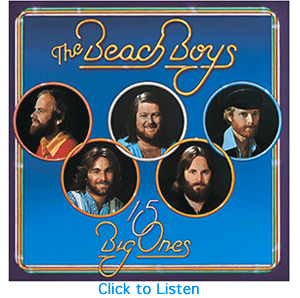 No musical remembrance in America for the past 50 years especially around July 4th would be complete without recalling a concert somewhere by The Beach Boys. No musical remembrance in America for the past 50 years especially around July 4th would be complete without recalling a concert somewhere by The Beach Boys.
I suspect that what’s left of the group, or a revival band, is out there playing this weekend, as you are reading this story.
Now that Brian Wilson the band’s musical genius has gone onto his greater reward, with a tip of our hat we close our opus with a song he created in 2000. Works into and puts a bow on all of this about America and why we love it.
As Americans we celebrate 250 years of the USA.
Whether it’s ghost riders overhead or a storm creeping across the freeway, America keeps telling a version of the same story: we’re traveling through something vast, and we don’t fully control the conditions. I think most of us know that our rule should be—any way the wind blows when the sky starts moving.
“Be sure you’re right and then go ahead,” American frontiersman Davy Crockett said.
We take a break and celebrate America and will report what we discovered to you July 13 th .
Happy 250th Birthday, America.
Geoffrey Arend
|
|










 100%
Green
100%
Green