 |
In the morning I often listen to “Prima Pagina”, which is an Italian radio programme that is now 50 years old. A different journalist each week reads the headlines of several Italian newspapers, then hosting comments and phone calls. It is an interesting window on the way Italians see themselves and the rest of the world. Italy is not doing well in independent journalism, as we rank 56th in the list, almost last in Europe, but Prima Pagina is better than the average. Today a lady called from Central Italy. She explained that, with 1200 EUR a month for a full time contract, raising a child and trying to make a living amid spiralling costs was really hard. She was calm and her voice did not sound resentful, but her argument detonated within the radio audience as a bombshell. In the subsequent “Tutta la città ne parla”, which draws its topics from Prima Pagina, this was literally the talk of the town.
So this morning’s discussion related to social conditions and salaries in Italy, a sticky point indeed. The debate soon derailed: some, fortunately not many, thought that blaming China for its success was the answer, instead of trying to understand (and cure) the reasons of Italy’s decline, which are well rooted in present and past national choices. The car industry is probably the wound that aches the most right now. Germans and Italians have almost demolished their car industry by betting on the wrong horse for at least two decades, but the lesson seems hard to learn . . . Car manufacturing in Europe symbolized our excellence, but now it reached a cul-de-sac. Running larger and larger combustion cars that look like space invaders may please the petroleum industry, but what about the public? Enough! These sales were subsidized for years. Now sales point down, period. When the rest of the world, the U.S. and China in particular, invest all their resources in developing electric vehicles . . . well, who is likely to win the race? The EU policy had tried to persuade FIAT, BMW, Volkswagen, Mercedes, etc. to invest in innovation with the usual carrots and sticks, but these giants thought they could lobby against their future (and ours), until the market taught them its bitter lesson.
A few months ago LUCE, the ‘electric’ Ferrari was even derided with a lofty statement: “a car that at least the Chinese will not copy”. The man who spoke was clearly not ready for the news that the electric Ferrari sold out in China through 2027 already. An entrepreneur as Enzo Ferrari, who said that “the best Ferrari ever built is the next one”, may have taken another view on LUCE, his soul rest in peace, but those were other times indeed.
So today’s discussion was taking place over the ashes of the ailing Italian car manufacturing and you may be wondering why am I starting with this to speak of Chinese logistics. I do because China is clearly emerging as the overall winner in international trade today, not only in electric cars; and we are looking at a world that is accelerating the change of all paradigms we used to know.
I shall try to give you a few examples, starting from the recent gathering in Shanghai and delving into a more detailed analysis of the new Chinese maritime rules, which just entered into force. Some may be surprised at how fast China has embraced the best of the best practice in many areas, including in the maritime, but the time for learning is never over and if you wish to continue reading there will be something to learn here.
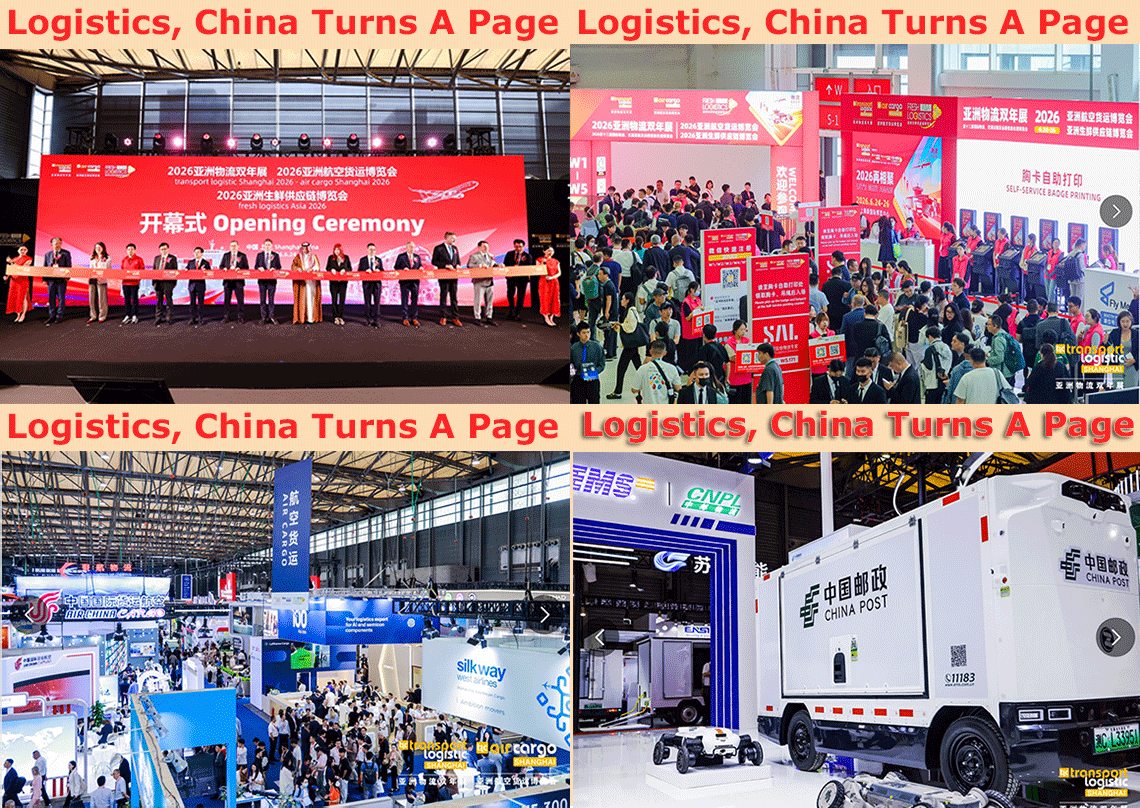
Let’s start with the meeting that was held in Shanghai at the end of June. If we have to remain in automotive logistics, these were the highlights: “China’s EV dominance is reshaping the global automotive landscape, especially in Europe and the U.S., where tariffs and restrictions are intensifying. In 2025, China produced 75% of the world’s 22 million EVs, exporting a record 2.5 million—double the previous year. Chinese models captured 55% of EV sales outside Europe and USA. This panel explores how Chinese brands are navigating tariffs to expand in Western markets: localizing production in Europe, forming joint ventures, pivoting to hybrids exempt from tariffs.” This is a remarkable statement of sheer power. Facts speak louder than promises, and this is the point where German and Italian carmakers had unlearnt their lessons: no sign or mention of anything that has to do with combustion engines, as though it was something fit for a museum. And yet the Shanghai meeting has even a German footprint… The programme is part of the wider portfolio offered by Messe Munchen. Clearly not everybody in Germany thinks in diesel terms. This could be food for thought.
Some of the participants told us that following the multiple levels of Transport and Logistics in Shanghai was not easy, and I am not really surprised. China is always beyond belief, whichever side you are looking at. When I was invited to Shanghai for the EXPO, the dimensions were mind-blowing, and 2010 China wasn’t yet what it is today!
 Glyn Hughes, (right) one of our best friends in the world, still at the helm of TIACA, made two comments that are completely in consonance with this impression: “the event itself had a good attendance with the usual mix of Chinese and international brands exhibiting” and “China continues to thrive in terms of e-commerce, AI infrastructure and energy infrastructure exports.” I am sure his expectations were fulfilled and he returned home with total satisfaction. Obviously Glyn travelled to attend the Air Cargo Shanghai event, which was contained in the perimeter of the larger logistics gathering. The sheer numbers of the air cargo event are impressive: nearly 1,000 exhibitors from 57 countries (about 50% from outside China), more than 47,000 visitors. Even considering we are in China, which is a country accustomed to big numbers, this is quite impressive, if you speak of air cargo alone. Glyn Hughes, (right) one of our best friends in the world, still at the helm of TIACA, made two comments that are completely in consonance with this impression: “the event itself had a good attendance with the usual mix of Chinese and international brands exhibiting” and “China continues to thrive in terms of e-commerce, AI infrastructure and energy infrastructure exports.” I am sure his expectations were fulfilled and he returned home with total satisfaction. Obviously Glyn travelled to attend the Air Cargo Shanghai event, which was contained in the perimeter of the larger logistics gathering. The sheer numbers of the air cargo event are impressive: nearly 1,000 exhibitors from 57 countries (about 50% from outside China), more than 47,000 visitors. Even considering we are in China, which is a country accustomed to big numbers, this is quite impressive, if you speak of air cargo alone.
 Our main cargo airport in Italy, Milano Malpensa, managed to organize a workshop in Shanghai and we have had the opportunity to extract a declaration from Paolo Dallanoce, (left) cargo manager of SEA, the company in charge of Milan airport: “Milano Malpensa Cargo is the leading cargo gateway in Southern Europe, thanks to a strong and well-integrated community of operators. At SEA Milan Airports, we strongly believe that the competitiveness of an airport cargo system relies on the ability to act as a single, coordinated ecosystem. This is why we have been actively promoting the Milano Air Cargo Community, bringing together airlines, express couriers, handlers, freight forwarders and trucking companies, technology providers and logistic supply chain associations. Our goal is to enhance collaboration, improve operational efficiency and support the sustainable growth of the entire supply chain. The Milano Air Cargo Community reflects a shared vision among all stakeholders: strengthening connectivity, fostering innovation and contributing to the sustainable development of the logistics system. It also represents a concrete commitment towards the territory and international trade, positioning Malpensa as a competitive and reliable hub within the global cargo network. Events like Air Cargo China are a valuable opportunity to further strengthen international partnerships and present Milano Malpensa as a unified, collaborative and forward-looking cargo ecosystem.” Our main cargo airport in Italy, Milano Malpensa, managed to organize a workshop in Shanghai and we have had the opportunity to extract a declaration from Paolo Dallanoce, (left) cargo manager of SEA, the company in charge of Milan airport: “Milano Malpensa Cargo is the leading cargo gateway in Southern Europe, thanks to a strong and well-integrated community of operators. At SEA Milan Airports, we strongly believe that the competitiveness of an airport cargo system relies on the ability to act as a single, coordinated ecosystem. This is why we have been actively promoting the Milano Air Cargo Community, bringing together airlines, express couriers, handlers, freight forwarders and trucking companies, technology providers and logistic supply chain associations. Our goal is to enhance collaboration, improve operational efficiency and support the sustainable growth of the entire supply chain. The Milano Air Cargo Community reflects a shared vision among all stakeholders: strengthening connectivity, fostering innovation and contributing to the sustainable development of the logistics system. It also represents a concrete commitment towards the territory and international trade, positioning Malpensa as a competitive and reliable hub within the global cargo network. Events like Air Cargo China are a valuable opportunity to further strengthen international partnerships and present Milano Malpensa as a unified, collaborative and forward-looking cargo ecosystem.”
If you peruse the pages of the rich website portraying the event, you have a clear picture of a successful initiative that managed to tick all the right boxes. But this is not the only aspect where I think China is making giant steps into the future. China is fast adapting to new international realities and has adopted a forward looking approach in its rules and regulations. To give you an example we need to look at the maritime industry, to see some giant steps being taken by the Chinese government as recently as this year.
 I have the privilege of having worked with many exceptional Chinese personalities in my time at FIATA and I am particularly happy that we kept the conversation going even after I retired. One of these exceptional personalities is a good friend of mine, Dr. Yang Yuntao, (left) who is Chief Compliance Officer of the China Merchants Group, besides being a Board Member of FIATA and Chairman of its Advisory Body Legal Matters. Through his remarkable courtesy, I have recently seen his presentation about the Revised China Maritime Code. Dr. Yang discussed the key implications for the International Freight Forwarding Industry, in particular with regard to its scope, the carrier’s liability, also concerning Multimodal Transport and the use of electronic records during a FIATA online webinar. I have the privilege of having worked with many exceptional Chinese personalities in my time at FIATA and I am particularly happy that we kept the conversation going even after I retired. One of these exceptional personalities is a good friend of mine, Dr. Yang Yuntao, (left) who is Chief Compliance Officer of the China Merchants Group, besides being a Board Member of FIATA and Chairman of its Advisory Body Legal Matters. Through his remarkable courtesy, I have recently seen his presentation about the Revised China Maritime Code. Dr. Yang discussed the key implications for the International Freight Forwarding Industry, in particular with regard to its scope, the carrier’s liability, also concerning Multimodal Transport and the use of electronic records during a FIATA online webinar.
As FIATA published the news after Dr. Yang synopsis, “Mr Lianjun Li, (right) Partner at Reed Smith Richards Butler LLP,  addressed China's countermeasures and the growing complexity of sanctions and counter-sanctions in maritime trade. His recommendations included screening against both Western and Chinese sanctions lists, reviewing contracts for two-way risks, planning payment arrangements, documenting compliance decisions and seeking legal advice where needed. The session underlined that the revised Maritime Code presents both a compliance challenge and an opportunity for freight forwarders to strengthen risk management.” (source, FIATA) addressed China's countermeasures and the growing complexity of sanctions and counter-sanctions in maritime trade. His recommendations included screening against both Western and Chinese sanctions lists, reviewing contracts for two-way risks, planning payment arrangements, documenting compliance decisions and seeking legal advice where needed. The session underlined that the revised Maritime Code presents both a compliance challenge and an opportunity for freight forwarders to strengthen risk management.” (source, FIATA)
Ten years in the making, the new Maritime Code has just come into force. “The revised China Maritime Code came into force on 1st of May 2026. This marks the first comprehensive and systematic revision of China Maritime Code in more than three decades, since the original version first came into force in 1993. The amendments reflect the realities and needs of China’s current shipping and logistics sectors, as well as the approaches and standards developed in relevant maritime arbitration and court practice.” This is Dr Yang speaking, when presenting this result to FIATA Members.
The guiding principles are in line with the most recent rules covering the carriage of goods, recognizing the obligations, and protections, of freight forwarders acting as contractual carriers. Yuntao mentions another modern aspect of the Chinese Code: “Article 295 of the revised Code respects the principle of party autonomy by allowing the parties to choose the law applicable to their contract, unless otherwise provided by law. If no choice is made, the law with the closest connection to the contract shall apply. However, Article 295 also introduces an important mandatory application rule. For an international contract of carriage of goods by sea, where either the port of loading or the port of discharge is located within the territory of the People's Republic of China, Chapter IV of the revised Code, which governs contracts of carriage of goods by sea, shall apply. This provision confirms both the principle of party autonomy in choosing the governing law of the contract and, where no such choice has been made, the determination of the applicable law by reference to the law with the closest connection to the contract. What deserves particular attention is that, drawing on comparative legislation and judicial practice in various jurisdictions, the legislature has introduced a mandatory application rule for Chapter IV of the Maritime Code. In other words, where either the port of loading or the port of discharge under an international contract of carriage of goods by sea is located in China, Chapter IV of the Chinese Maritime Code — that is, the chapter governing contracts of carriage of goods by sea — will apply as mandatory law.” I have reproduced Yuntao’s words literally, because I believe this principle is very important indeed.
In addition, “in the field of international carriage of goods by sea, China has not acceded to the Hague Rules, the Hague-Visby Rules, the Hamburg Rules, or the Rotterdam Rules. In summary, if an international freight forwarder acts as a principal, and the shipment involves a Chinese port of loading or discharge, then once the dispute is heard by a Chinese court, Chapter IV of the revised China Maritime Code may be applied mandatorily by that court. This is a new rule that freight forwarders should pay much attention to.” With little exceptions, these rules also apply between Chinese ports. There are also new rules regarding damages and liabilities, fire on board exemptions, etc.
Yuntao also affirms that “in principle, the actual value of the goods shall be determined according to the market price at the place of delivery at the time of delivery.” This and all related provisions are in line with modern rules governing the carriage of cargo; there is also an obligation to give evidence in the B/L of the agreement between shipper and carrier that cargo be loaded on deck: “where the carrier and the shipper have agreed that the goods may be carried on deck, this must be expressly recorded in the bill of lading. If it is not recorded, the agreement may not be asserted against a bona fide third party, such as a good-faith holder of the bill of lading.” And there are also “improved rules on the right of control, unclaimed cargo, and carrier’s lien”, but in my view one of the most significant provisions that would certainty sound very attractive to some of our readers is the following: “the revised Maritime Code specifically establishes a regime for electronic transport records. It makes clear that electronic transport records meeting statutory requirements have the same legal effect as paper transport documents, and their validity shall not be denied merely because they are in electronic form. This is of great significance for electronic bills of lading, electronic sea waybills, electronic cargo release, and the online circulation of documents. However, please note that an electronic transport record is not simply equivalent to a PDF bill of lading, a scanned copy, or an email attachment. Under the revised Maritime Code, an electronic transport record must satisfy the following requirements: the recorded information can be retrieved and accessed for use; the content is complete and accurate; the issuer can be identified; and the holder is able to prove its identity. For transferable electronic transport records, the revised Maritime Code further requires reliable methods or reliable transaction systems to ensure the uniqueness and integrity of the record and to guarantee the holder’s exclusive control over the record.”
So with a certain degree of straightforwardness China jumped the gun of electronic records and put itself at the forefront of this discussion, where other developed countries still show considerable uncertainty, with few exceptions. Another area in which the revised Code builds on the previous regime is its retention and refinement of China’s network-liability approach to multi-modal transport: “In terms of liability, the revised Maritime Code adopts a sectional liability approach, which in substance reflects a modified network liability regime. Where the loss of, damage to, or delay in delivery of the goods occurs in a determined transport section, the relevant law governing that mode of transport shall apply. Where the section in which the loss occurred cannot be determined, the provisions of the revised Maritime Code on carrier liability, limitation of liability, and limitation periods shall apply. For freight forwarders and multi-modal transport operators, these provisions in effect reflect the idea of a modified network liability system, consistent with the legislative framework of the 1980 United Nations Convention on International Multimodal Transport of Goods.” In good substance this is consistent with the rules applicable for the FIATA Multimodal Bill of Lading, which are based on the same principles, another aspect where this piece of legislation steps ahead of any other.
Lastly there is another aspect of these rules that can be quite interesting for freight forwarders, as Dr. Yang Yuntao underlined: “In terms of limitation periods for claims, the revised Maritime Code continues to adopt a one-year period. This is consistent with the Hague Rules and the Hague-Visby Rules, and does not adopt the two-year period found in the Hamburg Rules and the Rotterdam Rules. Freight forwarders should not expect the one-year limitation period to be extended by contractual agreement or subsequent negotiation. The revised Maritime Code also further clarifies the rules on interruption of limitation periods. A limitation period may be interrupted where the claimant makes a demand for performance, commences court proceedings, applies for arbitration, applies for arrest of a vessel, or where the party against whom the claim is made agrees to perform its obligations. In addition, freight forwarders should pay particular attention to the limitation period for recourse claims. In addition to the one-year limitation period, the revised Maritime Code provides for a special 90-day period for recourse, where the original one-year period has already expired or where fewer than 90 days remain before its expiry, which runs from the date on which the recourse claimant settles the original compensation claim. For freight forwarders, this rule is both a protection and a reminder. It provides an additional window for recourse against the party actually responsible after a claim has been settled down. However, 90 days is a very short period and cannot replace day-to-day limitation management. Freight forwarders should promptly preserve evidence, identify the responsible parties, and, where necessary, interrupt the limitation period through litigation, arbitration, or other procedural measures.”
This is how our friend Yuntao concludes his presentation: “The implementation of the revised Maritime Code presents both a compliance challenge and an important opportunity for global freight forwarders to enhance their service capabilities and risk management standards. Looking ahead, the competitiveness of freight forwarders will not depend solely on pricing, cargo space, or network resources. It will increasingly depend on their ability to understand cross-border transport rules, organize complex transport chains, and manage legal and commercial risks. I hope that all colleagues in the industry will take the implementation of the revised Maritime Code as an opportunity to further improve operations, control risk, serve clients, and create value.”
In other words, Yuntao is looking at a promising future for freight forwarders in China and elsewhere. Going back to my original statement, China has used the last ten years in many useful ways, one of which was to review and modernize their maritime sector, also with this new piece of legislation. Considering the dimension of Chinese trade today, the ripples of this adoption will reverberate in many ways through the complex supply chains internationally and probably will influence the pace at which other countries will look at the same issues.
From another point of view, in a way I find it perplexing that we should consider “modern” something that is largely based on principles that were freely available already in 1980. I remember that in the mid-90’s we were under the impression that everything was going to change, and international trade was going to explode and become seamless – easy for everybody. From some points of view, it did, from others not. The two epochs are hardly comparable, but my off-hand impression is that China did not waste any time in upgrading its logistics landscape and Chinese logistics today are at least as good as the very best in the world and still improving.
The ball is now in the other court, let’s see what can be done to keep global logistics on the route of progress, possibly not only in China . . . Time for the RAP?
Marco Sorgetti |








 100%
Green
100%
Green