 |
What appeared to be a straightforward migration of freighter operations from Mumbai's Chhatrapati Shivaji Maharaj International Airport (CSMIA) to the new Navi Mumbai International Airport (NMIA) has become considerably more complicated. What was initially presented as a carefully planned transition is now raising questions about infrastructure readiness, international treaty obligations and the practical realities of moving one of India's busiest cargo gateways.
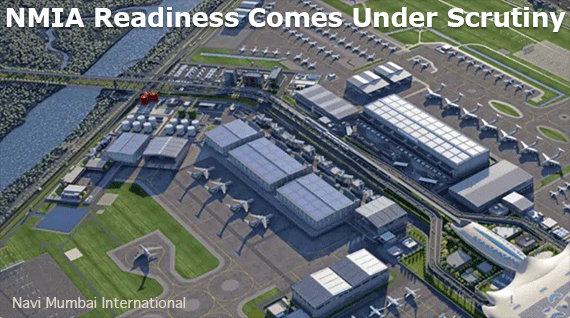
The transition is already under way. Non-scheduled charter freighter flights are expected to cease operating from CSMIA this month, while all dedicated scheduled freighter operations are expected to move from August as Mumbai airport begins an extensive programme of infrastructure works. Yet the airport that is expected to receive this traffic is still not fully operational from a cargo ecosystem perspective, creating uncertainty for airlines, freight forwarders and exporters alike.
At the same time, the move has attracted formal objections from the United States, which argues that American cargo operators, particularly FedEx, should not be compelled to relocate in a manner that could conflict with the India-US Air Transport Agreement.
What therefore began as an airport operational issue has evolved into a complex mix of commercial interests, regulatory preparedness and international diplomacy.
According to information available from both Indian and international sources, the U.S. Department of Transportation formally raised concerns with India's civil aviation authorities earlier this year, arguing that airlines operating under the bilateral agreement should continue to enjoy commercially viable operating access at Mumbai. FedEx, currently the only American all-cargo carrier serving Mumbai, is understood to have expressed concerns that a mandatory relocation would increase operating costs while reducing the commercial advantages it currently enjoys.
Washington's position is that bilateral air service agreements are designed not merely to grant traffic rights but also to protect fair and commercially reasonable access to airports. Any unilateral relocation, particularly before alternative facilities are fully operational, risks becoming a treaty issue rather than simply an airport management decision.
For cargo operators, location is critical. Mumbai remains India's largest commercial and financial centre and one of the country's biggest export gateways for pharmaceuticals, engineering goods, gems and jewellery, electronics and express parcels. Mumbai International Airport handles between 7 and 8 cargo flights daily. The stoppage of cargo flights -- when it does happen -- will mean that Mumbai which handled around 890,000 tonnes of cargo in FY 2025 or around 25 per cent of all air freight in India, will see a big dip.
Adani Airports, however, maintains that the transition is driven by operational necessity rather than commercial preference. CSMIA is preparing for major infrastructure upgrades, including the reconstruction of Apron G, development of Taxiway E, improvements to rapid exit taxiways and subsequent runway rehabilitation. Together, these projects will significantly reduce aircraft parking availability, particularly for freighters, which currently rely heavily on Apron G. Airport planners argue that maintaining normal freighter operations alongside these works would simply not be practical.
There is considerable logic in that argument. Mumbai's existing airport has operated close to capacity for years. Hemmed in by urban development, it has virtually no room for physical expansion. The development of NMIA has always been intended to create a dual-airport system capable of supporting the region's future passenger and cargo growth.
Yet relocating cargo operations involves much more than opening a new runway. An airport cargo ecosystem takes years to develop. Airlines require customs officers, BCAS security clearances, DGCA approvals, ground handlers, bonded warehouses, trucking operators, freight forwarders, customs brokers, express logistics companies, temperature-controlled storage, aircraft maintenance support and hundreds of trained personnel working as a single integrated system.
While NMIA has invested heavily in its cargo terminal and physical infrastructure, much of this wider ecosystem is still being established. Industry sources indicate that several operational approvals are continuing while logistics companies are still setting up facilities and staffing operations. Airlines therefore face uncertainty over whether every component required for seamless cargo handling will be fully in place when the migration begins.
That uncertainty has led to growing industry concern. Some international cargo operators are understood to have sought temporary flexibility regarding the transition schedule, while logistics companies have quietly begun evaluating contingency options through other Indian cargo gateways should operational bottlenecks emerge during the initial months.
The challenge becomes even more complicated because dedicated freighters represent only part of Mumbai's cargo business. A significant proportion of the city's international cargo continues to travel in the belly holds of passenger aircraft, which will remain at CSMIA. As a result, exporters could find themselves operating across two airports — using passenger aircraft for some consignments while trucking dedicated freighter shipments to Navi Mumbai.
Such fragmentation would increase handling complexity and transport costs, at least during the transition period. The dispute also revives a broader debate about airport ownership and market power.
Adani Airports now controls both CSMIA and NMIA. From one perspective, that provides the company with an opportunity to manage Mumbai's airport system in an integrated manner, directing traffic where infrastructure is available and improving long-term capacity planning.
Critics, however, argue that when one operator controls both airports, decisions about where airlines operate inevitably attract greater scrutiny. Airlines have fewer commercial alternatives, while regulators must ensure that operational decisions remain transparent, proportionate and non-discriminatory.
That appears to be one of the underlying concerns reflected in the American intervention. The timing is particularly sensitive.
India and the United States have spent the past several years strengthening cooperation across aviation, aerospace manufacturing, defence, technology and trade. Aircraft purchases, engine manufacturing partnerships and regulatory cooperation between the Federal Aviation Administration and India's Directorate General of Civil Aviation have become important pillars of the broader strategic relationship.
Neither government is likely to welcome a dispute over cargo rights overshadowing that growing partnership.
Although airport operators retain considerable authority over operational planning, any prolonged disagreement involving treaty obligations would inevitably draw New Delhi into the discussion. India would be reluctant to allow a commercial airport issue to evolve into a diplomatic irritant, particularly when American logistics companies continue to play an important role in India's international supply chains.
For that reason, many within the industry believe a pragmatic compromise remains the most likely outcome. Rather than imposing fixed deadlines, regulators could permit a phased migration based on NMIA’s demonstrated operational readiness. As cargo handling systems develop, airlines may move services gradually, with temporary flexibility where operational necessity requires. Such an approach would allow CSMIA's infrastructure programme to proceed without unnecessarily disrupting exporters or international cargo operators.
Cargo rarely commands the same public attention as passenger aviation, yet it remains the bloodstream of international commerce. Pharmaceuticals, electronics, perishables, engineering components and e-commerce shipments depend on predictable airport access and reliable logistics networks.
What is unfolding in Mumbai is therefore about much more than moving aircraft between two airports. It is a test of whether India can relocate one of its most important air cargo gateways while preserving operational efficiency, maintaining international confidence and honouring bilateral commitments.
Adani Airports’ success will not be as simple as opening a new airport. This will depend on demonstrating that an integrated dual-airport system can function smoothly without affecting airlines or supply chains.
India’s challenge is to demonstrate that the pace of infrastructure development is matched by equally robust operational preparedness. The coming weeks will answer the most important question for the cargo industry: not if freighters can be moved, but if the ecosystem that supports them is ready to move with them.
Tirthankar Ghosh |









 100%
Green
100%
Green