 |
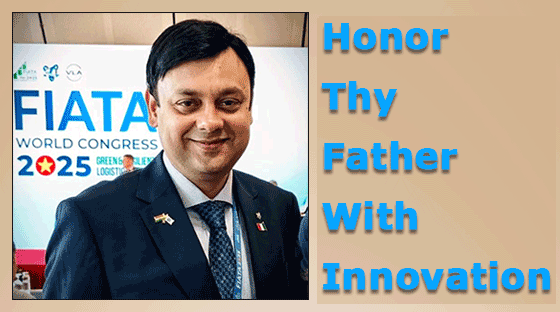
India has made a loud and clear announcement on the worldwide logistics landscape with the successful election of two Indian delegates to the top leadership posts of the International Federation of Freight Forwarders Associations (FIATA) during its World Congress in Hanoi.
Tej Mayur Contractor of the Federation of Freight Forwarders Associations in India (FFFAI) was elected by the majority of votes as Vice President of FIATA. This achievement was not only momentous as it brought back the Vice Presidency of FIATA to India after 25 years, but it signified the Indian influence to an ever-expanding degree in the global logistics sector.
Tej Mayur Contractor's appointment is one of the achievements of the whole Indian logistics sector. On the occasion of his promotion to the vice presidency, Contractor thanked FIATA and its member associations for their support. "To carry on the legacy of my father Mayur C. Contractor and to FFFAI, I am honored to represent India on such a platform. I assure you that I will strive to incubate collaboration and innovation within the logistics sector. As a coalition, we can easily negotiate the complexities of global trade and a green future for our profession is guaranteed."
FlyingTypers spoke to Contractor. Here is what he said:
FT: What are your primary goals and priorities for your term as FIATA Vice President? How do you plan to leverage this position to benefit the Indian freight-forwarding community?
TC: First off, I believe we must transform global logistics standards from being ‘nice to have’ into ‘must-haves’ for every forwarder—large or small, global or local. In my term at FIATA, my primary focus is three-fold:
• Digital interoperability — for example, advancing the eFBL (electronic FIATA Bill of Lading) standard so that Indian forwarders can plug into global trade flows seamlessly. FIATA has released the open-source eFBL data model. (FIATA)
• Capacity and skills building — India has enormous potential but also big gaps in workforce readiness. Through our work in India (via FFFAI, the IIFF and other institutions) we can use the FIATA platform to elevate Indian practitioner voices in global forums, attract training, and build a true pipeline of next-generation freight professionals.
• Inclusive global access — to ensure that Indian MSME forwarders are included in FIATA’s global advocacy, in cross-border dialogues, in digital standards formation and in trade-policy frameworks. My father’s legacy taught me that the small logistics service providers often bears the burden of change while the big ones reap the benefits.
 |
FT: What are the most significant international policies or agreements FIATA is currently focused on, and what role is India playing in shaping them?
TC: We are living in a world where trade isn’t just about things moving — it’s about data moving, trust being built, and resilience being embedded. At FIATA right now, two major initiatives stand out:
• The eFBL – this enables freight forwarders to issue negotiable multimodal bills of lading in electronic form, registered on immutable ledgers, enhancing trust and reducing cost.
• Trade facilitation frameworks tied to digital logistics, cross-border data sharing, and multimodal connectivity. FIATA’s “digital strategy” is about turning documents into data and processes into platforms.
India’s role in all this is increasingly strong. With the rollout of the Unified Logistics Interface Platform (ULIP) via the NTFC-DPIIT and API-based integration across Customs and logistics platforms, India is positioning itself as a test-bed and scale-up hub for digital freight practices. The Indian freight-forwarding community, supported by organizations like FFFAI and IIFF, is participating in global policing of standards and contributing Indian-specific use cases (for example: inland last-mile, multimodal corridors).
FT: What is your vision for FIATA’s role in the next five years, especially concerning geopolitical risks, supply-chain resilience and cross-border trade?
TC: Over the next five years, I see FIATA becoming the stabilizing compass of global trade — the body that helps forwarders navigate uncertainty with intelligence, not panic.
The world is shifting from globalization to regionalization of trade corridors — India–Middle East–Europe (IMEC), INSTC through Central Asia, BIMSTEC in the East — each creating both opportunity and complexity. FIATA’s role must be to align these evolving trade routes with digital, operational, and policy frameworks that ensure predictability and transparency.
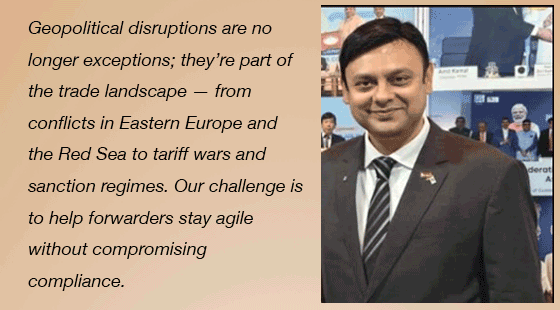
Geopolitical disruptions are no longer exceptions; they’re part of the trade landscape — from conflicts in Eastern Europe and the Red Sea to tariff wars and sanction regimes. Our challenge is to help forwarders stay agile without compromising compliance.
FIATA works to strengthen data-driven risk-mapping, digital documentation like eFBL, and coordination among regional associations so that trade doesn’t freeze every time a border heats up.
This means pushing beyond traditional markets — exploring Africa, Central Asia, and Latin America as new growth destinations, backed by reliable logistics corridors. FIATA’s global network and India’s geographic advantage together can create alternative routes to resilience — trade lanes that are diversified, digitally connected, and geopolitically smart.
FT: How has the National Logistics Policy (NLP) and other initiatives (like PM Gati Shakti National Master Plan) impacted the ground reality for Indian freight forwarders, and what more needs to be done?
TC: The NLP launched in September 2022 is a landmark; its vision to reduce logistics cost, improve our LPI ranking and build a data-driven logistics ecosystem is exactly what we in the forwarding community have been asking for. On the ground, the impact is visible: digitization of clearances, greater push for standardized physical assets, and more ministries pulling in one direction. But let’s be real — there are gaps.
What’s working:
• Better policy alignment between road, rail, air and ports;
• Digital infrastructure such as ULIP and Logistics Data Bank are generating real-time visibility;
• Skilling and human-resource focus is clearer than ever.
What still needs focus:
• The last-mile part remains fragmented — multiple systems, multiple stakeholders, inconsistent enforcement.
• For air and sea forwarding, we still need true multimodal integration, one window clearance, fewer hand-offs.
• Cost reduction targets are still ambitious — the goal under NLP to cut logistics cost to global benchmarks is ambitious but doable with sustained effort.
In short: ground momentum is building, but what we need now is scale-up, enforcement and tech adoption so that policy meets practice.
FT: What are the most pressing infrastructure challenges — at airports, specifically — that continue to affect the efficiency and cost of logistics in India?
TC: When you talk about airports, the challenges are three-fold — capacity, connectivity and coordination.
• Capacity: we see freighter slots constrained, especially at major gateways. When cargo waits for a slot or transit clearance, cost adds up.
• Connectivity: many airports have good terminals but weak last-mile links (truck docks, cold-chain access, mechanized warehousing). This creates dwell time and drives up cost.
• Coordination & customs/terminal ecosystem: handling cost is still high, partly because multiple actors (Airlines, Customs, Ground-handlers, Trucking) operate in silos. If we don’t harmonize schedules, data flows and terminal operations we end up with inefficiencies of 48-hour hand-offs instead of 12-hour.
For India to compete globally in air-cargo/logistics efficiency, we must treat airport hubs like ports of the future — with digital gateways, mechanized cargo chains, 24/7 operation, fewer manual interventions and clear cost-transparency.
FT: With the industry rapidly evolving, what is your strategy, particularly through the Indian Institute of Freight Forwarders (IIFF), to address the shortage of a skilled, modern workforce?
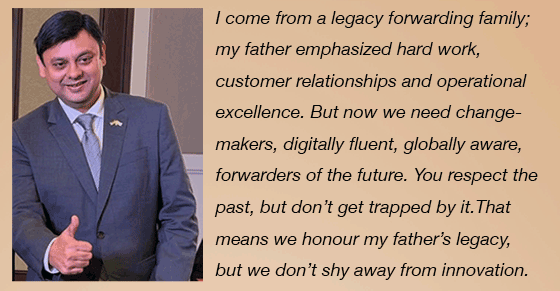
TC: One of the biggest bottlenecks in our industry is talent. I come from a legacy forwarding family; my father emphasized hard work, customer relationships and operational excellence. But now we need change-makers, digitally fluent, globally aware, forwarders of the future.
Through IIFF, our strategy is:
• Modular curriculum: short courses 16 modules in specific domains – Customs, Information Technology, multimodal operations.
• Apprenticeships & industry placements: we are setting up tie-ups with our members where students can work, earn stipend, learn on-the-job and be job-ready.
• Recognition & certification: graduates from IIFF get a IIFF Certificate, we are collaborating with FIATA’s training programmes and global affiliates.
 |
FT: India’s logistics costs are still high compared to global benchmarks. What specific measures — besides infrastructure — do you believe are critical to bringing them down?
TC: The infrastructure build-out is important, but if you only build roads, corridors and terminals without addressing process, data and financing, you end up with under-utilised assets and high costs. Here are specific non-infrastructure measures:
• Process re-engineering: seamless pre-arrival clearance, one-window customs, less duplication of data entry. Lower dwell time = lower cost.
• Data-driven visibility: when you know where your container/truck is, traceability
• Working-capital and trade-finance access: many MSME forwarders struggle with delayed receivables, high financing cost. Better financing reduces cost of doing business, which reduces freight cost ultimately.
• Digital documentation & paperless trade: each manual step adds cost. Scaling digital BLs, digital airway-bills, e-manifests — these cut cost, risk and time. The FIATA eFBL initiative is a global example. In short: cost-reduction about smarter operations
FT: As a leader from a prominent freight-forwarding family, how do you balance the legacy practices with the need for disruptive innovation in your organisations and the industry at large?
TC: My father built our firm on relationships, integrity and grit. Those values remain non-negotiable. But the world around us is changing fast. I balance the two by using what I call the 70-20-10 model:
• 70% of the firm runs on the time-tested values: client service, on-time delivery, grounded operations.
• 20% is ‘improvement’: better systems, better training, better data.
• 10% is pure innovation: trying new tech, new business models, new trade-corridors.
I often tell my team: “You respect the past, but don’t get trapped by it.” That means we honour my father’s legacy, but we don’t shy away from innovation.
Tirthankar Ghosh/MarcoSorgetti |










.gif)
 FlyingTypers reserves the right to edit all submissions for length and content. All
photos and written material submitted to this publication become the property
of FlyingTypers Media.
FlyingTypers reserves the right to edit all submissions for length and content. All
photos and written material submitted to this publication become the property
of FlyingTypers Media. 100%
Green
100%
Green