
Kale Advert

EMO Trans ad
FlyingTypers Logo
#INTHEAIREVERYWHERE
Feed The Children Ad
   Vol. 25  No. 34                                                                        

Tuesday July 28, 2026

linespacer
linkedin
facebook
Instagram

PayCargo Advert

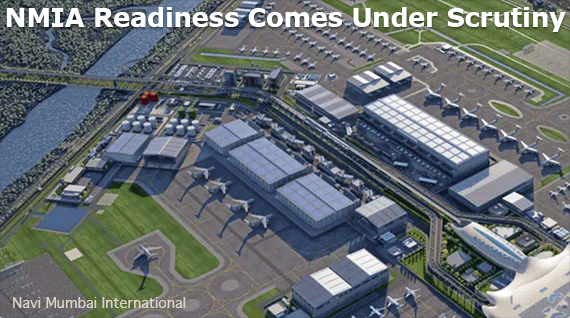
Navi Mumbai Airport

     What appeared to be a straightforward migration of freighter operations from Mumbai's Chhatrapati Shivaji Maharaj International Airport (CSMIA) to the new Navi Mumbai International Airport (NMIA) has become considerably more complicated. What was initially presented as a carefully planned transition is now raising questions about infrastructure readiness, international treaty obligations and the practical realities of moving one of India's busiest cargo gateways.
     The transition is already under way. Non-scheduled charter freighter flights are expected to cease operating from CSMIA this month, while all dedicated scheduled freighter operations are expected to move from August as Mumbai airport begins an extensive programme of infrastructure works. Yet the airport that is expected to receive this traffic is still not fully operational from a cargo ecosystem perspective, creating uncertainty for airlines, freight forwarders and exporters alike.
At the same time, the move has attracted formal objections from the United States, which argues that American cargo operators, particularly FedEx, should not be compelled to relocate in a manner that could conflict with the India-US Air Transport Agreement.
     What therefore began as an airport operational issue has evolved into a complex mix of commercial interests, regulatory preparedness and international diplomacy.
     According to information available from both Indian and international sources, the U.S. Department of Transportation formally raised concerns with India's civil aviation authorities earlier this year, arguing that airlines operating under the bilateral agreement should continue to enjoy commercially viable operating access at Mumbai. FedEx, currently the only American all-cargo carrier serving Mumbai, is understood to have expressed concerns that a mandatory relocation would increase operating costs while reducing the commercial advantages it currently enjoys.
     Washington's position is that bilateral air service agreements are designed not merely to grant traffic rights but also to protect fair and commercially reasonable access to airports. Any unilateral relocation, particularly before alternative facilities are fully operational, risks becoming a treaty issue rather than simply an airport management decision.
     For cargo operators, location is critical. Mumbai remains India's largest commercial and financial centre and one of the country's biggest export gateways for pharmaceuticals, engineering goods, gems and jewellery, electronics and express parcels. Mumbai International Airport handles between 7 and 8 cargo flights daily. The stoppage of cargo flights -- when it does happen -- will mean that Mumbai which handled around 890,000 tonnes of cargo in FY 2025 or around 25 per cent of all air freight in India, will see a big dip.   
Adani Airports, however, maintains that the transition is driven by operational necessity rather than commercial preference. CSMIA is preparing for major infrastructure upgrades, including the reconstruction of Apron G, development of Taxiway E, improvements to rapid exit taxiways and subsequent runway rehabilitation. Together, these projects will significantly reduce aircraft parking availability, particularly for freighters, which currently rely heavily on Apron G. Airport planners argue that maintaining normal freighter operations alongside these works would simply not be practical.
     There is considerable logic in that argument. Mumbai's existing airport has operated close to capacity for years. Hemmed in by urban development, it has virtually no room for physical expansion. The development of NMIA has always been intended to create a dual-airport system capable of supporting the region's future passenger and cargo growth.
     Yet relocating cargo operations involves much more than opening a new runway. An airport cargo ecosystem takes years to develop. Airlines require customs officers, BCAS security clearances, DGCA approvals, ground handlers, bonded warehouses, trucking operators, freight forwarders, customs brokers, express logistics companies, temperature-controlled storage, aircraft maintenance support and hundreds of trained personnel working as a single integrated system.
While NMIA has invested heavily in its cargo terminal and physical infrastructure, much of this wider ecosystem is still being established. Industry sources indicate that several operational approvals are continuing while logistics companies are still setting up facilities and staffing operations. Airlines therefore face uncertainty over whether every component required for seamless cargo handling will be fully in place when the migration begins.
     That uncertainty has led to growing industry concern. Some international cargo operators are understood to have sought temporary flexibility regarding the transition schedule, while logistics companies have quietly begun evaluating contingency options through other Indian cargo gateways should operational bottlenecks emerge during the initial months.
     The challenge becomes even more complicated because dedicated freighters represent only part of Mumbai's cargo business. A significant proportion of the city's international cargo continues to travel in the belly holds of passenger aircraft, which will remain at CSMIA. As a result, exporters could find themselves operating across two airports — using passenger aircraft for some consignments while trucking dedicated freighter shipments to Navi Mumbai.
     Such fragmentation would increase handling complexity and transport costs, at least during the transition period. The dispute also revives a broader debate about airport ownership and market power.
    Adani Airports now controls both CSMIA and NMIA. From one perspective, that provides the company with an opportunity to manage Mumbai's airport system in an integrated manner, directing traffic where infrastructure is available and improving long-term capacity planning.
     Critics, however, argue that when one operator controls both airports, decisions about where airlines operate inevitably attract greater scrutiny. Airlines have fewer commercial alternatives, while regulators must ensure that operational decisions remain transparent, proportionate and non-discriminatory.
     That appears to be one of the underlying concerns reflected in the American intervention. The timing is particularly sensitive.
     India and the United States have spent the past several years strengthening cooperation across aviation, aerospace manufacturing, defence, technology and trade. Aircraft purchases, engine manufacturing partnerships and regulatory cooperation between the Federal Aviation Administration and India's Directorate General of Civil Aviation have become important pillars of the broader strategic relationship.
     Neither government is likely to welcome a dispute over cargo rights overshadowing that growing partnership. 
     Although airport operators retain considerable authority over operational planning, any prolonged disagreement involving treaty obligations would inevitably draw New Delhi into the discussion. India would be reluctant to allow a commercial airport issue to evolve into a diplomatic irritant, particularly when American logistics companies continue to play an important role in India's international supply chains.
     For that reason, many within the industry believe a pragmatic compromise remains the most likely outcome. Rather than imposing fixed deadlines, regulators could permit a phased migration based on NMIA’s demonstrated operational readiness. As cargo handling systems develop, airlines may move services gradually, with temporary flexibility where operational necessity requires. Such an approach would allow CSMIA's infrastructure programme to proceed without unnecessarily disrupting exporters or international cargo operators.
     Cargo rarely commands the same public attention as passenger aviation, yet it remains the bloodstream of international commerce. Pharmaceuticals, electronics, perishables, engineering components and e-commerce shipments depend on predictable airport access and reliable logistics networks.
     What is unfolding in Mumbai is therefore about much more than moving aircraft between two airports. It is a test of whether India can relocate one of its most important air cargo gateways while preserving operational efficiency, maintaining international confidence and honouring bilateral commitments.
     Adani Airports’ success will not be as simple as opening a new airport. This will depend on demonstrating that an integrated dual-airport system can function smoothly without affecting airlines or supply chains.
     India’s challenge is to demonstrate that the pace of infrastructure development is matched by equally robust operational preparedness. The coming weeks will answer the most important question for the cargo industry: not if freighters can be moved, but if the ecosystem that supports them is ready to move with them.
Tirthankar Ghosh


 Juan C. Correa, Stephanie Penarete

  When terrible trouble strikes, it's reassuring to have some bright, competent and hopeful faces jump to the rescue.
  That's exacty what happened as Avianca Cargo and DSV - Global Transport and Logistics teamed upto move 58 tons of donated humanitarian aid from Miami to Caracas in support of communities affected by the June 24 earthquakes there.
  Interesting reactions from two people who got involved and helped.
  This year DSV, founded in 1976 by a small group of Danish haulers, marks 50 years—in the business of moving goods and connecting markets.
  About helping others, Stephanie Penarete (L) Vice President, DSV Air Product Americas declared:
  "We never forget that the greatest impact comes from what we achieve together with purpose and collaboration."
  Juan C. Correa, Chief Commercial Officer at Avianca (R) that provided the airlift via an A-330F noted:
  "Our core priority is ensuring the seamless, efficient delivery of international humanitarian aid, which requires ongoing alignment with local authorities and our relief partners.
  "As part of our ongoing commitment to supporting communities in times of need, Avianca will continue to put its logistics network and operational infrastructure at the service of those affected by emergencies," Juan Correa assured.
  We are thinking it's good to have some Danish with your Colombian when it comes to shipping.
  Humanitarian partners as relief work here continues include Direct Relief, Global Empowerment Mission (GEM), Heart to Heart International and World Central Kitchen.

India Truckers

  Thinking about truckers, we always come back to the vision of the lady from Kale Logistics Solutions, Donna Mullins.
Donna Mullins delivering food to truckers  When COVID hit America, out on the truck line at Hartsfield-Jackson Atlanta International Airport, Donna (shown here) with the milk of human kindness turned a "dwell from hell" for truckers, who were barely able to get out of their rigs to use the facilities. There she was at the truckers' queue, handing out chicken dinners that she secured locally, to help people who were keeping the supply chains open, whilst they had nowhere to go for basic necessities.
  Donna’s action recalls that often truckers get little or no respect.
Here are a group of people we all depend on, but don’t always stop to thank enough.
  TrucksUp India is a digital platform for online truck booking and transport services, designed to simplify logistics operations for businesses, transporters, and truck owners.
  "TrucksUp Drivers Appreciation Day July 19th effort was mounted to recognize the work drivers do every single day to keep our country moving. Truck drivers are the ones hauling essentials, feeding supply chains, keeping factories running, and making sure goods reach towns, cities, and remote corners of India on time."

Sarthak Elwadhi  TrucksUp’s co-founder, Sarthak Elwadhi, framed it in a way that goes beyond praise.
  His point was that drivers aren’t just part of logistics, they’re the backbone of it.
  Sarthak points up that his larger vision is to help drivers move up the ladder: from driving a truck to owning one, and building a stable livelihood over time.
  TrucksUp talks about an “integrated ecosystem,” meaning support across the full journey of ownership and operations to include helping drivers buy pre-owned commercial vehicles, connecting them to finance options, arranging insurance, helping them find loads, and then giving them tools to manage the business side more efficiently.
  "The TrucksUp App is positioned as a single place where drivers can tap into business opportunities through a load board, save money with a fuel card, handle FASTag-related needs, use GPS tracking, access insurance services, and get digital support through different stages of truck ownership.
  "The idea is to make growth feel more achievable.”
  The initiative isn’t just about business tools.
  "TrucksUp welfare programs are aimed at the wider trucking ecosystem.
  “For instance we regularly conduct health check-up camps, focusing on preventive care and basic well-being, which matters for a profession where long hours and constant travel can take a real toll.”
  At the heart of this Drivers’ Day initiative was a line that sums it up well: 'they drive miles, so that India smiles'.
  “Appreciation is important, but what really matters is turning respect into practical support," Sarthak concluded. https://www.trucksup.com.
Geoffrey Arend

India International Cargo Show

     India’s air cargo sector could be on the cusp of one of its biggest transformations in decades after Union Civil Aviation Minister Kinjarapu Rammohan Naidu unveiled a sweeping reform agenda aimed at boosting cargo volumes, reducing dwell times and lowering logistics costs.
Kinjarapu Rammohan Naidu     Speaking at the India International Cargo Show (IICS) 2026 in early June at Delhi, Naidu delivered what industry executives described as one of the strongest policy endorsements the air cargo sector has received from the government in recent years. The reforms come at a time when India’s exports are showing resilience despite geopolitical disruptions, while the proposed India-European Union Free Trade Agreement (FTA) is expected to significantly increase high-value freight flows between India and Europe.

     The timing may be critical. India’s airports handled 3.48 lakh tonnes of freight in April 2026, up 10 per cent year-on-year from 3.15 lakh tonnes in April 2025, according to Airports Authority of India (AAI) data. International cargo volumes alone surged by nearly 40 percent during the period, underlining the growing importance of air freight to India’s export economy.
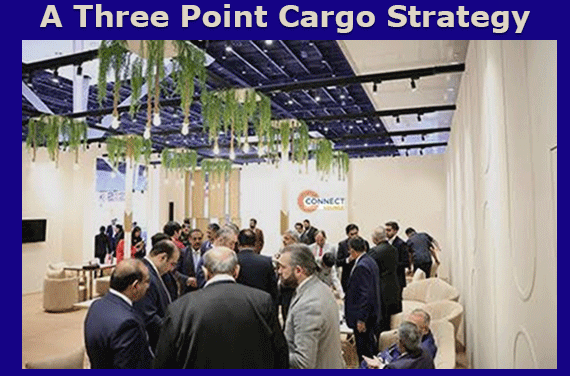
     Naidu outlined a three-point strategy focused on increasing cargo volumes, cutting transit delays and reducing costs for exporters and logistics players. “Increasing the air cargo volumes in the country will be the number one priority for us,” the minister said. “The whole point of sending a product through air cargo is the advantage of time. So, cutting down the dwell time is going to be another priority for us.”
     He added that lowering logistics costs would be equally important to widen participation in the sector, particularly for smaller exporters and MSMEs. “The third priority is to cut down the costs that are associated with that. There is an opportunity for us to reduce the cost even more, make it more viable for the smaller players to also come into this network and proudly utilize the air cargo ecosystem,” Naidu said.
     The minister also announced impending reforms to India’s Air Freight Station (AFS) policy after admitting that the existing framework had failed to deliver expected results. According to Naidu, stakeholder consultations are now underway to redesign the system by studying global models and adapting them to Indian conditions.
     India’s strategic location between Europe, the Middle East and East Asia also gives it the potential to emerge as a major global transshipment hub — an ambition the government now appears keen to pursue more aggressively. “Because of the geographical location, we can create a system of transshipment where we not only cater for our domestic consumption but also international air cargo,” Naidu said.
     The government’s renewed push comes amid strong export performance from several Indian gateways, particularly Chennai. Chennai airport emerged as the fastest-growing cargo airport among India’s top five hubs between January and April 2026, recording growth of 16.4 per cent. Industry executives attribute the rise partly to Production-Linked Incentive (PLI) schemes, especially in electronics and telecom manufacturing, which are increasing demand for rapid freight movement.
     Exports of electronics, pharmaceuticals, perishables, engineering goods and automotive components have all contributed to cargo growth. Cross-border e-commerce has also become a powerful driver, especially for express and time-sensitive shipments.
     The India-EU FTA being discussed may well boost the pace of this development even more. India and the European Union Much increased their trade over the last ten years, and the value of their trade in goods was up to 118 billion in 2025. According to some industry experts, the trade deal has the potential of massively increasing the export of pharma goods, the growth of specialized manufacturing and strengthening of automotive supply chains.
     The pharmaceutical sector in particular may benefit from lower tariffs, simplified customs procedures and stronger cold-chain logistics demand. Industry executives believe temperature-controlled air cargo could see especially sharp growth if exports of biologics, APIs and specialty medicines rise.
Samir J. Shah     Yet despite the optimism, significant structural challenges remain. The most immediate concern is India’s continued failure to establish itself as a major transshipment hub, despite its geographic advantage. Samir Shah, President of the Air Cargo Agents Association of India (ACAAI), warned that procedural bottlenecks and fragmented regulation are preventing India from capturing cargo flows currently routed through Middle Eastern hubs such as Dubai and Doha.
     “We have missed one very big opportunity,” Shah said at IICS 2026. “The U.S.-Iran war gave us a great opportunity to position ourselves as a very good transshipment hub.” According to Shah, multimodal cargo operations involving sea-to-air or air-to-sea transfers remain cumbersome because operators must often deal with multiple customs districts and overlapping clearances.
     “Legally, I can do sea to air and air to sea, but the systems are not in place,” he said. “If we have a single window process, we can do sea to air and air to sea easily.”
Industry stakeholders also point to inadequate cargo infrastructure, limited customs-enabled cargo stations, high airport handling charges and inconsistent digitization across airports as continuing bottlenecks. While major airports such as Delhi, Hyderabad and Bengaluru have modern cargo terminals, several Tier-II cities still lack efficient cold-chain infrastructure and dedicated cargo handling facilities.
     Another challenge will be the geopolitical risks. While air freight has flourished from disruptions in maritime shipping due to tensions in West Asia and the Red Sea, the sector is still exposed to threats like increasing fuel prices, longer flight routes and shortage of capacities. Executives have, in fact, cited very steep increase in air freight charges as a consequence of rerouting to avoid conflict zones.
     Besides, it is feared that some cargo that for the time being is transported by air may revert to sea freight after the maritime routes have been stabilized considering that air transport still costs five to seven times more than ocean shipping.
     Yet, the overall image is quite optimistic. Manufacturing in India, the rising exports and growing e-commerce ecosystem are continuously driving up the strategic importance of air cargo. In case the government is able to simplify regulations, integrate multimodal logistics and enhance infrastructure, India could even start to pose a challenge to the long-standing regional cargo hubs. As Naidu put it, “The road to becoming a global manufacturing hub passes through becoming a global logistics hub.”
Tirthankar Ghosh


FlyingTypers Ad

If You Missed Any Of The Previous 3 Issues Of FlyingTypers
Access complete issue by clicking on issue icon or
Access specific articles by clicking on article title
FT062626
Vol. 25 No. 31
Happy Birthday America
FIATA In South East Europe
Chuckles for June 26, 2026
Kale Logistics Portel To Tomorrow
FT070226
Vol. 25 No. 32
Qatar Advances FIFA
Celebrating 250
Bridge To Tomorrow
FT072126
Vol. 25 No. 33
Mammen Mans Up As TIACA DG
Logistics China Turns A Page
Chuckles for July 21, 2026
Ivelina Stoyanova Princess Of Logistics

Publisher-Geoffrey Arend • Managing Editor-Flossie Arend • Editor Emeritus-Richard Malkin
Senior Contributing Editor/Special Commentaries-Marco Sorgetti • Special Commentaries Editor-Bob Rogers
Special Assignments-Sabiha Arend, Emily Arend
• Film Editor-Ralph Arend • Photo Editor-Anthony Atamanuik

Send comments and news to geoffrey@aircargonews.co
Opinions and comments expressed herein do not necessarily reflect the views of the publisher but remain solely those of the author(s).
FlyingTypers reserves the right to edit all submissions for length and content. All photos and written material submitted to this publication become the property of FlyingTypers Media.
Copyright ©2026 FTMedia, Inc. All Rights Reserved.
More@ www.aircargonews.com

recycle100% Green