 |
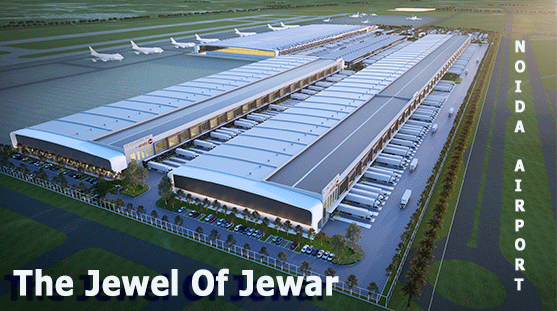
Come June 15, 2026, the roar of jet engines will signal more than just the birth of a new airport. The commencement of commercial operations at Noida International Airport (NIA) in Jewar (Delhi and the Indian National Capital Region’s second international airport) will mark the opening of a strategic sluice gate for global trade. While the passenger terminals will buzz with travelers, a more quiet, tectonic shift is occurring at the airport’s northern flank: the rise of a digitally integrated, multimodal cargo powerhouse.
At the heart of this ambition is AISATS (Air India SATS Airport Services), whose Multi-Modal Cargo Hub (MMCH) is designed to be the primary engine of NIA’s promised ₹1 lakh crore annual economic multiplier. In an exclusive dialogue, Ramanathan Rajamani, CEO of AISATS, explains why Jewar is not just another pin on the aviation map, but a fundamental redesign of Indian logistics.
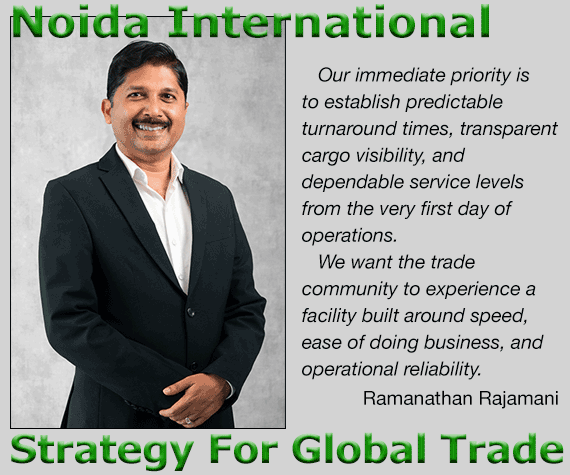
For freight forwarders and shippers, the “Day 1” experience at NIA is built around a philosophy of immediate reliability. The Integrated Cargo Terminal (ICT) is prepared to handle an initial 255,000 metric tonnes of cargo annually, with a blueprint that allows for seamless expansion as the region’s manufacturing muscle grows. “Our immediate priority is to establish predictable turnaround times, transparent cargo visibility, and dependable service levels from the very first day of operations," says Rajamani. "We want the trade community to experience a facility built around speed, ease of doing business, and operational reliability."
The traditional Indian cargo model has long been plagued by fragmentation—warehousing, customs, and terminal movement often sit in disjointed pockets, leading to "logistics friction." AISATS is countering this with the Integrated Warehousing & Logistics Zone (IWLZ), a first-of-its-kind development in the country. “At Noida, our IWLZ and Integrated Cargo Terminal have been planned as one connected ecosystem,” Rajamani explains. “This means cargo can move seamlessly from storage to build-up, customs processing, and airline handover within a single zone. The result is lower truck turnaround time, fewer hand-offs, and significantly reduced dwell time.”
The hub’s efficiency is underpinned by a “tech-first” approach. AISATS has deployed a suite of digital tools including truck slotting systems, digitally enabled gate access, and real-time predictive dashboards. This ensures that the heavy traffic expected from the Yamuna Expressway doesn't result in the bottlenecks seen at legacy hubs.
Beyond the tarmac, the strategy involves "bonded trucking" partnerships, such as the MoU with Continental Carriers. This allows exporters in distant manufacturing clusters to complete customs processes locally and use NIA as a streamlined exit point. “Airports today are no longer standalone terminals; they are networked gateways,” notes Rajamani. “This will offer exporters a cost-effective and streamlined gateway to accelerate the movement of cargo by airlines operating from Noida International Airport.”
The region surrounding Jewar is rapidly becoming a hub for electronics, textiles, and e-commerce. A recent collaboration between AISATS and Samsung SDS for electronics exports underscores this potential. However, high-value sectors like pharmaceuticals require more than just speed; they require precision.
To meet these demands, AISATS has integrated a dedicated "Coolport" with temperature-zoned storage and specialized truck docking zones. “The objective is to minimize exposure risk at every touchpoint, from truck arrival to aircraft loading,” says Rajamani. “For pharma and perishables exporters, this creates a highly reliable cold-chain environment aligned with international quality expectations.”
As global manufacturers face increasing pressure to lower their Scope 3 emissions, NIA’s net-zero vision becomes a significant draw. AISATS is mirroring this commitment by adopting electric ground support equipment (GSE) and paperless digital processes. “Sustainability is increasingly a commercial differentiator in global supply chains,” Rajamani asserts. “At AISATS, sustainability is not a standalone initiative but an integral part of the way we plan and operate our business.”
While belly cargo from launch partners like IndiGo and Akasa Air will drive initial volumes, the long-term play involves the Dedicated Freight Corridor (DFC). The integration of air, road, and eventually rail, positions Jewar to compete with the world's most efficient logistics zones.
As Uttar Pradesh attracts billions in investment for data centers and industrial townships, the AISATS MMCH stands ready as the gateway. “The combination of road, rail, and air integration around Noida will create one of the most efficient logistics zones in the country,” concludes Rajamani. “Our long-term planning fully recognizes the strategic importance of seamless air-to-rail cargo movement.”
With trial operations underway and the June 15 launch date looming, the message from AISATS is clear: The Jewar gateway is open, and it is built for the future of Indian exports.
Tirthankar Ghosh |







 100%
Green
100%
Green