 |
 Kale Info Solutions Vice President Donna Mullins emceed a packed house at Atlanta U.S. Customs Border Protection (CBP) and Partner Government Agency (PGA) Port Day, May 20 hosted by the Atlanta International Forwarders and Brokers Association, (AIFBA). Kale Info Solutions Vice President Donna Mullins emceed a packed house at Atlanta U.S. Customs Border Protection (CBP) and Partner Government Agency (PGA) Port Day, May 20 hosted by the Atlanta International Forwarders and Brokers Association, (AIFBA).
If you work in imports, brokerage, forwarding, air cargo, or compliance, this was one of those events where everything else aside—you walk out thinking, okay, I’ve got homework.
“Port Day was a real cross-section of the trade community,” Donna, who sent us a complete super report of the action said.
 “Importers, brokers, forwarders, airport folks, and a lot of government representation at hand. And the vibe was very practical: here are the risks we’re seeing, here’s what’s slowing releases, here’s what’s changing, and here’s how to communicate with the right people so you don’t accidentally create more delay.” “Importers, brokers, forwarders, airport folks, and a lot of government representation at hand. And the vibe was very practical: here are the risks we’re seeing, here’s what’s slowing releases, here’s what’s changing, and here’s how to communicate with the right people so you don’t accidentally create more delay.”
A great theme because it sounds simple, but it’s where things fall apart.
Right from the get go Donna thanked the event sponsors:
“These events don’t happen without sponsors and volunteers,” Donna declared.
AIFBA recognized sponsors across levels—Arnall, Golden and Gregory at gold, Quickcode at silver, Avalon Risk Management at bronze—Donna also thanked the speakers and volunteers.
 “CBP Port Director Clay Thomas and Assistant Port Director Brad Stroud kicked things off,” Donna reports. “CBP Port Director Clay Thomas and Assistant Port Director Brad Stroud kicked things off,” Donna reports.
“One operational point: CBP is still looking to fill an FP&F position—Fines, Penalties, and Forfeitures—and they acknowledge the SAV FP&F team for supporting Atlanta.”
CES Comeback
At the event the bigger known unknown for many people was the Centralized Examination Station (CES) situation.
After an absence of seven years the CES bid was awarded to Cal-Cartage.
The message from CBP was basically: a CES can make exams more efficient because inspectors can work from one centralized place instead of bouncing between locations for ocean, truck, and rail examinations.
So, in plain language: less travel time, better coordination, and faster movement when multiple agencies need to look at the same shipment.
Donna said, “CBP emphasized benefits like better staff utilization, potentially faster release when a shipment needs multi-agency review or an Import Specialist exam, and clearer visibility for cargo flagged for exam. CBP framed the CES move as a compliance, safety, and security advantage, not just convenience.”
CES Versus CFS
But there was also a systems headache tied to CES versus CFS. Donna walks us through that, because it’s one of those acronyms where the details really matter.
So a CFS is a—Container Freight Station— that can receive the full set of FSN messages about cargo disposition while it’s in their warehouse.
“A CES doesn’t get the same complete “push” of those message sets.
“Some CES operators end up paying to query ACE to pull disposition codes. It’s workable, but it’s not elegant, and it’s not as automated as it could be.”
Which is interesting we note, because the promise of the ACE Single Window was supposed to be streamlined coordination between government and trade.
“That came up,” Donna reports.
“The idea is: if you want efficiency and stronger border management, then CBP partnering with CES operators on automated exchange of disposition codes would be a practical step.
“It’s one of those “the policy goal is clear, now the plumbing needs to match it,” Donna smiled.
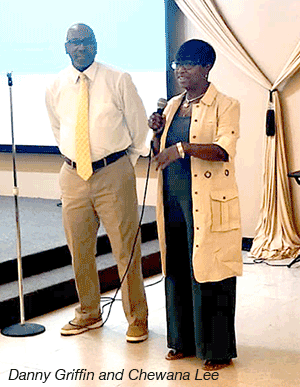 Sticking To Fundamentals Sticking To Fundamentals
CBP Atlanta Entry Branch Chief Danny Griffin and Supervisory Import Specialist Chewana Lee shared a refresh on entry summary fundamentals—refund requests, cancellations, administrative refunds, and then the tariffs landscape: 232, 122, 301.
“They were very direct about timelines and preparation,” Donna said.
“A lot of issues show up inside refund requests—missing support, wrong basis, misunderstanding which type of request applies, not matching the timeframe rules to the actual request type.
“The duo also stressed something that’s not going away: 232 tariffs,
“The message was basically, plan your compliance processes as if 232 is part of the baseline.”
On Compliance
Danny highlighted compliance problems CBP is seeing, and the Steel and Aluminum FAQ was specifically mentioned as a helpful reference.
More broadly, the reminder was: CBP’s informed compliance resources still matter.
Point here is also a reminder:
People forget about resources until they’re in trouble.
Chewana also brought up unmanifested shipments.
Making the big point that when you follow the proper procedure, things move faster.
“When you improvise, you can turn one issue into three—especially when it comes to getting cargo cleared,” she said.
Fundamentals To Remember
That brought us to the most memorable metaphor of the day. Multiple speakers basically saying what we do is like members of a team at football.
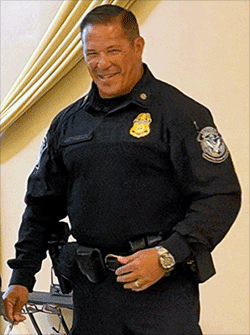 Here was the message: Here was the message:
With all the noise—tariffs, shifting requirements, operational disruptions—the discipline is staying focused on fundamentals.
Don’t lose the ball while you’re looking at the scoreboard.
Cargo Supervisory CBPO Ronnie Matheson, Donna reports, “laid out common problems impacting cargo release: manifest discrepancies, mis-deliveries, and ACE cargo release cancellations.
“He kept coming back to communication and internal best practices—on both sides, the broker/importer filers and CBP.
“Manifest discrepancies and mis-deliveries always sound like paperwork problems until you remember they’re also security problems.
“He also reviewed how to correct discrepancies the right way, what regulations apply, and the fact that penalties can be assessed.
“Another very practical reminder: if there’s a hold, inspectors generally need about 72 hours before before CBP is contacted for release updates.”
“He explained if CBP needs documents, they’ll use DIS, and if you don’t upload requested documents, the release slows down. And he really emphasized contacting the right department. Asking entry about cargo release, or asking cargo about entry status, just creates extra internal work and delays everyone.”
Time To Show Up & Learn
“There was a note about out-of-port brokers too,” Donna noted.
“Gaps often come from brokers not based in Atlanta.
“If they have an Atlanta office, their own internal handoff should include Atlanta port procedures, because local process details matter.
“That leads into a broader “show up” theme—being active in associations so you’re not guessing what the port expects.”
“Groups like NCBFAA have committees that meet with CBP and other agencies.
It’s one of the best ways to stay aligned with current procedures and policy direction, Donna advised.
Participate locally and nationally—was the word up.
Valuations & Refunds
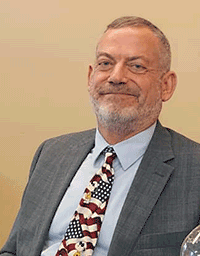 Damon Pike JD, LCB, Principal - Customs & International Trade Services at BDO USA, P.C—covered valuation and IEEPA refunds. He walked through valuation mechanics, including related parties and transfer pricing, and tied it into current tariff realities like 122 and 301. Damon Pike JD, LCB, Principal - Customs & International Trade Services at BDO USA, P.C—covered valuation and IEEPA refunds. He walked through valuation mechanics, including related parties and transfer pricing, and tied it into current tariff realities like 122 and 301.
For importers and brokers?
Donna said Damon covered the current tariff refund situation, “the 122 tariffs can be extended, so keep watching that space.
“Refunds are possible in certain scenarios, and he brought up the non-resident importer angle—only a few countries allow non-resident importers, including the U.S. Canada, and Australia.
“Also accounting discipline matters. The “simple math” inside entries can either protect you or haunt you.
“And he brought in First Sale too.
“He tied First Sale concepts into 301 in a way that reminded everyone: valuation strategy and tariff exposure are connected.
“You can’t treat them like separate conversations.
“Damon, in discussing the importance of accounting, quoted Grant Cardone, “The best math you can learn is how to calculate the future cost of current decisions.”
This is true in life and international trade too.
Beer Removed From 232 Cuty Calculations
 Clinton Yu and Luis Arandia, Partners and Co-Chairs, International Trade Practice, Arnall, Golden and Gregory talked about valuation, enforcement, and what might be next for metals. Clinton Yu and Luis Arandia, Partners and Co-Chairs, International Trade Practice, Arnall, Golden and Gregory talked about valuation, enforcement, and what might be next for metals.
“One big point was a CBP “Base Metal” memo—there’s controversy about whether it should be used for determining base metal amounts for 232 duties, and the expectation is this could end up in the Federal Circuit.
“So in other words, companies need to be careful about assuming today’s interpretation is the final word.
“They also covered how “chief weight” can matter in base metal determinations, reviewed exclusions and newly covered products, and then delivered what might’ve been the happiest news of the day: beer being removed from 232 duty calculations.
“You could hear the collective reaction in the room when that dropped,” Donna smiled.
 On Security On Security
TSA came in with bonded shipments and known shipper issues.
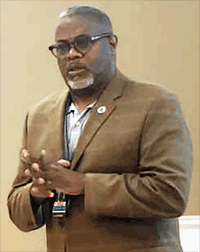
Orlando Gates, TSA Transportation Security Inspector/Targeting Analyst, updated the attendees about bonded shipments and known shippers under 4.7.
“A lot of the specific detail is considered Sensitive Security Information (SSI), and IACs (Indirect Air Carriers) will have access to it in their SSP (Standard Security Program).”
But the focus was on ocean cargo arriving and moving inbond through the U.S. via air and how the IAC should handle those shipments.
Known Shipper Management System
Orlando also discussed KSMS and the takeaway was: the known shipper program is required by regulation, it’s not optional, and TSA will continue to operate a program. The ongoing challenge is making it more efficient while raising the bar on security.
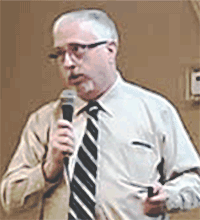 Anti Dumping and Duties Anti Dumping and Duties
“People either love this topic or fear it,” Donna said.
Dan Gladden, Supervisory Import Specialist, ADD Team, Automotive and Aerospace CEE, CBP conducted the session. He explained the rate differences can be dramatic depending on who’s who in the transaction.
And to determine the applicable rate correctly, you have to follow the hierarchy: exporter first, then manufacturer, then “other.”
For ADD/CVD, manufacturer and producer are treated as the same concept.
That hierarchy piece is where teams often trip, especially when documents aren’t consistent.
Dan also reminded everyone there are five ADD/CVD entry types, and you must use one of them even if the ADD/CVD rate is zero.
Another detail that matters in the real world: the importance of days – business vs calendar and the ADD/CVD entries must be liquidated before any protest can be submitted and “lifting of or the suspension” is a very crucial date. Since this was 101, yes, the Anti-Dumping Statement is still needed if applicable.
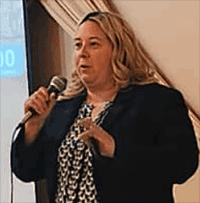 Focus Truck Pass At Hartsfield Focus Truck Pass At Hartsfield
Becky Francosky, Hartsfield Jackson International Airport Director, Air Service, Data Analytics, Research & Reporting provided us with information on Truck Pass Process for ATL air cargo that was implemented because of congestion—apparently including driver conflicts—and the system depends heavily on accurate information when drivers arrive at the marshaling yard.
“So if a driver says, ‘Yeah I have an appointment,’ but they don’t—or they go to a handler without one—that’s where chaos starts.
“Some handlers run appointment systems, but Truck Pass isn’t fully digitally integrated with the handlers yet.
“That lack of integration can cause confusion at terminals, especially around dock door assignments.
“The airport’s goal is more automation and community integration to move trucks through more efficiently,” Becky reported.
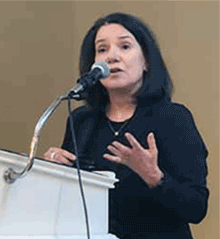 AI In Customs Compliance AI In Customs Compliance
Now for the tech segment—AI in customs compliance.
This is where a lot of people get excited and nervous at the same time.
Shannon Hynds, CEO of Quickcode AI, spoke about AI and technology in compliance.
She gave a helpful conceptual bridge: about Word2Vec and how it works as a popular technique in natural language processing (NLP) for representing words as vectors in a continuous vector space and that relation to Large Language Models which give us AI.
Quickcode provides compliance teams with real-time visibility into tariff changes, product codes product codes, and regulatory risks.
Using AI and machine learning, tools can help identify PGAs or ADD/CVD cases, or even missed 301 and other Chapter 98/99 tariffs in compliance audits based on the product specifications provided and machine learning in play.
Donna reported, the warning was clear too: AI is only as good as the question you ask.
“As example if you ask whether a mushroom is edible, you’ll get ‘yes,’ because mushrooms are edible. But ‘is it safe to eat this one’ is a different question entirely.
“In compliance terms, vague prompts can produce dangerously confident answers.
“For AI to work, you need careful prompting and human review.”
 FDA Goes Back To Basics FDA Goes Back To Basics
George Jackson, Supervisory Consumer Safety Officer with FDA’s Office of Import Operations (OIO), focused on prompt cargo release and best practices for communication.
He echoed the broader theme: many delays are avoidable if procedures are followed, have better lines of internal communication, and timelines are respected.
George said, “As example Prior Notice should be submitted before arrival, not after.” He also reminded people FDA regulates more than just food and drugs, so companies need to understand whether their products fall under FDA and what requirements apply. FDA’s educational resources were highlighted as a way to get grounded quickly.
“Communications systems matter here too—people mix up where to send what.”
Big time. FDA communications happen in ITACS, not ACE.
Also a DIS upload in ACE is for CBP and ACE PGAs—if FDA asks for documents, they should be submitted through ITACS.
Sending things to the wrong office and department can create a time delay, while it gets rerouted internally.
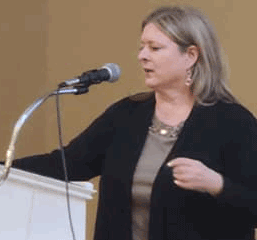 Time To Risk & Roll Time To Risk & Roll
To close the day, the conversation shifted to risk management—making sure companies are protected when the world gets chaotic.
LaDonna Blackwell, Vice President Southern Region-Avalon Risk Management talked through practical risk strategies and insurance types that trade businesses often overlook.
LaDonna said, “many brokers think of Avalon mainly for bonds, but they also do insurance . . . not just cargo insurance . . . insurance to protect you in your everyday business."
The message was: your business needs broader protection.
She highlighted E&O, Regulatory, Trade Credit, and Cyber Liability Insurance among others.
“E&O, as she put it, is basically the coverage for when a mistake happens.
“Regulatory insurance helps with penalty-related situations, though it doesn’t pay the fine itself. Trade credit protects receivables.”
And cyber insurance—she was blunt—“it’s not optional anymore.”
She cited that 65% of businesses that suffer a cyber attack don’t fully recover.
She also raised the spectre of “shadow AI,” meaning employee use of unapproved software on a work computer . . . it can feel harmless, but it can create massive exposure—financial cost, and serious operational consequences including the shutdown of a company.
That’s our recap of Atlanta Port Day.
Thanks to Donna Mullins for providing an essential, most worthwhile encounter for thousands of eager readers worldwide.
Donna is somebody who believes wholeheartedly in the concept: to keep up you have to show up, be involved, be present and be at the table, and not just in business.
Here is something you may not know about this great lady. Every 4th Monday of the month when she is in town at home, for as long as anyone can remember, Donna is in the streets of Atlanta, Georgia bringing food, concern and hope to hungry and homeless folks.
Seeing is believing.
An air cargo hero is something to be!
GDA/SSA
|











 100%
Green
100%
Green